
Discover your free Construction Marketing Ideas Email Newsletter
Showing posts with label Seth Godin. Show all posts

Sunday, October 04, 2009

Vapourware marketing

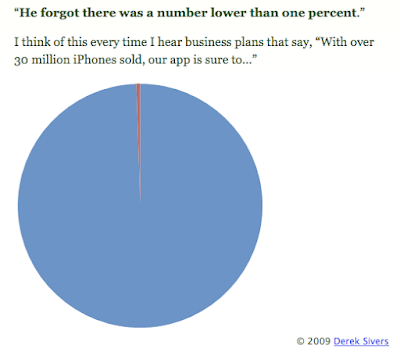
This image from Derek Siver's blog says that counting on even one per cent marketing reach may be folly. Many marketing initiatives result in no return. Beware of "vaporware marketing".

Derek Sivers, in a blog posting referenced by Seth Goldin, wrote about a musician who pressed 10,000 CDs, expecting a flood of orders from his quarter-page ad in a magazine with a circulation of one million. The musician assumed if he could attract just one per cent of the magazine's readers, his mailbox would be full, within a week.

The musician received four orders.

Experienced marketers know the folly of the musician's mistake; notably, don't pin all your hopes in a single ad and certainly don't spent significant amounts of money without checking and testing first. The musician might have had much better luck if he had received a raving review in the magazine or set up some "trial by Internet" system where people could hear his work. Or, as commenters remarked, the musician could have succeeded, slowly, by playing at local gigs and selling a few CDs at a time.

Seth Godin notes that the "long tail"; (see my review of Chris Anderson's book here) -- the great collection of small purchases and tiny niches possible within the Internet, still has a bottom limit. If no one buys, even if it costs a tiny amount to sell, you still have nothing. An if you spend a small fortune on marketing for minimal return, you are worse off than if you did nothing -- unless you persevere and learn from your experience.

This brings forward my next point. A few days ago I saw an ad on someone else's site promoting a contractor marketing service. I clicked on the ad, and (not surprisingly) received the free e-book offer in exchange for my email.

The book, not professionally set up, offered useful advice but nothing earth-shattering. That's okay, I suppose when it comes construction industry marketing, I "know it all" (I really don't.)

Not surprisingly, again, I am now on this marketer's autorespond list promoting his lead-generation program.

But I have my doubts about how much he is really selling (and has sold) and whether he has just bought someone else's package and is repurposing it. Whois.com searches take me to what I expect is a residential address in the Eastern U.S., and what appears to be some sort of inactive condo service business with an email address whose emails bounce.

I smell vapourware . . . that is someone putting something up for sale which he hasn't really validated or proven through first hand experience and results. I believe he will be disappointed about the response he actually receives and his own marketing budget will go into the "zero return" space.

(Note I will continue to try to track him down, and if the news is actually good, share it with you. If not, I will write a follow-up report without, as is my policy, identifying the marketer. As a rule, this blog does not publish negative reports naming specific individuals or businesses.)

Then does any marketing work? Of course -- but please use some common sense before believing any claims.

Check credentials with real references. If you are working with someone or something new, this is okay, but expect limited results and ensure you don't pay for effort without results.

Most times, if you expect people to give you money, they will need to form a relationship with you, validated by relationships with others they know. In other words, you need an environment where you can achieve social validity and word-of-mouth referrals to back up your marketing activities.

Wednesday, July 08, 2009

Testing your ideas (2)

Yesterday, I received a solid reminder of the costs and challenges of surveying and testing marketing ideas, especially when you engage in intrusive communications. The question, always, is whether the intrusion's reward is worthy of its cost.

The question is whether our special advertising-supported editorial feature concept, the backbone of our existing print business, could be adapted effectively to leads generated from this blog in the new Design and Construction Report (http://www.dcnreport.com).

You can see the original posting explaining the concept here.

Out of 1,419 survey invitations, 15 answered the question, but disturbingly, six people reported my email as "spam" -- the highest number of spam complaints I've received for a single mailing since I began using Constant Contact about two years ago. (The spam complaints may have resulted in part because I inadvertently selected one of my employees as "sending" the email, and the recipients may not have known her. (She got a surprise on waking up to find dozens of 'bounces' in her email box!)

However, while nine people responded by saying they would welcome publicity only without any cost at all to their organization (hardly of value for our business), three said "yes" to the question of whether they would be willing to pay for the service with a "satisfaction guaranteed or there is no cost" fee, and three said they don't know whether publicity would be of value to them.

Later in the day, Chase observed in an email to me:

"Three leads where people would pay a fee is promising.

"The real question is to determine if the people responding are the real decision makers or not.

"I suspect we would see an average of five per cent close rate from the blog leads. I have no problem working these and as more issues are published the close rate will increase."
The results, obviously biased with responses from people who have a relatively close connection with our business, suggest there is some interest in the concept, but we don't have overwhelming or obvious demand. In other words, I certainly have not hit a home run.

And, to get the answers, I pushed myself into the face of busy people who don't really need nor want the intrusion.

But it isn't a dead loss either. As Chase points out, if we can achieve a five per cent close rate in the early going (that is one in 20), without being a pest or spending too much sales energy on weak leads, we have a viable market -- because this blog and its high Google rankings generates upwards of 20 to 30 inquiries a week. With our average revenue per feature, this indicates a market potential of upwards of $100,000.

In marketing, sometimes we need to push out a little to see what is happening, and sometimes we need to be a little in the face of our current or potential clients. This is certainly not the "Permission Marketing" advocated by Seth Godin, but I think a totally passive approach with no assertion or invitation/call to action is asking for silence when you try out new things.

As well, I appreciate that our business idea probably requires the effective intervention and co-ordination of intelligent sales representatives. The editorial publicity/special advertising feature concept is reasonably simple, but may not lend itself to the "check the box, 'I'll take it'" attitude.

Nevertheless, I'll be respectful and careful before rushing to generate another survey. I need to respect that far too many people resented the intrusion.

Wednesday, October 15, 2008

Competency, passion and clients


Can you practically link your passions, competencies and marketing success? If you would like to participate in a project to prove that you are most likely to succeed by doing work you enjoy, please email buckshon@cnrgp.com.

A few weeks ago, several readers responded to an informal three-question survey to see if you do what you love, and are good at, you will be most successful at your marketing. Here are the questions:

1. In you opinion, describe your greatest competency: That is, the element of your business/self where you truly are among the best in your field.

2.Now, describe your greatest enjoyment/passion: The interests or activities (either personal, business, or both, which give you the greatest pleasure and enjoyment.

Finally, I asked:

3. Have you combined your competency and passion in reaching out to your potential market (previous, current and potential future clients)?

Four of the 13 who responded said "yes", five said "no", three said "not sure" and one didn't answer the question.

The interesting thing, however, is the nature of the responses to the first two questions: Your competencies and passions are varied, ranging from practical, career-focused talents, to purely recreational interests. You are all unique, and I don't think any of you would like to be pigeon-holed into a specific 'category'. And, as marketing guru Seth Godin notes in a recent posting Maybe you can't make money doing what you love, competencies and passions don't necessarily relate practically to business success: Poets rarely make money at poetry, and if you are a poet (artist) and try to jam your passions into something 'appropriate' for business, you may sell your soul, and heart, for an unfathomable misery.

How can you translate these questions and insights into practical marketing success? I see the seeds of a highly individualized and truly effective career/marketing consultancy here. The consultants would use some of the testing resources currently available to measure/assess your strengths and competencies, and then look at your business/client base/potential and determine likely synergies and matches. You would then receive practical and individual suggestions on how to connect your interests and passions to your market.

This personal consulting would be far more useful than the cookie-cutter systems where you are pushed into some one's rule-book, and told to follow it. If you have a multi-person marketing department, everyone would participate, and your unique talents and abilities would then be correlated to the team effort, allowing for your individual strengths and interests.

But this is theory. Can it work in practice? The only way to find out is to test and prove the concept. And to do that, we'll need some volunteers. You won't be paid (directly) for your time, but neither will you be charged any consulting fees!

Ideally, to qualify, you should either be an entrepreneur/business owner, or marketing/sales/business development specialist in the construction industry. I anticipate the voluntary exercise will involve some simple written/online tests, and interviews (either in person if in Ottawa or by video conferees if outside this area). You would then gain insights into what could be the best approach for you, and we would follow-up over several months to see if you achieve success, both in your work enjoyment and income. I expect the amount of time you will need to dedicate to the consulting/evaluation will be a matter of a few hours, to (over time) a maximum of a business day or two.

If you are interested in volunteering, please email me at buckshon@cnrgp.com or phone 888-432-3555 ext 224.

Thursday, September 18, 2008

More on isomorphism

Marketing Guru Seth Godin in But you're not saying anything observes how many corporate logos are bland and virtually indistinguishable. He also notes how his books are generally sold in the standard size at the standard price. The reason: You don't want to stand out from the crowd on elements of your message that are not essential to your differentiation. He writes:

If you're not telling a story with some aspect of your marketing choices, then make sure that aspect is exactly what people expect. To do otherwise is to create random noise, not to further your marketing.
Exactly! Brochures and company literature for AEC firms look alike (generally) for a reason: They, in general, aren't the defining difference or uniquely special quality of your business/practice. You need to pick where to focus your marketing risk/expense -- and your differentiation.

See this post on Isomorphism for a recent perspective here on this topic.

Sunday, August 31, 2008

More on Permission Marketing

Seth Godin's Permission Marketing provides insights into the concept of obtaining permission from your clients and prospective clients to receive marketing messages, rather than forcing yourself into their space. He offers four chapters to the book free (as a device, of course, to obtain your permission to receive other materials -- and ultimately to purchase the entire book.)

Here is the Wikipedia definition of Permission Marketing:

Permission marketing is a term used in e-marketing. Marketers will ask permission before they send advertisements to prospective customers. It is used by some Internet marketers, email marketers, and telephone marketers. It requires that people first "opt-in", rather than allowing people to "opt-out" only after the advertisements have been sent.

Marketers feel that this is a more efficient use of their resources because advertisements are only sent to people that are actually interested in the product. This is one technique used by marketers that have a personal marketing orientation. They feel that marketing should be done on a one-to-one basis rather than using broad aggregated concepts like market segment or target market.

In the United Kingdom, opt-in is required for email marketing, under The Privacy and Electronic Communications (EC Directive) Regulations 2003. This came into force on the 11 December 2003.

Permission based marketing is believed to have been developed by Seth Godin, a well-established international marketing guru at the turn of the century. A key element of "permission" based marketing is that you are in essence, purchasing someone's time and getting their "attention" which has become increasingly valuable in what may be termed the 90-Second Economy.

Seth Godin offers four free chapters to his book on Permission Marketing here. I'm also participating in (an at present closed) group he started at Triiiibes.com.

Clearly, the highest degree of Permission Marketing occurs when you enjoy great relationships with satisfied clients, who welcome further marketing communications from your organization. This should not be confused with pestering 'follow ups' -- I'm referring to the situations when you treat your clients so well they want to do business with you, and your follow up materials and offers provide real value in themselves, not just as come-ons to purchase more stuff.

Of course Permission Marketing is at the opposite end of the marketing frame of reference from hard-rock cold calling, telemarketing and canvassing, where the prospective client (or not) has no choice but to respond to the marketing inquiry, if only to (in anger) slam the door or phone!

In practice, we find a polarity in marketing between Permission Marketing and the other extreme -- intrusive marketing -- with less room for the other formats, primarily advertising, where you hope to attract attention through paid messages and cause people to contact you. In general, I expect you are in the best position if you can rely on Permission Marketing for virtually all of your marketing initiatives, but respect that in some cases you simply don't have enough stuff in the pipeline -- and you need to reach out and pull the business in. Then, the other, intrusive, alternatives, have a valid place in the picture.

Sunday, August 03, 2008

Triiibes doors re-open briefly

Marketing book author and guru Seth Godin has reopened the doors to his Triiibes network until August 5. You can find more information on the ground rules for joining at his blog post here.
Although he denies Triiibes is a marketing ploy to sell his book Tribes: We Need You to Lead Us (Amazon.com U.S. price is $10.97), at present count, he has sold more than 2,200 copies of this book which isn't due to be launched until October. The ground rules say we are not to discuss what goes on within the Triiibes.com, at least until the book is launched in October, and I will honor that request.

I received a real surprise last night when, in checking the Google position for Triiibes, I found this blog, at least temporarily, had been right below the tribes.com URL on Google's first page for relevant keyword searches. (Just hours later, it has dropped way back. I enjoyed my brief moment in the spotlight, though.)

Right now, there are only a few construction-related businesses at triiibes.com. Should you join? If you are into marketing in a deep sense, sure. The requirement to prepay for the book serves as a small but significant barrier to entry, perhaps improving the quality and relevance of the content beyond what you would find elsewhere.

(Last night, when I was on Page 1 of Google, the only other posting with similar elevation was Joe Cure's Monday Morning Blogger. In his posting, Cure raised some good questions about the value of being invited to a group which is, despite denials, essentially a very cool and effective book marketing ploy.)

Thursday, July 31, 2008

In the 'triiibe'


Marketing guru Seth Godin mentioned it once only, in a single blog posting; if you prepurchased his next book, Tribes: We need you to lead us, you would be invited to join a private and closed group of individuals on an inside track. He originally on July 29 set the target to close entry to the group to be August 10, but a few hours later announced that entries would close at 11 a.m. on July 30. With an incredibly short deadline, I hesitated not a second to commit the $14 at Amazon to pre-order the book. This night, I received the promised email inviting me into the closed group. At latest count, Godin's Triiibe has 827 members, suggesting to me the number will head up somewhere above 1,000 but below 2,000 before all the the numbers are counted.

Of course, Godin and his book publisher have played a brilliant marketing game -- they've presold these books, and sold them to a group of people who, sensing a place of inside leadership, will popularize the concept in blogs, marketing materials, and other communications, virtually assuring an incredible marketing launch come the book's formal release in October. Meanwhile, the early adaptor triiibalists, for want of a better word will have bragging numbers with low identification numbers and status as leaders in our fields. (I sense I am one of just a handful of people in the group connected with the AEC industry -- noticing just one person so far in the space served by this blog; someone affiliated with the SMPS Boston Chapter.)

The ground rules for Godin's closed triiibe group include the fact we are not to post stuff within the group out in the general public, spam other members, engage in overt self-promotion, or otherwise irritate the community. We'll be booted out if we do. Equally, we are not to lurk, sitting quietly and not speaking up. We are supposed to share our thoughts and insights, and cross-fertilize our imagination and experience. The result is as you can expect a somewhat egotistical, high-octane marketing community (which I can brag and say, with 100 per cent truthfulness, you can't enter, at least now.)

Does this kind of, for want of a better word, mass exclusivity, have a place in construction industry marketing? I'm not sure. As I detailed in my last post, most successful AEC firms thrive on a solid word-of-mouth reputation achieved within sectors and activities of influence rather than conventional marketing models. We're far less interested in hiring an architect, general contractor or sub-trade who has a cool image, than one we know will do the job really well, reliably, and on budget, and with good working spirit during the process. Although there are some exceptions, most of our projects span relatively long times of intense and sometimes potentially confrontational interaction -- just doing our work really well, with good spirit, creates an indelible brand in the minds of our customers, and it is simply a matter of building on the word-of-mouth dynamics to find new and repeat business. In other words, we don't really need to do much 'marketing' if we do our work well.

Still, it is nifty to belong to an exclusive, private group, The Triiibe.