The greatest marketing opportunities, I think, occur when you are in the enviable position of having something new that overcomes an existing product/service's biggest deficiencies, and can be sold within the framework of that service.
Consider, for example, the marketing environment of services such as Reach Local, which provide Internet marketing alternatives to the Yellow Pages. (They co-ordinate keyword advertising placements with the search engines.)
For these services, the market is easy to find, their representatives simply need to open the Yellow Pages! (Connecting with decision-makers within the companies is a greater challenge, but that is a sales more than marketing problem.)
The problems of the traditional book are apparent: You need to sign up (and pay) for a year's service, hoping things will work, but with no recourse if they don't. If your business circumstances change, you are stuck. (Of course if you have a successful ad, you don't mind at all, because everything is locked in and secure, also.)
As a marketer, however, you also have a good idea of how much the potential clients are paying, and if your research is good, yo can suggest alternatives which will generate better results for less money -- and without the mandatory yearly commitment. You still need to build trust and prove yourself, but you know the market is there, and you can align your product and sales approach to it.
You may not have the same technology-disrupting opportunity, but you can still study your business (and market) to find out where your service has a significant advantage over your competitors, and where you can then sell into it effectively.
For example, you are a new roofing contractor with experience in the business and contacts (and credit access) to key suppliers Here you can enter public bid competitions and undercut the competition for larger jobs because your internal business costs and overhead are lower, but you have access to supplier capital. Once you get these initial clients, you then can broaden your scope (and brand) to serve commercial maintenance accounts. (This is how successful Shorex Roofing got established in Ontario.)
Of course your challenges are different if you are in a defensive market position. If you are the Yellow Pages, you can use your existing clout to push aggressively into search engine marketing (perhaps with limited success, but enough to confuse the mind-set of your existing clients, at least).
In some cases, of course, you have an uphill battle in gaining trust because of the destructive impact of your competitors.
We continue to earn most of our revenue by providing advertising supported editorial features in our print and electronic publications, but this approach to marketing has been abused, severely, by some competitors who combine high pressure techniques with low quality/value. The result: "Once burned, twice shy."
In these circumstances, I think you have a couple of choices. You can work hard to build and maintain the trust to overcome the competition, or you can reframe your service so that the competition doesn't matter.
Monday, November 16, 2009
Aligning your marketing; Going with the flow
Posted by
Construction Marketing Ideas
at
2:42 AM
0
comments
Labels: client focus, strategy
Sunday, September 06, 2009
The customer service mantra: Why?
Yesterday, I reported on the (to me) surprising fact that word of mouth and referrals are not the first source of information/impression about new home projects, at least in Ottawa. Most people initially discover projects and learn about developments from nothing more elegant nor important than the directional signs to the builders' sales offices.
But word-of-mouth is important in a direct sense (about a quarter find the builder in the first place through word of mouth) and much more important, in an indirect sense.
Sure, potential clients may learn about your business through signs, advertisements, your website, or newspaper and magazine ads. But once they start engaging with your organization, are they more or less likely to sign on the dotted line if your reputation is good?
To answer the question, lets look at some other numbers from the J.D. Power survey for Ottawa
Research
Some 78 per cent of homeowners researched their builder before buying (82 per cent first time home buyers, 70 per cent repeat buyers).
Not surprisingly, most homeowners researched the builder website, but here is where reputation is important.
- 54 per cent spoke to previous purchasers
- 37 per cent checked the Tarion website. (Tarion is a legislated home warranty program in Ontario that provides protection to new home purchasers.
- 34 per cent checked independent websites
- 25 per cent visited magazines
- 21 per cent checked blogs (an increase from 12 per cent in 2008)
- 19 per cent visited newspaper websites
Now for the bottom line. If you screw up (in the new home market, this would include failing to deliver the home on schedule, misrepresenting the product, and requiring the homeowner to return to the house for several after-sales repair and service visits), you pay.
According to the J.D. Power survey, 60 per cent of homeowner say they "definitely will recommend) a builder if there are nine or fewer problems with the home's quality and service. Assuming 200 referrals, and a referral to close ratio, this would generate six referrals that translate to sales (average sale price $345,000) of $2.7 million.
Compare this to a builder whose clients report 20 or more problems with their property. Only 12 per cent would recommend; resulting in a referral close ratio of 1.2 or revenue of $414,000 from referrals.
In other words, referrals count, and your quality/service and the clients' experience -- including whether their reality matched their expectations, are vital in generating the client satisfaction which, in turn, generates the referrals.
The point here is not to rely on referrals, but to be thankful if in good times you achieve these referrals with such volume that you have all the work you can handle. You have in fact achieved one of the essentials of successful marketing -- you are providing such a great client experience that your current and potential clients are encouraging and advocating your service.
Maintaining and enhancing genuine client satisfaction continues to be one of the best ways to drive your business and build it for the future. This information is especially important if you are a larger or more well-established business with a significant marketing budget. Allocating some of your budget resources for client satisfaction initiatives will probably repay many times forward.
But if you are smaller, or have exclusively relied on word of mouth or referral business for your organization, remember yesterday's posting: That signs count more than word-of-mouth in generating initial inquires.
Marketing, whether it be through your website, search engine optimization, newsletters, advertising in print and magazines, flyers, and the like, all have their place in the picture. (I leave out canvassing and telemarketing because I would argue these create a negative experience for most people and while you can win some business these ways, you are likely to alienate many more potential clients than you win.)
Once you find your clients through marketing, then your experience and reputation will carry you through to the "close" far more effectively than any high pressure sales techniques.
Posted by
Construction Marketing Ideas
at
3:46 AM
0
comments
Labels: client focus, customer satisfaction
Saturday, May 09, 2009
The $25 cash flow (and client satisfaction) solution
Glen Kohlenberg at contractorblabblog.com offers a suggestion to kill two birds with one stone.
He said a contractor he knew was having trouble collecting cheques from clients upon installation.
The poor contractor would drive around town trying to get the money, often finding the clients declining to pay because they weren't 100 per cent satisfied.
The solution: Kohlenberg suggested offering the installer a $25.00 cash bonus for every cheque collected. This little bonus of course encouraged the installer to do the job right -- and collect the cheque.
Cash flow and client satisfaction solved in one shot. Brilliant!
Posted by
Construction Marketing Ideas
at
8:49 PM
0
comments
Labels: cash flow management, client focus
Saturday, May 02, 2009
The FW&D marketing and business model: Intelligent building from a local base
Yesterday, Karen Buckley and I met Ned Overton of FW&D LLC in Arlington, Virginia and I discovered how to build a successful contracting business from scratch.
Overton's two keys to success have been his ability to connect to immediate community needs, and really thoughtful (and inexpensive) marketing.
Overton had been a career employee with the Prince William County Fire Department in suburban Washing on, D.C. for 25 years when he retired in 2002 after 25 years of service. His responsibilities before retirement involved the staffing and scheduling of hundreds of firefighters in various stations. This challenge required him to be acutely sensitive to individual personalities to ensure working harmony and safe operations.
As retirement approached, a cycling friend who works at a local building supply dealership suggested he could start a second career by installing replacement windows and doors in his neighbourhood. Overton had been a carpenter before joining the fire department, and his neighbourhood, Fairlington (the "F") in the company abbreviation) has plenty of windows and doors needing replacing.
The neighbourhood's solidly-built townhouses, originally built during World War II to accommodate military families, had last been refurbished in the 1970s, when the neighborhood's residences had been converted to condominiums. Now, more than 30 years later, these windows and doors needed to be replaced.
Overton recalls his first order, from an free online Yellow Pages listing. Then others arrived, from the local community newsletter (where print ads cost less than $100 a month). Soon, referral business started, as Overton gathered all the information he could on various aspects of the business.
He found people needing windows and doors also wanted other services, including roofs, deck, new kitchens and bathrooms, and complete remodeling projects. Rather than turning this business away, he discovered he could do the work effectively and with client satisfaction.
Overton serves communities throughout the Northern Virginia suburbs of Washington D.C. He generally stays clear of the Maryland suburbs unless he receives a referral call -- he is acutely aware of the cost in time and effort to serve communities outside his area. Of course, just the Virginia suburbs give him a large enough market area.
Current business volume is about $1 million a year -- he is hoping to double that to $2 million within the next year. Window and door jobs generally generate about $5,000 in revenue, kitchen and bath renovations of course can be in the tens of thousands of dollars.
Fair enough, but how does he achieve marketing success.
Overton, at 57 years old, indicates he is like a sponge for information, especially from sources like contractortalk.com. He has learned simple techniques, like answering all inbound calls with an initial remark "Thank you for calling", to more thoughtful uses of online resources in explaining his company's services.
"When we receive a call, office co-ordinator Meaghan Hudson often refers the potential client to relevant pages on my blog, website, or our youtube.com videos," Overton says. This allows the potential client to see first-hand the quality of the company's work -- and of course the potential client can also view the FW&D's lengthy list of testimonials.
Other marketing techniques include:
- Company wine. Overton says he has high quality bottled wine with the company label. "The wine has to be really good, because the people around here know good wine," he says. He gives the wine as a 'thank you' for referrals or to clients when a job is completed.
- Use of effective and simple local resources. He ensures his flier in a local "door hanger" service stands out from the crowd by using a thicker stock paper Similarly, he is happy to pay a local leads service whose operator charges a 10 per cent commission when the lead pans out. "We just build the cost into our price, and if a client doesn't respond after we provide an estimate, we pass the information on to the leads service provider -- who often helps to close the sale." Because clients are satisfied with the work, and the leads service operator can make thousands of dollars for a lead, Overton receives many leads.
- The trailer. Overton says his job trailer is too small to be really useful for equipment and work -- but is a great advertising vehicle as it is in front of the home on residential streets. The trailer has a "take one" box for flyers -- and it draws business.
- Rational service extensions. You may call FW&D for a simple window replacement project, a relatively small job for about $5,000 for 10 windows. Then, seeing the work quality, clients order more services -- Overton says he will often do uneconomically small projects to either serve former clients or build relationships for larger work. His wife Alica provides design and co-ordination service for the larger interior renovation projects.
Can you follow Ned Overton's example? I think so -- and, like other contractors I've met in my journeys around the U.S. and Canada, he will be happy to share his insights and observations with you, just as he acknowledges the ideas and advice he has received from others on contractortalk.com and elsewhere within the online community.
Posted by
Construction Marketing Ideas
at
4:41 AM
0
comments
Labels: client focus, client relationships, flyers, remodeling
Thursday, April 30, 2009
Sincerity and manipulation: The marketing game
This morning, I received an enthusiastic comment for one of my blog postings, describing how someone purportedly received great service from a Los Angeles area plumber. I couldn't track the commenter's source identity (quickly at least) and the comment had conveniently embedded a hyperlink to the competing plumber so enthusiastically promoted.
Would you be suspicious of this type of manipulation and "accept" the link? (I decided to publish it, but removed all the built in hyperlinks, and put qualifying comments around it.)
Now, instead, what would happen if the competing plumber or its representative had really addressed the issue of marketing techniques and methodologies in the relevant blog posting, and described the importance of testimonials, then linked to his own web page where readers could read a long list of fully visible testimonials (with identifying information of all the testimonial-givers.)
Would I have been happy to publish the link? Yes. Would I have even made an effort to get in touch with the competing plumber to write a full hyperlinked entry about the competitive business? Most likely.
Great marketing always must be rooted in sincerity. You need to say something relevant and useful to the person with whom you are communicating. Note I use the singular expression here, even though you may print and send thousands of flyers, or hope your blog entry is read by dozens of qualified readers. If the readers don't find relevance, they will throw the material away or (worse) disassociate from you entirely, perhaps even throwing their hands up in frustration or irritation (especially if you are intrusive, by using the phone, spam, or knocking on their doors.)
Obviously, then if you are speaking to the masses (or a bulk distribution within a given area) your message needs to catch the attention and acceptance of a certain percentage of the readers -- and not irritate others so much that you alienate them. But when you are using individualized media or communications models, you really need to look at the needs of the person you are communicating with and throw away the canned model.
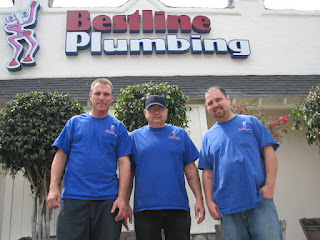
Maybe some auto bloggers would publish that competing plumber's comment (you can find it if you really want, by looking within the comments on the original posting.) But it didn't work because the plumber's marketing representative was simply trying to manipulate the SEO and making unvalidated claims in the process. (In case you are wondering, Leonard Megliola at Bestline Plumbing in Gardenia got my attention by publishing useful and immediately relevant information, essentially giving away his operating manual without expectation of any compensation, on the Contractortalk.com forum.)
Are you sincere or are you just trying to manipulate the process? Sincerity, but really, "smart sincerity" wins all the time.
P.S. If you are a plumber, you will want to connect with the Plumbing Zone forum. But don't go near there if you aren't. I was blasted out of there within minutes when I joined briefly after discovering references to my blog there.
Posted by
Construction Marketing Ideas
at
2:59 AM
2
comments
Labels: client focus, sincerity
Thursday, September 11, 2008
The We We Calculator
George Zarogiannis, president of Ecopainting Inc. in Toronto, introduced futurenow's "We We Calculator" in this contractortalk.com thread. This image above is from Ecopainting's own web site. How does your own website score?One of the basic principals of marketing is your message must be client rather than self-focused. So the "We We Calculator" is a nifty, if somewhat sobering, tool. The idea is to see how much your website is client rather than self-centric.
Take the test and see how you do.
Here are the customer focus rates among some of the blogs reviewed here.
Ford Harding -- 72.39%Ouch!
CofeBuz (Tim Klabunde) -- 52.78%
Markup and Profit blog (Michael Stone) -- 64.53%
PSMJ Resources, Inc. blog (Ed Hannan) -- 76.11%
Yours truly (the banned word goes here, you know who it is!) -- 38.72%
"You speak about yourself almost as often as you speak about your customers. Might you improve that?," the test results note.

George Zarogiannis at Ecopainting Ltd. in Toronto introduced this calculator and its source, grok.com in this Contractortalk.com thread.
Future now, a proponent of persuasion architecture, has a nice little tool.Lessons learned here -- look at Ford Harding, Michael Stone and PSMJ's results -- Impressive, eh. Can (bleep) do better?
It analyzes the "about you" or "about the customer" focus of a webpage.
Type in a url and find out. Ours needs work just found out.
Also, on that topic, Bryan Eisenberg, the authority on that subject has some interesting points:
"It's the Customer, Stupid"
http://www.clickz.com/showPage.html?page=843281
Posted by
Construction Marketing Ideas
at
2:07 AM
0
comments
Labels: client focus, websites