Discover your free Construction Marketing Ideas Email Newsletter
Showing posts with label risk. Show all posts

Wednesday, September 12, 2012

Thinking differently about construction marketing and business growth

As a somewhat prolific blogger, I receive plenty of invitations to receive review copies of books, proposals for link exchanges, and the like.  Most land in the trash can, but a few stand out.  Today, a proposal for a review copy of The Growth Gamble: Why Business Leaders Need a 
Vegas-Mindset to Successfully Grow landed in the in box just as I experienced a classic test of small business flexibility and organization.

Writers Ed Hess and Jeanne Liedtka advocate that growth requires risk, and many different adventures and experiments, from where you learn about what works.  Since the failure rate of new innovations is so high, it is important to plan for this -- by playing your cards right (the authors use the poker analogy a lot.)  Conventional business management seeks to reduce errors, to systematize processes, to standardize things so the risk of operational failure is reduced.  This is deadly for innovation.

Fair enough.  Late last night, a person I knew well sent out an announcement for a new publication which might be seen as a direct competitor to my business.  I forwarded the announcement to our most effective sales representative.  The salesperson emailed me back:  "Why don't you offer him a job?"

Seemed far fetched to me, initially -- I knew this individual values his independence and he doesn't function well in large, bureaucratic organizations.  But wait . . . we are NOT a large bureaucratic organization, but we have some things to offer a potential employee that might appeal to someone who wishes a bit more security and stability, including a decent benefits program.

So I emailed and then called the person.  I explained our general hiring compensation model.  We discussed his non-competing business activities and how we could manage these in the context of an employer-employee (with benefits) relationship.  Within a couple of hours of our conversation and my brief email, he sent me a comprehensive proposal which involves some "asks" but sets a reasonable negotiating position.  

I don't know if we will reach an agreement, but there is a good chance we will.  If we were rigid and overly structured, trapped in processes and protocols, this sort of decision could never happen.  Yet the new employee, if we hire him, will still work within the framework of responsible operating business systems and processes.  

I'll ask the publicity people for a review copy of this book.  Here is a bit more from the promotional materials:

Growth, and particularly innovation, is a probability game. When large organizations pursue growth, their mindsets are often completely out of sync with the reality that guides professional gamblers and VCs. Chances are that these organizations expect ten out of ten projects not only to win, but to win big. They demand that their managers and employees produce growth, inadvertently thwart their attempts, and uphold a system in which pulling the plug on a failed growth opportunity is a career-threatening act. Would-be growth leaders in this environment are like professional gamblers who are unable to act independently but instead receive instructions from on high—from a source that has little information about what is happening this minute in this particular game. Not a formula likely to win in Vegas—or in business.
“The reality is it takes on order of magnitude about 1,000 growth ideas to produce 100 good growth experiments,” explains Hess. “And doing 100 growth experiments may produce 10 viable growth initiatives worth investing in. Growth is an iterative learning process characterized by detours, zigzags, and remakes.”
Growth is a learning process. Good growth companies understand the realities of growth. Growth requires the right mindset—a learning mindset—and the right processes designed to make small bets, learn critical information quickly, and then assess next steps.
“We call that process Learning Launches,” says Hess. “Not only is the right learning mindset needed, but also the right attitude is needed individually and organizationally about failure. When you are exploring growth—when you are entering areas where you have not played before—by definition you will make mistakes and have failures. Remember, so long as you make small bets and use the right rigorous process, there is no real failure so long as you are learning.”
Growth can be messy and inefficient. Most companies can’t stomach the uncertainty that comes with growth. It violates their dominant no-variance operational mindset. Well, guess what—growth and innovation are high-variance processes by their nature. If you do not accept that fact, then your growth initiatives will be limited to small incremental improvements, which at some point will not produce enough growth to keep your stakeholders happy.
“Operational excellence strives for 99 percent defect-free performance,” says Hess. “Contrast this to growth experimentation that can result in failure rates of 90 percent. In operational excellence environments, managers are rewarded for stamping out variance. Yet, in growth environments, variance is the norm.”

From The Physics of Business Growth: Mindsets, System, and Processes (Stanford University Press, 2012, ISBN: 978-0-8047753-4-2, $12.99, www.EDHLTD.com). 

Friday, September 18, 2009

The Races and Construction Marketing

Members of the Ottawa chapter of Construction Specifications Canada at the Rideau-Carleton Raceway. My only bet, a $2.00 ticket, lost. Of course I didn't actually purchase the ticket.

Although the local racetrack and slot machine emporium is close to my home, I've never visited the facility since it opened in its new and "modern" form several years ago. The idea of putting coins into machines in hopes of winning big when you know the odds are stacked against you from the start hardly excites my sense of rational business awareness.

More significantly, I know enough risk and chance in day-to-day business ownership. Compare this time last year to where things are today, and I would say that anyone who thinks business planning and assumptions can truly predict your future is dreaming in some very bad form of colour.

The difference between business risk and gambling risk, of course, is that the business owner has some choice in the outcome. I suppose horse racing gamblers have a form of choice -- they can review the handicaps and statistics before placing their bets -- and card game gamblers can try to count cards, but the gambling business has solutions to these risks: Odds adjust automatically as bets are placed, so at the races the house takes its cut (about 25 per cent, I estimate) no matter who wins, and card counters are banned from the casinos.

The world isn't fair, it seems, especially for those who think that dumbly playing the game is the way to win.

Fellow members of the Ottawa Chapter of Construction Specifications Canada are not dumb, however. We know that casinos and racetracks offer enticing deals on meals and entertainment, if you don't gamble. So we didn't. Instead we shared stories of how games are set.

Here is a good example. One member explained the simple convenience store owner rule for "pull tab" games -- you know, those little cards where you pay a dollar and hope to win a jackpot. Convenience store operators fill the jars with these tabs, and watch whether anyone wins as the jar empties. The CSC member explained that if the big winner didn't appear by the time the jar had reached 1/4 empty, the store owner "purchases" the entire remaining jar. Of course, at this point, a win would be inevitable. Knowledge certainly helps stack the odds in your favour.

In fact, in business, our knowledge, instinct and gut feelings, combined with an understanding of the rules and some genuine luck are all essential for success.

One person at my table, who insisted on not being identified or publicized in any way, spends $5,000 annually on a well-known leads service, for example. He then assesses the information and sends out information packages, seeking to sell concrete products to contractors.

He said: "I can't be identified because in fact the products I distribute are also sold by the company's other divisions, and if they have the information, they will compete against me." It turns out the end-user may purchase the same thing from the same company, but the distributor at the race track wins or loses depending on whether others know he is looking for the work and opportunity.

"Could the original supplier save some money by simplifying and consolidating its sales force and arrangements," I asked the distributor. "Sure, in theory," he said. "But the seeming inefficiencies actually spur competition and create more business for the manufacturer."

In other words, by allowing different players to compete in selling the product, the manufacturer actually sells more, at greater profit. This may not make much sense to the bean counters, but it certainly works in the marketplace.

Then the distributor relayed a story which shows how things evolve. A few years ago, before electronic equipment replaced mechanical methods, tolerances of up to 10 per cent were permitted for cut stone. These tolerances remained in the contract language for a major, high-profile project, even though then-recent technology advances had eliminated the need for them. One contractor bid the job, then creatively arranged to have the stone cut to the minimum tolerance, which of course guaranteed a 10 per cent gain -- and possibly even 20 per cent. This certainly improved the margin.

As some of us left early (after the fourth race), and walked through the slot machine section, we felt a sense of rational superiority over the fools playing the machines. They simply don't get it, and are poor as a result. The world is not fair to the dumb and the passive (and sometimes bad luck can bring down even the brightest and most honorable).

But when we are play the business game, we can choose our strategy and change course when we need to find a new direction. We enjoyed our inexpensive, information-sharing evening at the race track. We had found a way to win, sure-fire.

Tuesday, July 28, 2009

Finding your ideal client

This can be easier said than done, but one of your primary marketing challenges is to focus your energies, resources, and strategies on building the trust and respect of your "ideal" potential client.

I put "ideal" in quote marks because this person (or organization if you are selling to other businesses), is not always as easy to find as you would like, and isn't always what it seems at first sight.

Nevertheless, if you have been in business for a while, you probably know who your ideal clients are: You probably can look at your current client list, and quickly find the top 20 per cent -- in loyalty, profitability, ease of service, and enjoyment.

The question is, can you find more of the same, or more clients with enough attributes that you would still be happy to have them?

You can then survey your market, and determine how many potential clients fit your description. In a local business-to-business space, you may find you have just a few dozen possibilities. In the residential market, you can connect the dots of demographics, neighbourhood size, and market area, to find your totals.

Then, take a close look at your former clients; the business you have either lost to the competition, or because the former clients simply do not see enough value in your service (or have had such a bad experience they have vowed not to return). This group should get special attention: If you can recover just a percentage of them, you will be ahead of the game.

Next, you have to develop your strategy to reach these individuals/organizations and attract their interest.

Along the way, of course, you may find your marketing process takes twists and turns.
Consider our business, for example. Eighty per cent of our business is from editorial feature profiles generally supported by supplier advertising. We've learned these are generally effective for businesses with sales volumes greater than $2 to $3 million annually (of course within the architectural, engineering and construction community.)

The actual advertisers, the suppliers of the profiled companies, don't need to be so large but we won't get their business without a direct referral from their clients and these clients need enough volume to have 'clout' with their referrals.

This blog reaches many thousand readers, but only a small fraction are decision-makers within this select community.

Ironically, this blog originated as a client service initiative. Advertisers, spending hundreds of dollars to support their clients (the featured businesses) were originally treated with less-than-respect by our business; we sold them their "support" ads, sent invoices, and then moved on to the next feature.

I started the blog to give the actual advertisers some real value -- ideas and insights to help their business grow. I certainly didn't anticipate it reaching international proportions, or achieving top rank on Google searches.

This status of course has led to other opportunities, and market development potential. So it hasn't been a linear or totally scientific process.

But our core marketing model hasn't really changed that much, we still need to focus our energies on businesses within the qualifying framework; the only difference is we now can communicate and offer something of value regardless of where they are located.

Consider your focus; but sometimes you can find the best results by looking in places where others don't go. Unfortunately, while it can make sense to head off the beaten track, I can't tell you where, or how.

Sunday, July 19, 2009

Balance and change

Construction marketing, I believe, is both a science and an art. You defy all probabilities of success if you fail to observe some basic rules (or laws), but if you think that just following the rules will solve your marketing challenge, you will most likely be disappointed.

Consider, for example, the challenge in stretching or ignoring industry norms. In the non-residential community, general contractors will rarely select their subtrades without inviting competitive bids. You might be lucky (or experienced) enough to be consistently invited to be a member of a reasonably small short list, but, even then, if you wish the job, you have to have sharp pencils. But if you are not on the "inside", how do you win your place on the short list?

Government work, meanwhile, is supposed to be fair and open, at least for larger projects. (For smaller projects, at least in Canada, the work is subbed out to a large private organization and you need to pay their game.) Then you run smack in the U.S. into the Brooks Act -- which allows bureaucrats to use qualitative criteria to keep their friends and previous suppliers in business regardless of price.

The residential (homeowner) space observes more traditional marketing principals, meaning if you play the game right, you can follow the rules, advertise, develop simple strategies and measure your results. I won't easily forget my meeting with Mike Feazel at Feazel Roofing in Columbus just before Thanksgiving, when he said he stays away from most non-residential work because price competition makes the potential profit for work in the non-retail marketplace hardly worth the risk.

But you can't just jump from the commercial (or residential wholesale, business-to-business) market to the consumer market at the drop of a hat. Your business operating systems, pricing, and strategies simply won't match. You'll flounder.

I share these points because most likely you feel a need to change your market, practices, or systems when things aren't working quite right. In some degree of desperation, you cast about for a quick fix -- only to find you've dug yourself into deeper problems. Or you might try doing more of the same, to more dismal results.

For example, a contractor in the U.S. called me last week to ask whether he should sign up for Dodge (McGraw-Hill). I told him it wouldn't hurt, and Dodge is a reputable leads service, but to be wary of chasing bids for jobs where he doesn't have a previous relationship. I referred him to a posting in Bobby Darnell's Building New Business Blog (November, 2008):

If you subscribe to F.W. Dodge, Reed Construction Data, DEC International, CDC News or any of the other construction lead services you need to make sure you milk each lead for useful information. Remember, you are not the only company purchasing those leads so you have to know how to leverage each one beyond its primary purpose.

One of the profound incidences that led to me this business is when I was working at Construction Market Data (Now called Reed Construction Data) and would see companies paying up to hundreds of thousands of dollars for leads and using the information to just a small degree of their worth. My analogy is they were purchasing a new set of woods and irons (golf clubs for the non-golfers out there) and when it was time to play; they would grab just three clubs and leave the rest in the bag.

In essence, Darnell is saying the value of the leads service is not so much in the ability to bid on (and hopefully win) current jobs, but in the market intelligence you can uncover to develop relationships for future work.

Fair enough. Where is the balance, and when should you change? Here are three clues:

  1. Your current and previous satisfied clients are your most valuable marketing resource. You'll win the greatest marketing points by doing something extra for them without expecting anything in return.
  2. Your greatest potential new markets are in places where clients can connect, appreciate and refer back to your current clients. That in part is why I like associations so much for non-residential marketing. You are putting yourself in the perfect environment to work within and in support these relationships.
  3. If you move into the residential (non commercial) space you can practice a whole stack of advanced marketing principals which will work wonderfully, if you dare, because only a few contractors use these methods.
However, should you jump between residential and commercial, or between traditional and new practices? Remember, sometimes you need to dive off the deep end but also remember you must be balanced in your understanding and awareness as you take the leap.

Tuesday, June 09, 2009

Relations: Why change is risky

Our visions, attitudes and reality are shaped by experiences, background, and existing relationships.

Most of us, most of the time, seek to live our lives within the safe zone of existing habits, values, and perceptions. Stretches outside these bounds are rare -- perhaps a crisis forces a change, or (more rarely) we feel comfortable enough where we are to reach out and try something new.

In part, this explains why businesses started during recessions usually do better long term than ones started during good times. Forced to create something out of nothing, in a tough market where innovation and selling abilities are essential, we somehow survive -- and then thrive when times improve. (Of course we can also get lazy, but even then, when times get tough, we can remember our earlier experiences, roll up our sleeves, and solve the problems.)

Our existing relationships, of course, provide stability -- and when our businesses are established, the repeat and referral business they generate allow us to maintain ourselves without straining too hard. They also provide an anchor and some security.

But they also can be costly and pull you down, or prevent you from making necessary changes.

The problem is in most cases you can't simply ditch them. Do you want to break up your marriage, for example?

Here is an example of how the dynamics of existing relationships (or lack of them) create opportunities and limitations in your marketing strategies.

In the first case, I am writing about an Ontario architect which has discovered a lucrative and highly successful business by acting as a self-contractor, especially for medium-to-high end cottages outside of Toronto. The architecture practice formed out of an informal partnership started during the 1990s recession, where the partners, not able to obtain architectural internships, ended up in family contracting businesses. They learned how to build as well as design. With the integrated approach and defined market niche, the architectural practice is thriving (and clients are receiving real value for their money).

In the second, a U.S. contractor which relies on architectural referrals for high-end residential projects asked me for marketing advice. Should this person bring in an architect and start designing his own buildings? I think you can see that this would be a highly risky move, indeed.

The best solution I could offer the builder is to engage in advising, helping, and training the architects on practical building techniques -- they may 'steal' the ideas, but the relationships formed will encourage more referrals (but nowhere as many as providing the architects with new client referrals directly.)

Of course, if your existing relationships are dysfunctional, you will need to change but beware of radical shifts. The grass is rarely greener elsewhere -- at least as you currently perceive things.

I remember well the failure of the Eatons Department Store in Canada. Founded by an entrepreneur, successive generations decided to live the life of the landed gentry, and the business reached the failure point. In a desperate move, the store tried to become "hip" -- ignoring that most of its current clients were elderly, and a massive new advertising campaign, with new merchandise designed entirely for younger people, would do little to satisfy the needs of the loyal, if aging, current clients.

Friday, June 05, 2009

The boundaries of extreme behavior

Have you ever experienced the soaring, then crashing, feeling, of reaching new heights, amazing insights, and then, wham, all seems to fail?

For most of us, this kind of experience happens rarely, but I sense some push the limits more often than others.

In polite company these individuals are called eccentrics. In less-than-polite environments, they are called "nuts".

In a business or social environment, intelligent eccentrics challenge you to think differently, to stretch your limits, to try new things, and then, you want to be away from them (unless you are, yourself, a truly exceptional person).

If you can tolerate their presence, eccentric geniuses can truly challenge your assumptions and cause wonderful change. They can also blow away your clients and drive your employees and colleagues crazy. You then need to know when to ask them to leave.

I can now safely relate two examples of this dynamic at work.

In the first, in my final days in Africa, I had discovered (drum roll here please), the secret to life. I was soaring -- on top of the world -- and daring all sorts of assumptions. After one particularly wild escapade which goes down in personal memory as the night I discovered my self identity, my supervisor called me into his office and asked me, point blank, "Are you well?" He then invited me to resign, immediately.

My boss, then, of course, made the right decision. He would himself soon leave, of course, as the political and historical changes I had witnessed took real effect on the newspaper as the country morphed from Rhodesia to Zimbabwe.

My second example is more complex. The leader of a major business organization battled as co-defendants with my business in a lawsuit initiated by a competing publisher. Things ran their course and the judge ultimately cleared my business but not the business organization or its leader. Still, as the organization ended up having to pay a large part of my legal bills, this leader said: "Don't worry, I have another project for you in the New Year."

Then he headed down to one of the seediest parts of town, and picked up a police woman. When news about him needing to attend "John School" reached the media, the association's board of directors asked him to leave.

Certainly, in business we don't want a bunch of "yes men" who do what they are told to do and never question authority or challenge our thinking. And sometimes it is good to have eccentrics in the picture -- they really can shake up our thought processes and assumptions.

But do we need to "fire" them when they disrupt harmony or exceed social norms to such a degree that they threaten your business integrity, brand or reputation?

Probably.

Sometimes this is sad, because in moderate amounts, their eccentricity helps you to be creative, to keep your balance, and to risk change.

Tuesday, June 02, 2009

Dream Big (thanks to Tim Klabunde)

Tim Klabunde's most recent CofeBuz blog posting is brief, and I don't think he will mind my stretch of copyright rules to republish it in full.

I like being comfortable. It is so easy to enjoy the normal flow of life, the moment by moment interactions of daily living. Yet every once in a while my life is shaken from the inside out by a force that boils up from within me, a force that demands that I do something incredible, achieving something that is greater than myself.

It is in these moments that I truly understand what I am capable of, the realization that I am able to do so much more. I struggle to find dreams that are big enough; I look in vain for obstacles that can’t be conquered.

I find it strange that throughout my life I have worked to suppress this force through logic and rhetoric. ”I can’t do that because…” and “if that were possible someone else would be doing it.” Yet today, I can see that success isn’t found in a single accomplishment, it is one’s approach to life that makes greatness. It is something that I can do and live today. A choice to rejoice in the past, plan and dream for the future, and live life to the fullest in the present.

Your turn

Monday morning has its own way of reminding us that life happens not in individual moments of greatness, but during everyday actions. It is the culmination of your actions today and tomorrow that will turn into your greatest successes. So today what are you going to pursue that is greater than yourself?
I certainly share and believe in these thoughts. Through our lives, opportunities arise to change course, to take risks, to adventure beyond our safety zone, but we need to be ready spiritually, financially and physically. Then, at crucial points -- we generally know in our heart when they are -- we can take the risk and seemingly dive off the deep end, though we often know the risks we are taking are more in the perceived fears of others than in the practical dangers we are about to experience.

(So, at 25, I went off to observe a war in Africa, for a while riding a motorcycle around Bulawayo as Rhodesia turned to Zimbabwe. Sounds daring, and the experience certainly opened doors for my life, but I used common sense and local knowledge to stay out of trouble. And, at 34, I flew to Washington, D.C. with non-preference U.S. immigration visa applications for about 300 people, but I knew I was complying with all the rules and laws, and having some fun while helping others to achieve their dreams. Yes, the scheme delivered the goods and helped me to find my current passion and connection with the Washington-area community.)

If you are in business for yourself, or if you have discovered your passion is marketing and business development and you are reading this blog in part to grow in your own abilities, you may have found part or all of the answers related in Tim's posting.

But there are other aspects you can only find in your own heart and soul. When you let go of your fears, when you accept responsibility for your mistakes, and when you take risks and reach beyond the ordinary by combining your strengths and your solid moral codes, you'll achieve greatness, too.

Go for it.

Wednesday, April 29, 2009

Big dreams and great achievements

A few postings ago, I observed that you must not fall into the trap of "wishful thinking" about your business and construction marketing. This should not however be interpreted as suggesting you should not take business and marketing risks by turning big dreams and thoughts into real ventures.

The most important element of risk and reward is that there are times when you must, indeed, dive into the unknown. For example, if you've always relied on repeat and referral business, and now are contemplating paying for advertising to attract new business, you will find the expense scary and most likely, the immediate results to be disappointing. (In earlier blog postings I suggest the least risky ways to develop your advertising campaigns, and these approaches allow you to systematically tap into your repeat and referral business, rather than to passively rely on this support, in starting and planning your first advertising campaigns.)

On a larger scale, decisions to expand your business scope or, conversely, deliberately jettison sideline enterprises and focus on core markets/businesses may appear risky as well. If you've worked as a lone wolf, hiring your first employee will be a challenge; even worse is when you discover you have to fire the employee, either for poor performance or because your business is tanking!

We all have different risk tolerances and entrepreneurs, by our nature, have a greater willingness to push ourselves to limits than others seeking superficial security. The paradox is that despite our apparent risk-taking nature, we have much more control of our lives and destiny with the entrepreneurial route. (This statement, I admit, applies more to Canadians who are less known than Americans for entrepreneurial leadership, but the fact remains the state-supported universal health care system removes a significant barrier to entrepreneurship in the North. In the U.S. if you are working for a company with a great health plan and have a dependent who is ill, is the risk really worth taking to leave and start on your dreams? The safety net for many in the U.S. is your spouse's health plan.)

You know you are on the right track when others around you perceive you are taking a major risk, while you know the dangers are manageable and reasonable. I'm thankful that in my youth I headed off to Africa to experience first-hand the end of the Rhodesia/Zimbabwe civil war, but am equally thankful that I had the common sense to (mostly) stay out of danger zones.

Later on, in my own business, I've stretched its expansion beyond my comfort zone and (worse) my knowledge of how to operate the business effectively on a larger scale. A couple of near-death (business) experiences because of ill-fated decisions certainly helps me understand that you need to be really thoughtful about the risks you take.

Some risks, of course, can be mitigated with insurance, but others are part of business life. For almost any achievement, at some point you will need to move beyond your comfort zone, defy your fears and go for your dreams. You can do it -- just remember that in taking the risk you are likely to fall flat and have setbacks as you move towards your dream.

Tuesday, February 24, 2009

Risk and reward

When do you go against the grain of logic and reason, and hard and fast numbers, and decide to move forward with a business?

The answer, almost always, is when your gut feeling tells you to do it - when you are willing to take the risk because you think the likeliness of success is high enough even if the superficial barriers suggest you should be cautious.

These thoughts went through my mind today as I revisited the decision to pull the plug on relaunching Washington Construction News. On some levels, our red-line business indicators say this expansion would be a mistake right now. But on another level, I concluded that the investment required -- if necessary I could tap into retirement savings to maintain obligations -- is worth the reward.

This touches on a fundamental question and challenge for anyone involved in construction marketing. When do you go for it, and when do you hold off? Which projects do you bid, and which do you ignore? (The opportunity and cash cost for many RFPs I suspect would be greater than my actual cash at risk in restarting Washington Construction News -- the combination of local knowledge and business experience, with an established operating infrastructure, reduces the risks even more.)

The answer to the go/no go decision almost always depends on the quality of your relationships with your client counterparts. Open public bids where you have no relationship with people setting up the bidding opportunity are generally a waste of time and energy. If the bidding opportunity is truly fair and open and based on price, you probably will lose by winning as some desperate low-baller will most likely get the job.

If on the other hand the bidding rules allow qualitative and relationship-oriented measurements (like the Brooks Act does for AEC federal projects), then will you win the work if you are coming out of the cold, or are your chances a whole lot better if you are properly connected and relate to the bidding organization? The answer is obvious.

I thought of these matters today, realizing the quality of the relationships we have in the Washington D.C. area are impressive, as are the quality of relationships of the person we hope will take the publisher's job. So if she says 'yes', we will get started. And I will remember the rules of business risk and reward need to be put to the test in practice.

Saturday, January 31, 2009

The right kind of risk-taking

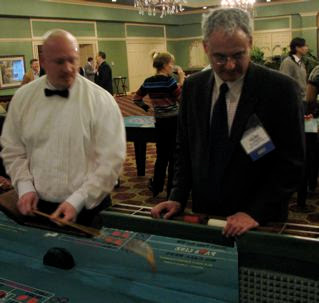
I won and lost about $250 -- in funny money -- as a high roller at the DC Metro Subcontractors Association Casino Night on January 29. This is the only type of gambling I'll do.

I've never been much into gambling, lotteries and casinos (except to write stories about their building projects or play with funny money at charity and association events.) Why would anyone choose to play a game where the odds are stacked against you -- and you know it in advance! Insurance, I realize, works on some of the same principals of gambling, here you are betting with the hope that you will never have to file a claim, though.

Business risk, done right, of course, is an entirely different kind of challenge. You can go through ups and downs (and many businesses these days are going through downs), but if you own the enterprise, and maintain proper controls, you can control the process with creativity, resourcefulness, marketing, and your own knowledge. You may have to jettison employees and close divisions -- your business might even fail and you may need to file for bankruptcy, but if you handle things properly you can rise again, and succeed.

Monday, January 26, 2009

Your risks in construction marketing

You can build a successful business quietly, brick by brick, solidly on the foundations of solid relationships and respect within your community and among your clients and peers. You can also build your business by taking risks; by audacious advertising, assertive marketing, and unconventional behaviour that makes you unpopular with your peers -- by attracting clients few of them really want.

Which approach is better? The paradox is that while the latter approach is undoubtedly best for my (advertising focused) business, the former may be the best if you are a consumer, or someone who wishes to enjoy balanced business life.

However, you will need to achieve the rare combination of both elements if you wish to achieve true greatness in business. (Don't worry: Most of us don't want to go that far -- you need to be willing to roll your dice and take yourself far out of most conventional comfort zones to go there.)

Consider the professions, especially law and engineering. Lawyers for many years in most jurisdictions discouraged and often banned advertising. Then the rules cracked, and now you see ads on television, the Internet, and more, selling the virtue of contingency-fee lawyers for a variety of civil claims.

Are the lawyers who advertise the most extensively likely to provide the best quality legal advice? Maybe, but my sense is, if you really need a lawyer, you should forget the ads and focus on the relationships and referrals from people you really respect who have actually used their services in the past.

Now what if you are an architect or engineer, and decide to break convention, and allocate major funds for advertising? You likely would recoil in disdain -- and puzzlement about whether this is a wise thing to do. After all, your practices are likely built on personal relationships, reputation, and integrity, and loud ads seem highly unlikely to take you where you wish to go. (I'm not arguing with you.)

However, I sense if you had the courage and budget to break the rules, your practice could grow to levels beyond your dreams (though you would find your life among your professional peers lonely, as they reject you, and you might find your ideal clients want little to do with you.)

Thursday, December 20, 2007

Serendipity power -- the trust jump


In searching for graphics to go with this blog entry, I (perhaps with serendipity), discovered the blog: Slow Leadership -- Articles on returning humanity to working life.

I love serendipity -- that amazing confluence of forces that causes good things to happen at exactly the right time. You might call it good luck, and in some ways, it is "luck" but the special thing about serendipity in marketing and business is that you usually need to create the luck for it to happen; and that sometimes involves, for want of a better phrase, "trust risk".

To explain the concept, we'll have to travel far back in my own life experience, to youthful summer agony at age 21.

I had, (through serendipity) obtained a job as a cub police reporter on the Vancouver Province newspaper while in university -- clearly one of the best student jobs you could imagine.

But I had one rather big problem to overcome; my utter lack of social skills and capacity. No close friends -- certainly not a girlfriend -- really awkward personal behaviours; loneliness, personal identity confusion, yuk.

So I sought help, and ended up in the university's student service psychiatric research program as a subject. They had something called "Day House" (see page 2 of this link) an intensive group therapy program where grad students and researchers tested the then latest techniques and therapies on a rather intelligent group of subjects; generally students and recent graduates. The catch: I would have to forgo starting my summer job, while going through this therapy program.

I failed.

Yes, unlike almost everyone else who made it through the program, they drummed me out -- asked me to leave -- after four weeks. Seems, my problems were so serious, so major, that I was disrupting the program and simply didn't fit in. They referred me to another day treatment program at the university. I lasted there about two days -- everyone seemed virtually psychotic (they may have been) on really heavy medications (drugs were not allowed at the initial program). Sensing the choice between spending my summer with drugged out psychotics and working as a police reporter on a daily newspaper, I wisely chose the latter direction.

But the 'failure' in the initial therapy program haunted me.

Somewhere, in the period of being kicked out of the first treatment program, I saw my psychiatric assessment and diagnosis. "Personality Disorder -- Schizoid." I guess you could call it a really bad case of introversion -- so bad that I could not connect or look outside myself effectively.

I can't be sure if this is the reason they kicked me out of the initial program, but perhaps symbolic of the deeper issues, I recall well having difficulties with the "trust jump".

The entire group stood around in a circle, and you were expected to jump off a perch, letting go, and allowing everyone to catch you. Somehow I resisted doing this.

Like many things in life, negatives turned into positives, and I learned some lessons through the horrible ordeal of the "trust jump" and the aborted therapy program.
  • There are times when you really need to let go; to trust, to allow yourself to fall freely from your inhibitions, and allow the forces beyond to 'catch' you.

  • You are still absolutely responsible for creating your own opportunities and circumstances; I chose to be in this therapy program, of course, and I also had a great safety net -- that wonderful summer job on a daily newspaper -- to fall into when things 'failed'.

  • We all can overcome our deficiencies, weaknesses, and challenges with a combination of will and serendipity -- I have learned how to trust jump through life's challenges and circumstances.
Today, the difficult experiences from the late 1970s are a distant memory. I hesitated before posting this blog entry, because it obviously touches on some very personal matters and I wasn't sure it right to broadcast the old psychiatric diagnosis (if that was my illness, I'm clearly 'cured' as I have a great family life now, and people who work with me would not describe me as extremely introverted.) But I decided to publish the posting, because these themes connected just a little more than a year ago, when I needed to take a leap of faith -- accepting the risk, accepting trust -- and let a formerly key contractor resign, without knowing whether we would ever find a replacement.

In marketing, sometimes you need to follow a less conventional path, let go of assumptions, and sometimes, just let go, period. Then you may find the magical power of serendipity occurs, and you'll achieve the success you deserve.