Information and ideas for marketing and promoting your construction or construction-related business.
Discover your free Construction Marketing Ideas Email Newsletter

Friday, July 31, 2009

Plumbing and plumber marketing: The accidental discovery


A search of Google keywords "Plumbing Marketing" leads you to plumbermarketing.com, not Adam Hudson's Plumbingmarketing.com, which I discovered yesterday. Why?

Yesterday, I reported on my discovery of some really useful resources at Adams Hudson's Plumbingmarketing.com site (one of a network of sites he operates from Alabama.) But what do you find when you key in "Plumbing marketing" without quotes on Google?

Another site, plumbermarketing.com has first ranking (at least from my Canadian base, but using the global Google search engine, not its "Canadian" version. That takes us to this site, whose domain is owned by Torske & Sterling Pty Ltd. in Sydney, Australia. When you search into Torske & Sterling, you find some stuff relating to "legal marketing" which of course makes this even more confusing.
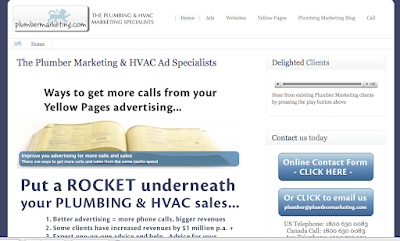

Nevertheless, yesterday evening, in searching for the ownership of plumbermarketing.com I inadvertently used the whois.sc tool to research "plumbingmarketing.com" and discovered Adams Hudson's site, truly accidentally. His hudsonink.com site ranks fourth on the first page for "plumbing marketing", but the "plumbingmarketing.com" site is nowhere to be found. In any case, as I reported a few weeks ago, there are big differences in search site visits and time spent between first and fourth place on the Google rankings.

I have calls out to both Hudson and someone named Grant, who provides phone numbers serving the U.S., Canada, Australia, and the U.K., and provides audio testimonial clips focusing on U.S. clients. I sense Plumbermarketing.com has a cleaner, simpler, and less stereotypical Internet interface, but the real key to its success may be the mysterious Torske & Sterling in Australia.

The research continues, but I had one other question to solve: How important and valuable are the search terms "plumbing marketing" and "plumber marketing"?

Here I used the Google Keyword Analysis tool to discover that the local search volume in June was 590 inquiries, with the monthly global search inquiries at 720. "Plumber Marketing" meanwhile had 110 and 170 searches respectively.

For comparison sake, I tried "Construction Marketing" and discovered 12,100 local searches and 9,900 global searches.

This doesn't necessarily mean this blog has a better "place" in the actual keyword value because more people who are really interested in -- and willing to pay for -- plumbing marketing services may go to the appropriate plumbing site(s) than here. But I'm not complaining!

Can we learn anything from this research?

First, most readers here are seeking to serve local rather than international markets. If you are a contractor in Chicago, you don't really want inquiries from people seeking services in New York -- though you might want potential customers based in New York but with a job in Chicago to find you!

Second, a great search engine ranking does little for you if you cannot convert the initial inquiries into real clients. This is easier said than done, and is a key element of my current research project (one I wish to solve, because of truly enlightened self interest.)

But I am going to take a stab on explaining why I think Google may like plumbermarketing.com so much more than plumbingmarketing.com.

Back-end SEO sophistication
Torske & Sterling appears to know something about SEO. I'll call them to see if I can learn more about what they are doing and how (assuming they will share things with me).

Simple design using video and audio tools
Note the audio clip and video image

Multi-national contact information
This may not be helpful if you are purely local, but if you have a worldwide service, Google probably loves it.

There are some puzzling gaps on the successful site. For example, you can't easily find who "Grant" really is, and I can't determine on the surface exactly where the site owner is located! These would seem to be essential in building real trust (but, then again, the top Google ranking may trump these qualities.)

An accidental discovery


A screen shot of Adam Hudson's "squeeze page". The free offers are worthwhile.

Sometimes in business you find really interesting things by accident. Yesterday evening, I uncovered some really great resources (and lessons for my own marketing library) from Adam Hudson, including two well-written free papers, "Double Your Yellow Pages Leads" and "51 Can't Miss Contractor Marketing Tips". He also offers a bi-weekly newsletter.

In reading through these materials, I felt somewhat humbled because they are both well written and easy-to-implement.

For example, consider his concluding points (48-51): "Top Smartest Marketing Moves for the Year."
  1. Design Yellow Pages ads for lead generation. Hudson says "this is most contractors (77%) number one expense. Either cut the expense or increase its lead-pulling ability with an exceptional ad."
  2. "Identify every lead source". Hudson advocates you "simply ask and note for each call: 'And how did you find about us?' or 'Did you see our ad in the ."
  3. He says you should construct a simple marketing plan. "Start marketing costs per sales and choose your marketing 'type'," he writes. "Moderates 4 - 6 per cent. Conservatives two to four er cent. Less than 2 per cent is asking for stagnancy or decline." (These numbers are interesting to me as I've asserted in a previous posting that if you are spending less than five per cent on marketing, you will be in trouble, and the top range is 25 per cent. The discrepancy can be explained in my including sales with marketing -- pure external marketing expenses might more accurately fit within Hudson's criteria.)
  4. Hudson also says you should start a customer retention program. "This is the costliest oversight for contractors," he writes. Start one and you'll stand out from your competition, who'll be forced to 'copy'. Copiers are never leaders. Be a leader. Use a newsletter that is full of customer benefits . . . " he writes.
In his paper, "Double Your Yellow Pages Leads" Hudson accurately notes the declining influence of this traditional media,with a critical observation that an increasing number of phone users only have mobile phones, and don't receive the book. The more important issue, of course, is that the Internet search has replaced the phone book for new business searches -- and your best lead source now is not the Yellow Pages, but truly effective rankings on the search engines.

Hudson's challenge: I noted that I found his useful materials by accident, and this important fact may shape your perceptions about the rapidly changing directions in marketing. I'll share these observations tomorrow. Some consultants, such as Michael Stone, advocate drastically reducing or totally ending your Yellow Pages allocations, and most start-up contracting businesses, I think, will do far better with Internet rather than Yellow Pages marketing initiatives.

In the meantime, I recommend you get over your fear of responding to his (in my opinion) unsubtle marketing "squeeze page' and sign up for his newsletter to receive the free reports. They are certainly worth reading.

Thursday, July 30, 2009

Marketing maturity

Some people just "get it " from a young age. They understand the basics of human and personal relationships and responsibility, have a solid (and realistic) self-esteem, naturally focusing their lives with great relationships, enjoyment and achievement.

Others never get it. They blame other people for their problems, are often filled with hate, unstable relationships, and destruction, or simply apathy.

Finally, some learn the answers through sometimes tortuous paths.

I'm in the latter group. Nothing comes easy for me in social and personal relationship (marketing) skills except perhaps for two gifts, my ability to keyboard really rapidly, and some ability to write clearly and quickly.

Nevertheless, with these skills, coupled with some adventurous spirit and luck, I learned a little about the other stuff. I realized I could work around my weaknesses by applying my strengths. I might not be a social leader, but could become a contributing writer (and achieve leadership that way.)

Generally, in marketing in the business-to-business space, you don't have to worry too much about the people who don't "get it "for two reasons. First, rarely will people lacking social maturity be in a position to make major decisions and purchases. And if they are, you probably don't want to do business with their organization (it is likely to be a real basket case.)

(Unfortunately, another group of people -- psychopaths -- sometimes ingrain themselves in organizations and community groups. Sometimes you don't discover you are working with the criminally-minded until it is too late -- as they can be charming and appear to be socially mature, which they are, from a bent perspective.)

In the consumer world, things are a little more complicated. Not everyone is mature, and many struggle through life, but they still buy stuff, and some of them own homes needing repairs and upgrades. I suppose in this group you can be pragmatic, focusing on the task at hand and perhaps playing to their insecurities and fears to make the sale.

Now, what if you don't "get" this posting. This could mean two things: One, you are so naturally mature you don't need to see the issue. The other is more challenging. You may not yet have achieved maturity.

If that is the case, unless you are ready, you won't understand the importance of these words. If you are, you will soon embark on a change in course that will revitalize your life. You'll also become a much more effective construction industry marketer.

Tuesday, July 28, 2009

Finding your ideal client

This can be easier said than done, but one of your primary marketing challenges is to focus your energies, resources, and strategies on building the trust and respect of your "ideal" potential client.

I put "ideal" in quote marks because this person (or organization if you are selling to other businesses), is not always as easy to find as you would like, and isn't always what it seems at first sight.

Nevertheless, if you have been in business for a while, you probably know who your ideal clients are: You probably can look at your current client list, and quickly find the top 20 per cent -- in loyalty, profitability, ease of service, and enjoyment.

The question is, can you find more of the same, or more clients with enough attributes that you would still be happy to have them?

You can then survey your market, and determine how many potential clients fit your description. In a local business-to-business space, you may find you have just a few dozen possibilities. In the residential market, you can connect the dots of demographics, neighbourhood size, and market area, to find your totals.

Then, take a close look at your former clients; the business you have either lost to the competition, or because the former clients simply do not see enough value in your service (or have had such a bad experience they have vowed not to return). This group should get special attention: If you can recover just a percentage of them, you will be ahead of the game.

Next, you have to develop your strategy to reach these individuals/organizations and attract their interest.

Along the way, of course, you may find your marketing process takes twists and turns.
Consider our business, for example. Eighty per cent of our business is from editorial feature profiles generally supported by supplier advertising. We've learned these are generally effective for businesses with sales volumes greater than $2 to $3 million annually (of course within the architectural, engineering and construction community.)

The actual advertisers, the suppliers of the profiled companies, don't need to be so large but we won't get their business without a direct referral from their clients and these clients need enough volume to have 'clout' with their referrals.

This blog reaches many thousand readers, but only a small fraction are decision-makers within this select community.

Ironically, this blog originated as a client service initiative. Advertisers, spending hundreds of dollars to support their clients (the featured businesses) were originally treated with less-than-respect by our business; we sold them their "support" ads, sent invoices, and then moved on to the next feature.

I started the blog to give the actual advertisers some real value -- ideas and insights to help their business grow. I certainly didn't anticipate it reaching international proportions, or achieving top rank on Google searches.

This status of course has led to other opportunities, and market development potential. So it hasn't been a linear or totally scientific process.

But our core marketing model hasn't really changed that much, we still need to focus our energies on businesses within the qualifying framework; the only difference is we now can communicate and offer something of value regardless of where they are located.

Consider your focus; but sometimes you can find the best results by looking in places where others don't go. Unfortunately, while it can make sense to head off the beaten track, I can't tell you where, or how.

The Marketing funnel

Conventional sales practice requires you to process many "leads" before you find the gem of real business.

Not-very-good salespeople (or not terribly effective businesses) then instruct their sales representatives to "make the numbers" by calling and calling, emailing and emailing, and knocking and knocking on doors. A few thrive within this cold approach to business development -- but most either become drones or burn out and move on to something better, quickly.

Undoubtedly, this approach to finding business actually is effective, to a point. Since it is so distasteful and frustrating to encounter rejection, few bother to go through all the steps necessary to succeed; and since a few people may actually wish your service, if you are lucky, a few of your spam emails or nuisance phone calls may actually respond (and, in the case of spam, because it is "cheap" to send it, you can theoretically just turn up the volume.

Of course, these practices are exactly why most people build up huge defensive walls when they encounter any selling initiative; especially the clients you most want to reach -- the ones with more money than time to waste fending off unwanted solicitations.

You may find the "numbers" this way, but can you find the trust to win the commitment and business you need; and what about the negative fall-out from all the people you bother, who are not at all interested in your service (and won't have a favorable first, second or third impression of your business.)

Effective marketers seek to turn these problems on their heads; winning trust in your business to the point that (a) people will call you to initiate the relationship or (b) you are so well respected that when you call (for good reason), your call is accepted with anticipation.

Here, the numbers game is modified, because you don't want to waste marketing dollars and energies on people and organization with no capacity to pay for your architectural, engineering or construction services. You need to focus your marketing energies and resources carefully to build the trust and relationships of the people you really wish to meet. In the next few blogs I'll look at some ways you can achieve that focus.

Sunday, July 26, 2009

Your three most important construction marketing priorities

You have limited time and resources. Where should you focus your marketing attention, and how?

Here are three fundamentals which, I believe, should reflect about 80 per cent of your marketing energies.

Know and understand your current and recent clients (and the ones that left for the competition).

The ongoing Construction Marketing Ideas poll, How do you attract most of your business?, shows that 34 per cent of this blog's readers obtain most of their business from repeat clients -- and 39 per cent from referrals. So you really need to know your clients, on two levels: How they relate and feel about your service, and who they are: Their likes, interests, socio-economic status, values, and more. And of course, you especially need to know this information about the clients you have lost to your competition.

With this information, you can build closer bonds, draw out referrals and repeat business, and correct mistakes. And, significantly, the information will provide you valuable clues about where to spend our resources for other marketing initiatives; which media to use, where to advertise, and so on.

Know your employees, what they think, their values, and how they relate to you, each other, and your clients.

Your employees are at the front line of client service and marketing; and if you have problems here, you will have problems everywhere. You need to be in touch with everyone in your organization -- remember, the front-line installers or service reps are the people your clients will spend most time with; and even if you are on the non-residential side of the business, you want to be sure to put the right tradespeople and specialists in place where there may be client contact.

One of the most effective ways to connect with your employees is to have regular meetings and huddles -- and periodically, if your business is larger, go out and work with your front-line staff at their jobs; you may pick up eye-opening insights.

Know your numbers.

You are running a business, after all. You had better have reliable financial and cash flow reporting information. How are your receivables, are sales matching projections, and are you collecting your accounts on a reliable schedule? You need to know your business as a business.

A training video

Just for fun . . .Discovered this on the remodelcrazy.com site.

Two (new) places on the construction marketing spectrum

I've just posted a couple of worthy permalinks, representing two places on the spectrum in this blog's readership.

In the first, Chicago-based Anne Scarlett of Scarlett Consulting reports in her Scarlett Letter blog on some intriguing and high level AEC Marketing issues. Consider, for example, her recent posting where she offers some thoughts on what professional firms measure in assessing bonuses and achievements.

Earlier this year, I delivered a session to the SMPS Southern Regional Conference. I met a gentleman (Greg) in the audience that works for a large, multi-disciplined engineering firm (XYZ Engineering). I don’t have their exact revenue figures, but they have multiple offices across the U.S. and abroad. We discussed how the firm is structured from a financial accountability standpoint. Apparently–rather than individual offices serving as profit centers, and rather than one big profit center for the whole firm–this firm has opted to group their profit centers according to regions.

We all know there’s no ‘one size fits all’ magic to a firm’s financial and organizational structure. We also know that it largely depends on these factors: client type and location; design and delivery philosophy; shared resource preferences; long-term business goals; etc.

Circling back around to my conversation with Greg at XYZ Engineering. He shared that there are two layers of bonuses offered at their firm on an annual basis. OK, makes sense. I’ve seen firms with up to three layers of bonuses. But this was what surprised me: Greg told me that rather than measure actual profits, these regions consider two things to measure their success: billability and net revenue. Nope, not profit. They figure if the other things are there, the profit will be as well.

Now, I can think of all sorts of reasons why good billability factors and net revenue figures might not lead to a truly profitable business. So I found it curious that this large, highly reputable firm would measure it this way.

Months later, I’m still curious, and am taking this opportunity to reach out to you, dear readers, to hear your own perspectives on this topic. If you are willing to share (anonymous is fine; feel free to send a direct message if you prefer), then I’d love to learn more about how your organization is structured financially, and how that structure is helping–or hindering–your firm in this current economy. Any collection of data will be shared in future blogs for consideration.

I wish I had read Scarlett's blog before contributing my article on Metrics for the upcoming SMPS Marketer issue. I looks like Greg's company, in measuring "billability" and "net revenue" is seeking to establish Key Performance Indicators which may be within the capability of individual employees to influence and change. On the other hand, I 'm wary of complex, two-level bonus structures; how effective are these benefits, really, and how much do they actually influence behaviour rather than become seen as entitlements.

On a different level, Paul Lesieur of Silvertree Remodeling in Minneapolis called me about three weeks ago to tell me he had partnered with Rory Swann of Servicez Unlimited in Washington D.C. to establish a new site/forum for remodelers, Remodelcrazy.com. The site is now in operation; it is early going, but a true grassroots community is developing. Here is Paul's explanation of how the remodelcrazy.com idea developed.

I'm driving around last year thinking "What a crazy business and what a crazy remodel I'm doing for this couple".

Ding, Ding I grab a flat carpenters pencil three inches long and write down Remodel Crazy.

I get back and put the paper away and four months later I'm talking to Ridgewalker from CT (editor: CT is Contractortalk.com) who I don't even know and he tells me to get an open domain name for that was available that would help promote my business.

I get my domain and remember Remodel Crazy and buy and register RC.com.

Months go by and now I'm friends with some nutcase from Washington DC and we start talking and I tell him about Remodel Crazy.com and my dream is to build a great place for all the people in our industry. One thing leads to another and we get Len involved and here it is. It was just a little dream for a guy who feels like the best people in the world, its builders, don't get the proper credit and respect. The painters, carpenters, electricians, designers, and the solid vendors and associates who make it all click. All of us, this is for you. And I mean it.

Its new, and its gonna take some work, but nobody is more ready to tackle this than the Remodel Crazy crew.

So lets kick it!
White collar, blue collar, years of formal education, or the practical experience in the schools of hard knocks and success -- this industry creates opportunities and working relationships for everyone, and the two new hyperlinks here reflect its diversity.

Saturday, July 25, 2009

How much should you spend on construction marketing -- and where? (2)

In my last posting, I answered the first part of the question with a one-size-fits-all answer, suggesting the percentage of resources for marketing (and sales) should be 5 to 25 per cent of your projected sales.

Of course, this is a wide range -- because the allocation depends on your business. Your most important concern should occur if your marketing allocations are above and below this range: If it is above, I can't see how your business can be sustainable unless you are ripping off your current clients, and if it is below, I can't see how you can retain any meaningful future business.

The next part of the question, "Where?" suggests a hierarchy of answers, as well. Usually, you will be in the higher range if you need to hire or contract with a direct sales force. Sales representatives, of course, need to eat, and good ones need to be paid well. The issue of whether to pay representatives salary of commission is complex and consistently debated -- but my experience is sales reps who forgo a portion of their commission for better marketing are usually much happier, if the marketing provides actionable leads which they are confident will convert.

(The volume of quality leads is probably the best metric of your marketing success. Softer indicators like "branding" and "top of mind awareness" are used to justify expense, but when it comes to brass knuckles business, good, convertible leads, are what count the most.)

In essence, you want to allocate your marketing resources so that you achieve the highest quality leads at the lowest possible cost -- while retaining your current clients, of course.

Here is my ranking order of the cheapest and best sources of leads:

1. "Free" word-of-mouth referrals and repeat clients
Obviously the highest and best source of leads, if you don't simply "rely" on this source. Usually good referral and repeat volume indicates you are doing your work well, and ensuring clients are satisfied. Skimping on the quality of your work to enhance your profits (or external marketing budget) is usually not such a good idea. But the problem with this source of leads is that it can be fickle in hard times. You don't control the process. You are "marketing" by chance.

2. Positive media publicity
Attention to you and your business and referrals by endorsement through news media (newspapers, radio, television) and relevant social networking and rating sites can be highly powerful -- of course this is only free if you receive it without spending any money on advertising or public relations consulting. The problem, of course, is again control -- you simply can't tell the media when to promote you, and you can encounter negative publicity. (Our business offers a service to generate positive editorial publicity, which is free if you have the scale of business to induce co-operation from your suppliers.)

3. Your website and/or blog
You can have your website designed effectively for $500 or less, and produce a blog for free. With time and effort, you can then achieve high Google search engine rankings, and when you reach first place on Google within relevant keywords, the "free" leads will start flowing. This solution often requires patience and can be difficult to achieve in highly competitive markets -- and Search Engine Optimization (SEO) scammers out there will promise you gold when they deliver nothing. But you can often pull it off.

4. Associations, community groups, and networking organizations

You may have to pay some dues, or (in some cases) make in-kind contributions, but the right associations can pay dividends far greater than their costs, especially if you can connect with other members and find the sweet spot of personal relationships within the group.

These four marketing approaches should not require more than five percent of your total budget, so they are virtually "must dos" for any construction business.

When you go beyond these initiatives, you enter the space of hiring or contracting with sales representatives, using print or paid electronic advertising, establishing significant paid referral programs, participating in trade or home shows, paying for keyword advertising or the Yellow Pages, or other marketing approaches.

Each of these approaches costs money, and often takes time to succeed. The individual approach you elect will depend on your business so I cannot suggest one-size answers here (but you can call or email me if you would like more personalized recommendations.)

Generally, I advocate you should:

  • Avoid commercial leads services, but you could work with local and competent referral leads providers if you know them (usually these operate on a personal level, within your community.)
  • Avoid businesses or services which bother you with in-bound telemarketing or spam (usually their marketing costs are way too high to deliver real value.)
  • When your marketing can be "in kind" or requires your sweat/time equity rather than cash, you should give it priority, especially if cash is short. This is especially relevant if you want to get closer to your current and potential clients;
  • Listen to your current clients to find what they like and respect;
  • Use your trade associations to speak with successful marketers in non-competitive but similar markets;
  • Use Internet forums (such as contractortalk.com) to gather ideas and bounce off your thoughts. Don't worry about "secrecy" -- your bright ideas are generally not unique or original, and if they really are, few will rush to copy them right away, anyways.
  • You should be able to put these ideas into a simple plan; not requiring more than a page/spreadsheet where you project your expenses and set up tracking columns for leads and business. This doesn't need to be overly sophisticated. You just want to be able to measure your results.
Add up your costs, figure out our revenue, and determine the best way to build a marketing strategy within your budget. The go for it.

Friday, July 24, 2009

How much should you spend on construction marketing -- and where?

If you think I will offer a simple and fast solution to the question posed in this thread's title, you will need to be patient, or truly believe that superficial answers can apply to all businesses, in all circumstances.

Nevertheless, I'll suggest some general guidelines here which may help you as you start framing your marketing budget (which you should co-ordinate with overall resources and capacities.)

(For this blog, I'm including "marketing" and "sales" expenses in the same rubric. You can be more specific in the allocations -- in which case, you would put the cost of lead generation and indirect supporting activities into "marketing" and the actual commission and direct sales salary costs into "sales". The challenge here is that I think the best salespeople are most effective if they think and act like marketers; in essence they need a marketing budget for themselves, as well as direct compensation/commission.)

As a rule, marketing expenses range from 5 to 25 per cent. The "five per cent" marketers have mature products/services in clearly defined niches, you aren't worried about growth, and you have a stable and solid business operation, generally selling high ticket, repeat purchases.

If you are fortunate to have a business, for example, providing maintenance and service for several large (and unrelated) organizations not all of which would suddenly be affected at the same time by an economic downturn, you could handle 5 per cent quite comfortably. This would pay for basic support, relevant association membership, and a little promotional activity to prime the pump.

As we go up the ladder, 25 per cent is near the high end. This is common for businesses with relatively high transaction costs, often selling intangibles, and where the unit cost is relatively small, at least in the business-to-business space. Yes, advertising-selling businesses fit in this category, which suggests one reason why it is challenging often to find real value when you purchase advertising; you need to pay the (very real and valid) overhead and operating costs of the organization selling the advertising, as well as its hard costs in actually delivering the service.

If marketing costs are higher than about 25 per cent, you are heading into scam territory. Here, the promotional and sales costs are so high that it is virtually impossible for the vendor to truly give value to you. Realistically, if there is no substance behind the business (in other words it is a scam), marketing costs can be 50 to 60 per cent or more of revenue, since the remainder just falls into the criminals' pockets!

Three other factors may influence your marketing budget:

  • Your growth vision or plans. In early goings, you will need to "spend" more on marketing than when you have a mature business. Of course, you most likely wont' have the money (and if some sugar daddy has large pools of capital available for you, I recommend you decline it -- you will burn and waste that money really quickly if you use it.) At this stage, marketing budgets should be in sweat rather than cash. "Pay" yourself a commission rather than a fixed salary, and find the business!
  • The economy may decline and you may need to spend more for less. This works generally if you have a solid marketing system and strategy, and rarely is effective if you've "never marketed" but are desperate for business. But if you have a regular plan, reliable advertising sources, and the like, you can manage your lead flow by increasing your budgets within your effective media. However, I also think you would be benefit by testing some alternatives because new media can often save money.
  • Your competition may be stepping up the fight in your space. You may have to respond to increased pressure on your 'mind share' because of competitive behaviour. I think you should be wary about knee-jerk reactions, however.
In the next posting, I'll offer some ideas about how you can allocate and spend your marketing budget.

Thursday, July 23, 2009

Tricks, gimmicks, and shortcuts

This comment I received overnight (about 2 a.m. EDT) certainly seemed flattering.

Dude, GREAT blog. This whole site that you have set up is top-notch. Well done. I stumbled across it as I was looking for an article on general contractors.

I’m really looking forward to reading all of your archives. Terrific job, keep it up!
However, my sixth sense immediately told me something didn't ring right here. Why would anyone write such flattering remarks for an old posting relating to the Ontario General Contractors' Association? Must be, I ultimately correctly deduced, an effort by someone to steal a back link through a form of comment spam/management.

However, the back link wasn't obvious from the surface. I only discovered the trick when I posted the remarks and discovered the link embedded in the name "Janee Martin". I then immediately deleted the comment, after a cursory examination of the referenced site.

Paradoxically, the site may have had some value to the blog's readers. But why should I extend it any respect if the organization seeking attention is playing tricks and games, and presumably using an offshore service, to manipulate things.

These observations lead to a larger, more challenging question: Is it wrong to use tricks, gimmicks and short-cuts to achieve your marketing aims? And here, I cannot give you a clear answer.

Earlier in the day, for example, I saw how I could get a (purported) "free ride" with an email "blast" to thousands of people, many of whom have asked to be removed from my mailing list.

The extra mailing would take just a few minutes to set up, and would not cost a cent financially -- at least in the immediate sense. And I probably would recover some valid names and maybe a few clients, while others, perhaps fuming at the spam, would simply hit "delete" or send a spam complaint to the mailing service, not me.

Why not go for it?


But I hesitated, and then rightfully decided to stop. Maybe a follow-up or verification mailing can be justified, but it needs to be handled carefully and the intent of people asking not to be bothered again by me must be respected. Until I can scrub the list clean of anyone who asked to be removed, the email won't be sent. And if I send it, I will think hard and fast about the content and relevance first.

Then, late last night, one of my talented representatives saw for the first time the "send" list of a regional construction association. We certainly don't have permission to use this list for advertising or marketing -- but he deduced that he could send out an email inviting readers (if they wish) to submit suggestions for a guest column or editorial contributions to the publication. It is unlikely anyone will be offended by that kind of offer. A trick? Maybe, but good marketing as well (as long as he doesn't routinely repeat the exercise with the same list.)

So, what, after all, are the rules here?

In the perfect world, I suppose, we would all only send and receive marketing messages we really wish to get. And when we achieve this perfect match, we almost inevitably succeed. Consider the natural flow of personal relationships, word of mouth, and inbound inquiries.

Potential (and current/former) clients want to do business with you, so they seek you out. Undoubtedly this is the easiest and most enjoyable way to sell anything.

However, most marketing communications efforts involve some waste and (worse) irritation of people and organizations who, often for truly valid reasons, will never do business with you.

This sort of thing happens when you "force your pitch" on someone at a networking event (rather than focusing entirely on the person you are speaking with's real interests), in intrusive advertising, telemarketing, and (painfully) spamming. Telemarketing and canvassing probably are the most intrusive approaches, but they come with a trade-off -- the need to personally interact with the person you are troubling. So you either pay handsomely for the canvassers or callers to "take the rejection" or you endure it, knowing that you can gracefully back off and move to the next "prospect".

Spam, frankly, is one of the most challenging (and perhaps tempting) options. If you have a list, it costs virtually nothing to force it out on people's email, and you don't (directly) have to face the rejection. So why not just do an email blast!

The cost, of course, is in your reputation and your chance at a future relationship. Remember as well, spam can be on a small scale. Some Public Relations agency, trying to interest me in a marginally relevant story, sent the same release -- and follow-up "personal" email to me and two employees of my organization on leave, so all three emails landed in my mailbox yesterday. I deleted them all.

But another PR representative sent a straightforward news release, without any purported personalization, to more than one address. Most of these announcements land in the round basket (okay) but this one stood out -- I followed up and will probably write a story on the topic. When does spam become newsworthy?

I believe the more you can engage people with good stuff and the less you resort to intrusion and disrespect, the more you will succeed at your marketing. But sometimes it doesn't hurt to break the rules. Just be aware of the risks and real costs when you do.

Tuesday, July 21, 2009

Trust, "scams" and the Great Game of Construction Marketing

Bruce in the PSMJ Resources Blog uses the story of the late Walter Cronkite's influence in ending the Vietnam war to validate the power of trust in marketing. Meanwhile, a few days earlier, Matt Handel in Help Everybody Everyday posts a couple of videos of Brian Brushwood's presentation at SXSW Interactive 09 with a rather direct title "How to Scam Anybody". Bushwood explains how scammers -- and marketers -- use psychological manipulation techniques to influence results, and get what they want.

For many of this blog's readers, of course, Walter Cronkite is some old figure from the past. You may have been a little kid when he disappeared from the little screen (the picture I've used is of his broadcast announcing the Kennedy assassination), or weren't even born yet.

As I'm 56, I certainly remember pulling an all nighter (at age 16) watching Cronkite comment on the 1969 Apollo moon landing.

Conversely, Bushwood looks like a kid to me. But he's having fun poking holes in the assumptions people have and perceptions of what is right and what is effective. He is disarmingly trustworthy as he shows us how to play tricks with our friends (and clients). Of course, he also is on television -- web television, that is.

As you review Bruce's blog and Bushwood's videos, here is some food for thought.

  • How important is "being on television" (as yourself, not some artificially concocted "advertisement") effective in building trust? Just for fun, I prepared for this blog a brief video clip of myself. (But if the video isn't good, should you really use it? I looked at what I had prepared for this blog and, thought, "No way do I want people seeing me that way." If you want to see some really bad video, you can look at this link, however.)
  • How much time do you spend following the cliches of marketing and sales, without realizing the real focus should be on the quality of your business relationships? If you can't truly earn and sustain your clients' trust, ethically, you won't be in business long. And if you engage in unethical "tricks" to manipulate people to earn the trust, you are a con artist (and maybe should join Bernie Madoff in a federal institution.)
  • In 2009, how much more control -- and choice -- do both you and your current and potential clients have over the marketing process and relationship-building channels, than you would have had in 1969? Of course, then, as now, you could attend "Networking Events", but could you build the whole relationship-development process in online forums and with blogs like this one?
You may notice I've framed these points as somewhat rhetorical questions. Thankfully, the science and art of marketing in the construction industry has progressed far in the last 40 years.

After all, when Walter Cronkite had enough trust-generating power to influence the decision to end the Vietnam war, the association representing architectural, engineering and construction marketers, The Society for Marketing Professional Services, didn't exist. Now it has more than 6,500 members in chapters in most major U.S. cities (and one in Toronto.) Marketing has certainly advanced far and fast in this industry.

Monday, July 20, 2009

Slogans


In this video, marketing guru Al Ries explains some of the basics of successful slogans.

I've enjoyed this lengthy contractortalk.com thread, Company Slogans. Some are downright hilarious -- and some efforts at "slogans" are so laden with cliche, they are beyond boring.

This comment by "Dick", a Minnesota-based masonry consultant, succinctly describes the core of a good slogan.
Slogans are worthless if they are the usual, trite ones about how good I am or where it work(s).

A good slogan is remembered to trigger a future solution for a project or problem . . .Sort of like logos that say nothing, but are remembered and recognized.

One great and insane one was in Virginia Beach - "It it does not go down, call Brown" - Everyone remembered that one even if they did not have a sewage problem. If they had a problem they remembered Brown.
If your slogan has words like "Quality Service" or "Free Estimates", you need to go back to the drawing board.

I think a good slogan mixes a dose of humor with some edge -- and might even seem a little risky (but how far you want to go depends on your personality and market). Of course, you can also consider the basics -- the four "mental glues" as outlined in Ries's video: Alliteration, double ententre, repetition, and reversal.

How important is it to be first on Google?

This chart showing the importance of high ranking on Google is published in Distribution of Clicks on Google's SERPs at seoresearcher.com, October 26, 2006.

How important is it for your architectural, engineering or construction business to be in first place with relevant keywords for organic Google searches?

The answer is "very" if you consider two important elements, the percentage of searches that rely on Google, and the amount of attention given to the top position on the search rank compared with others, even on the first page of organic search listings, at least if you can believe one widely quoted study from Cornell University researchers Laura A. Granka, Thorsten Joachims and Geri Gay.

The Cornell study using student volunteers discovered that 56.26 per cent of people click on the first organic listing, and the number of clicks declined to 13.45 per cent for second place and 9.82 per cent at third place. Near the bottom, the 10th ranked spot attracts 2.55 per cent and the seventh ranked is in a kind of black hole, at 0.36. Nevertheless, if you are in the top three spots, you have an advantage in two ways: First, 79.63 per will click within the first three places, and they will spend 68.23 per cent of their time there.

How important, however, is Google in relationship to other search alternatives? According to comScore, in June 2009, Google had close to two thirds of the search market at 65 per cent, followed by Yahoo at 19.6 per cent and Microsoft's new Bing at 8.4 per cent. (See this Eweek.com story, Microsoft Bing Gamed Market Share in June, says comScore.)

If you extrapolate this data, you can see how important it is to have top spot on Google -- more than 35 per cent of the total search volume from all engines and sources occurs if you are lucky enough to be first there.

My check shows this blog is referenced in the first, third and fourth places on Google when you search "Construction Marketing" (without quotes), suggesting it is capturing almost 45 per cent of all search inquiries from all engines, based on the Google searches alone. The actual numbers are probably better. While this blog doesn't rank as highly on Bing and Yahoo.com, it still is in the first three to four places.

If you fear you don't think you have a chance of reaching these glorious heights, I should add a couple of other important considerations: Geographical targeting, and true keyword relevance.
Increasingly, Google is segmenting its search results to achieve greater localization. Certainly, at the highest level, Google results vary by country, but Google Local is creating a new level of relevance if you are strong within your community, and have little market elsewhere.

The second point, true keyword relevance, relates to the actual probability of someone searching for your keyword with the intent of finding you (or your type of business). This is where Google has been so successful -- its search results generally are relevant, and it appears to bias its results so that business manipulation to achieve top ranking doesn't really help very much. In other words, (unless you pay Adwords for the privilege), you can't pay your way to the top.

The consequence of negative publicity for high search engine rankings can be equally devastating.

Consider the story of Christian Kirschner in Denver, who declared personal bankruptcy at the same time as the High Country Club destination club he founded went bankrupt earlier this year, leaving hundreds of people who had prepaid for vacations in the queue of unsecured creditors. This thread on the Destination Club Forums tells the story.

One of the forum's participants noted:
When you do a Google search of Christian Kirschner this website is #1 and #2 in the SERP (Search Engine Results Page).

Statistically 1st place gets 42.1% of all clicks for the search and 2nd place gets 11.9% or 54% of all mouse clicks are done for #1 and #2.

Job well done.

Now try for #3 which adds an additional 8.5%....
(Full disclosure: Our family participated in this club and we had four successful vacations before the business failed.)

Kirschner
is working to rebuild his Denver-based Kirschner Partners real estate brokerage business. Despite the Destination Clubs Forum reference, his brokerage's own listing has first place on Google searches from our Canadian location. I cannot tell from here how he ranks in Denver, where it matters the most to him.

Sunday, July 19, 2009

Balance and change

Construction marketing, I believe, is both a science and an art. You defy all probabilities of success if you fail to observe some basic rules (or laws), but if you think that just following the rules will solve your marketing challenge, you will most likely be disappointed.

Consider, for example, the challenge in stretching or ignoring industry norms. In the non-residential community, general contractors will rarely select their subtrades without inviting competitive bids. You might be lucky (or experienced) enough to be consistently invited to be a member of a reasonably small short list, but, even then, if you wish the job, you have to have sharp pencils. But if you are not on the "inside", how do you win your place on the short list?

Government work, meanwhile, is supposed to be fair and open, at least for larger projects. (For smaller projects, at least in Canada, the work is subbed out to a large private organization and you need to pay their game.) Then you run smack in the U.S. into the Brooks Act -- which allows bureaucrats to use qualitative criteria to keep their friends and previous suppliers in business regardless of price.

The residential (homeowner) space observes more traditional marketing principals, meaning if you play the game right, you can follow the rules, advertise, develop simple strategies and measure your results. I won't easily forget my meeting with Mike Feazel at Feazel Roofing in Columbus just before Thanksgiving, when he said he stays away from most non-residential work because price competition makes the potential profit for work in the non-retail marketplace hardly worth the risk.

But you can't just jump from the commercial (or residential wholesale, business-to-business) market to the consumer market at the drop of a hat. Your business operating systems, pricing, and strategies simply won't match. You'll flounder.

I share these points because most likely you feel a need to change your market, practices, or systems when things aren't working quite right. In some degree of desperation, you cast about for a quick fix -- only to find you've dug yourself into deeper problems. Or you might try doing more of the same, to more dismal results.

For example, a contractor in the U.S. called me last week to ask whether he should sign up for Dodge (McGraw-Hill). I told him it wouldn't hurt, and Dodge is a reputable leads service, but to be wary of chasing bids for jobs where he doesn't have a previous relationship. I referred him to a posting in Bobby Darnell's Building New Business Blog (November, 2008):

If you subscribe to F.W. Dodge, Reed Construction Data, DEC International, CDC News or any of the other construction lead services you need to make sure you milk each lead for useful information. Remember, you are not the only company purchasing those leads so you have to know how to leverage each one beyond its primary purpose.

One of the profound incidences that led to me this business is when I was working at Construction Market Data (Now called Reed Construction Data) and would see companies paying up to hundreds of thousands of dollars for leads and using the information to just a small degree of their worth. My analogy is they were purchasing a new set of woods and irons (golf clubs for the non-golfers out there) and when it was time to play; they would grab just three clubs and leave the rest in the bag.

In essence, Darnell is saying the value of the leads service is not so much in the ability to bid on (and hopefully win) current jobs, but in the market intelligence you can uncover to develop relationships for future work.

Fair enough. Where is the balance, and when should you change? Here are three clues:

  1. Your current and previous satisfied clients are your most valuable marketing resource. You'll win the greatest marketing points by doing something extra for them without expecting anything in return.
  2. Your greatest potential new markets are in places where clients can connect, appreciate and refer back to your current clients. That in part is why I like associations so much for non-residential marketing. You are putting yourself in the perfect environment to work within and in support these relationships.
  3. If you move into the residential (non commercial) space you can practice a whole stack of advanced marketing principals which will work wonderfully, if you dare, because only a few contractors use these methods.
However, should you jump between residential and commercial, or between traditional and new practices? Remember, sometimes you need to dive off the deep end but also remember you must be balanced in your understanding and awareness as you take the leap.

Saturday, July 18, 2009

Personal, business, or both

This image of a construction worker at Providenciales, Turks and Caicos, is relevant to the business, but does the viewing of some construction sites make the family vacation over the Christmas holidays a business trip? Not in this case: We kept our costs rock-bottom low, but used personal not business funds to pay for the vacation.

Successful entrepreneurs rarely truly separate their personal and business lives. If you start your business because of your passion, skills, and drive for the business, you can't just "leave it at the office" when your work day ends. This isn't that bad, of course, if you are married to someone who shares your entrepreneurial values (my wife, thankfully does), and you don't allow your business time to take away so much from your family that you cannot be with the key people in your personal life.

A more complex and challenging situation occurs when you merge your personal and business interests to improve your life. At least one major Canadian construction association, for example, structures its conferences so that every second year they are in warm and sunny places, and all conference business sessions are conducted in the morning, leaving the afternoons (and most evenings) free. The conference brochure also outlines the resort's "Children's program".

Lets call this what it really is, a free ride, vacation junket (paid for by the company, regional construction association, or your business, which then claims the business expense deductions for the conference.)

Other examples of merged business and personal activities include season's tickets for major league sports teams, cultural events "sponsorships" and the like. If you can bring your family along, all the better.

Is this bad marketing or business? Here, things get a little complicated -- and potentially lucratively interesting. Clearly, if you enjoy these free activities, and you are associating with current and potential clients, the time is well spent. We melded for example last summer a visit to the Society for Marketing Professional Services (SMPS) national conference in Denver with a family vacation. (I claimed my air fare, and the hotel accommodations for the actual conference days as business expenses, obviously reducing costs for our family overall.)

But there is an argument against this sort of mixing of business and pleasure; and it occurs when the pleasure overrides your business judgment and common sense, or causes you to fail to appreciate the true cost of your enjoyment. For example, if your company is struggling, how would your employees feel if you enjoy your annual junket?

Think carefully when you "ask" your company to pay for something that benefits you personally. But when it makes sense, go for it -- nothing says you can't enjoy your life when you are running a business.

Blogger or Wordpress

Clay Posey of Mychiefmarketingofficer.net, who is helping me on developing and managing leads, shares the perspective of Hubspot that business bloggers should always host their own blog rather than rely on external services such as blogger. He outlines his reasons in his personal Marketing Fusion Blog posting. (A screenshot of my own 'holding' Wordpress blog at constructionmarketingideas.com is on the right.)

I agree, in part, but think this issue is on the weaker side of the 80/20 rule; that is, 80 per cent of the value and business you create is in 20 per cent of your activities, or (conversely), 80 per cent of your frustrations and problems occur within the bottom 20 per cent.

Whether you place your blog on your own site with Wordpress or use something like Blogger is only vitally important, in my opinion, to the extent you don't get so cheap that your host is allowed to place or control ads for non-related businesses on your business site. If that is the case, you must take steps to find a better host or operate the blog server yourself.

(Blogger, to its credit, does not host ads on your site unless you wish to "monetize" it with Google ads, for which Google will share revenue with you. If I am using the site to promote a business or professional service unrelated to advertising, I would not worry about the modest potential revenue from this source, and just use the space for your own blog content, without third-party advertising. As my business's primary revenue source is from advertising, obviously this rule does not apply in our situation.)

Otherwise, the points made by Posey (and Hubspot), are helpful but really insignificant in comparison to the key issues: Your frequency, content, and relevance.

Too many people start blogs, and fail to update or maintain them. Others see the blog purely as a Search Engine Optimization ploy, and hope that just setting it up will significantly boost the interest and traffic to their main site. Still others crank out entries mostly by lifting material from other sources or referencing other blogs. Others hope for as many back links to their site or blog as possible without realizing that the principal of reciprocity works wonders when you simply offer your own free back links (without expecting anything in return) to truly relevant blogs or sites.

Finally, blogging success requires two other things. You need to be first within your niche, and you need lots of patience.

If you are second or third within your niche, you will have to consistently apply some of the other principals here to dislodge the first place player. I needed to wait for upwards of eight months before my blog broke through to page 1 on relevant Google search keyword listings, and it has taken another year for it to consistently be in first place (finally dislodging, at least in the U.S. and Canadian markets, a long-established British site.)

Remember, of course, that you may have less problem becoming first place if you are working within a local or highly specialized niche. Of course, you should also realize that the more focused you are, the less "traffic" you can expect -- but this won't really matter, because the people who visit your blog will be truly interested in its content, and the responses will produce relevant leads for your business.

That doesn't change the fact that I will most likely make the switch to the Constructionmarketingideas.com Wordpress site once I'm satisfied the template I elect to use is robust and ready as obviously I have the capability of setting up and running the site on my own. I can see how having the site under my own domain will ultimately be more professional and like the aspects of self-reliance and control a self-hosted site has. But I don't think these issues make or break a successful blog. You need to have your niche and content right before self-hosting becomes an issue. Focus on these issues first.

Friday, July 17, 2009

Passion and marketing

Participants share a moment at the Greater Ottawa Home Builders' Association Golf Tournament earlier this year. If you enjoy golfing, and have products or services to market, association events like this can be invaluable for building your business (and you'll have fun while you play.)

Some of the saddest people I've seen are older (or for that matter younger) people who are working because they "have to"; for the money, for survival. Sometimes this situation is through no fault of their own, or is a trade-off for something better for the future. I have great respect for immigrants, for example, who take on menial jobs to create a future for their families.

But many times, people lose touch with what is really important in life. If you can't enjoy your work, then you doom yourself to a trapped life. The paradox is you may be "good" at your work and the pay may be excellent. But are you really living a good life?

"What does this thinking have to do with Construction Marketing?", you may be wondering. The answer is that if you can connect your own passions with those of your current and potential clients, you'll have the perfect marketing space -- and you'll be successful in ways that transcend your paycheck (though you will probably do well financially.)

These thoughts come to mind as I prepare to write a feature about the Ontario Masonry Contractors' Association. I've had the privilege of speaking with several of the association's leaders and supporters in preparing the article, and one thing came through to me loud and clear: They really care about their stuff.

They aren't just in the brick and masonry business to make some money (though undoubtedly they are successful at it). They really care about and consider their work to be truly important.

Now, you wouldn't want me anywhere near a construction site actually doing the work of a mason, (or for that matter, handling the responsibilities of an architect or engineer.) My passion has always been journalism and business, and writing.

I happened to connect with the construction industry about 20 years ago, almost by accident. Over the years, I've had the good fortune to meld my interest in journalism and publishing with the construction industry, and begun to understand it at a greater depth than most writers. This means, even if I can't actually operate the equipment or perform the actual skills of the construction industry, I can still sense its heart and the passion of industry practitioners and tradespeople.

If you want to be successful at marketing, your challenge is to connect your passion for your trade or profession, with the passions and interests of your potential clients. (You can see for a start that if you don't really like what you are doing, I would advocate you find some way to get to do what you really enjoy).

How do you achieve this connection? One place you can make the links are relevant client-focused associations. Usually they have special interest groups and committees. In other words, if you love golf, you offer to help co-ordinate the golf tournament. You'll be connecting and playing with potential clients who enjoy golf, like you, and (best of all), your respective business passions and interests will "connect" in an environment of common interest. Yes, you'll have fun -- and discover business at the same time.

I've applied these principals by using my writing and journalism skills with the relevant association for construction industry marketing, The Society for Marketing Professional Services. By writing for the association's magazine, I've made many truly useful connections and developed some great business opportunities. But I haven't struggled to do the work. I truly enjoy it.

Take a close look at your circumstances. If you love what you are doing for a living, you are on the right track. If you can connect with others by finding common ground with what they truly enjoy doing, you'll achieve true marketing success -- and have lots of fun in the process.

Thursday, July 16, 2009

Consulting: Which way to turn

I'm sure most contractors (and for that matter, publishers like me) would not mind earning $250 an hour or more as a consultant. It's pretty good money for sharing your knowledge, insights, and experience.

The question of course, is it worth spending that kind of cash especially when things are tight and your business is faltering?
The answer, of course, is "it depends".

If you are fortunate enough to find an honorable consultant who minimizes his time waste and knows how to help you solve your problem, the hourly fee is not only reasonable, it could be your wisest bargain.

But you can also get caught in the trap of paying large dollars for self-serving advice, or boilerplate business management stuff you can pick up just as well by reading a few books or attending a local community college course. Finally, if you are lured by a big name expert, you may be shunted to a "coach" who has been trained in that guru's systems, but lacks the brains or independence to actually understand your business.

Consulting, after all, comes in many models. There is nothing wrong with a consultant having an agenda -- as long as you know it correlates with your best interests.

For example, Michael Stone in his latest newsletter outlines what he thinks are the essentials in choosing a consultant especially if you are a smaller scale or residential contractor. His advice is unabashedly self-serving, but there is nothing wrong with that -- he is marketing his own services, and they are undoubtedly worthwhile. I recommend him. I'm confident, that when you write the cheques for his $1,000 for four hours service, you will receive far more than that in value -- and you may solve your crucial problems, quickly.

Can you obtain the advice you need for less money?

Sometimes free consulting is part of a package to serve the interests of marketing a particular product or service.

Here, I make full disclosure. We sell advertising, and promote editorialized advertising features in regional and national (see The Design and Construction Report) publications.

I started this blog two and a half years ago when I realized our business was falling into the trap of some scuzzy publishers who, using relationship and supply chain methodologies, were roping subtrades and suppliers into advertising costs for editorial features, but giving them nothing in return. It didn't feel right to me, so I sought to share everything I knew about marketing with our advertising clients.

Since we charge between $285 and $485 for a small ad, the blog seemed a good, fast, and inexpensive way to deliver this client service. (Of course, all clients can call on me for personal advice and guidance; thankfully relatively few take up the offer, or I wouldn't have time for anything else, but the service is always there for them.)

Meanwhile, I researched success stories, best marketing practices, and achieved certification through the Society of Marketing Professional Services (SMPS), while contributing on the editorial board to the associations' national magazine, The SMPS Marketer. In other words, I've achieved the level of expertise to be a valid consultant for the construction industry, at least as far as marketing is concerned.

While we don't charge $250 an hour -- and often our services are provided to you without any cost at all -- we still make money in the process, and that is fine, because when the dust settles, you (and your suppliers) will achieve more value than you invest.

I know of a few other businesses which provide this type of service. Consider Jon Goldman, for example, whose business markets promotional items and campaigns. You can elect to purchase his services or not, but he offers really useful ideas and insights in his marketing materials.

I'll conclude this posting with a thought: Could you be an expert consultant in your area of knowledge and experience? I hope so; after all, you should be really good at what you do to be n business, especially in the current economy.

Can you leverage this knowledge and insight into your marketing strategies, perhaps by contributing and speaking to relevant community and business groups or associations, and writing articles, starting a blog and expressing your thoughts?

Will sharing your expertise this way help you in your marketing? Absolutely.

Wednesday, July 15, 2009

Wordpress or Blogger: Which do you prefer?

I've posted a Wordpress blog at http://www.constructionmarketingideas.com. For now,the new blog will be a holding spot for an upcoming article in the SMPS Marketer. The question: Should this blog migrate to the new site?

After a few nights work, I have successfully uploaded and implemented a Wordpress blog at the Constructionmarketingideas.com domain.

For now, the new blog is a holding site -- an upcoming article in the SMPS Marketer references the domain for a simple readership survey.

The process of setting up the blog, while simple in that you don't need to be a computer guru to do it, is most definitely harder than Blogger. You need to know some basics of uploading, FTP, and have access to your server's core functions -- skills I'm confident most readers here lack (and don't need for their regular work.)

Things are helped along by pre-developed templates and widgets. I'm sure, that once I learn the style and format of Wordpress, it won't be much harder to maintain than Blogger.

In my reading, I've learned it is hard to move from Blogger to Wordpress -- you can't simply transfer all the files and think everything will be fine. So I'll be faced, I suspect, with a choice if I decide to make the move: To do what I can to transfer 2.5 years of files, or simply leave the old blog intact on Blogger and begin adding new entries exclusively on the Wordpress site.

If you have any thoughts on this topic, please feel free to comment here or on the Wordpress-formatted Constructionmarketingideas.com site.

Reaching first place with Google

Sometimes we enjoy moments of joy and glory in business.

Yesterday, I appreciated how this blog -- originally started 2.5 years ago as a client service initiative -- has become a significantly valuable marketing resource. The reason: It has keyword leadership on Google for the phrase "Construction Marketing", which means that of about 8,000 search inquires a month using these words, this blog is first.

I can trace calls, inquiries, and some meaningful business to the blog -- and sense that much more is on the way. Clearly, a first place ranking within Google for keywords relevant to your business will be lucrative, especially if you don't have to pay a cent for advertising (or, if you are in the publishing business, you can earn money from advertising revenue.)

How do you do it?

Here is a strategy that may work for you.

  • Figure out what people searching for your service are actually doing. The keyword combinations may be obvious, but they may not be that clear.
  • Build a website with practical information about your business, but most importantly, useful and relevant content about the topic on which you are an expert. Don't worry about giving away secrets. Just be helpful.
  • If you enjoy writing, start and maintain a blog. Write daily if you can, but not less than once a week. If you enjoy video, make a video blog.
  • Offer, without worry of reciprocation, other websites and organizations which have information relevant to your readers a free link on your blog. Don't worry about trading or reciprocation. It will happen naturally.
  • Contribute to relevant forums and groups, again sharing your knowledge and insights.
If you think all of this is a lot of work without any immediate reward, you are correct. Patience is important. This is not an instant gratification program. (You can of course buy your way to the top paid listings by allocating enough money -- and turn that system on within minutes.)

Note: If someone is already in exactly the space you wish to occupy, you will have an uphill battle. Whoever is first, and does a reasonably good job, wins.

Is this effort worthwhile? While I knew there were some immediate benefits in blogging early on, it has taken more than two years for the intuitive to generate revenue, and I think it will be another year to 18 months before it reaches its full potential.

So, yes, this takes time. But not cash.

Tuesday, July 14, 2009

A fresh day

Every day is different.

If you have the responsibility for overseeing your own business, you know that your assumptions and plans and even specific tasks will not always go as planned. You start the day with some expectations, and end up with something very different.

Understanding this variability is important in your marketing. The challenge is to develop (through experience) enough control
mechanisms so that, if one element isn't quite working the way it should, you can develop an alternative.

This is where marketers with solid advertising strategies have a natural edge over business owners "relying" on referrals and word-of-mouth.

With an advertising and lead conversion strategy, you can quantify your results and if elements aren't quite adding up, add resources or change course to achieve the results you are seeking. If you are passively relying on referrals, if for any reason these dry up, you are in trouble.

Monday, July 13, 2009

Construction marketing: Outsiders, insiders and the point of transition


At the Design and Construction Network Happy Hour in Washington on June 30: Sarah B. Dolby, Associate Account Manager with Atlantic Risk Management Corporation, Kathleen C. O'Leary, Business Developmentt with Scott-Long Construction, Inc., Lindsay B. McGhee, Account Manager with Atlantic Risk Management Corporation, and Brad McCoy, Account Executive with Mainbrain. You can connect with this group (no cost!) by visiting mydcn.com.

Successful construction-industry marketing is all about winning a place within your current and prospective clients' inner trust circle. When you get there, your relationships don't feel like business, they are more like enduring friendships. Money is still important, but your clients don't begrudge you your price (and profit) because they know you have their best inters ts at heart.

If your clients are "forced" by regulations or standard practice to ensure there are competitive bids, they will wire things so that you virtually always win. (I still remember a Labor Day weekend email containing the complete bidding documentation of a competitor sent to me by the bidding authority. No, I didn't ask for this confidential information, or imply even indirectly that this unofficial communication should happen. It just did.) In the U.S. public sector work especially at the federal level operates under Brooks Act rules, which takes price out of the picture and puts relationships and trust at center-stage.

The first construction marketing success question is how you win this trusted place? Equally important -- and providing a great clue to the the second question's answer, is "How do you retain the trust?"

The second question of course is easiest to answer. You retain the trust by delivering the goods with sensitivity, respect, and a sense of community, compassion, security, and adventure. In other words, you do your work so well and with your clients' interests so much in your heart that they would be insane to leave you.

(If you have in good times had a successful business by 'relying' on referrals for new work and repeat orders, you mostly have the second question answered correctly.)

Most importantly, you need to solve the second question before you even try to answer the first question. In other words, if you cannot truly deliver value for your clients, you must stop, think carefully, and either revise your business or do something else. You will be spinning your marketing wheels.

Nevertheless, even if you are great at what you do, you still need to answer the first question. You need new clients to replace ones that leave and to grow. You need to show people who don't know you, or who know you but aren't ready to accept you, that you are worthy of their consideration. Solutions include:

Connect your current, satisfied clients with new/prospective clients
This is where organized referral programs are helpful. These could be as simple as inviting clients for a meal and seeing if they know friends or colleagues who would do business with you, or as sophisticated as co-ordinating Networking and Thank-you events for your current/prospective clients.

Achieve media recognition and respect
Positive articles about your business in credible news media provide powerful trust-developing capacities. You aren't selling, you are delivering. The best media publicity is mostly "free" in that you don't pay directly for it, nor can you control every word or image that is published, and you don't have marketing control over the time and schedule of the publicity. Advertising-supported editorial (advertorial) publishing can be an effective compromise. It is what we do best and we can often provide this service without any cash or financial requirement from your business. See the Design and Construction Report for example.

Connect with your community
In the consumer market, this includes sports and community groups and associations; in the business market, you'll gain much traction by contributing to relevant client-centric associations. (Yes, participate in your own trade association, but your marketing clout will be highest when you participate in the association reflecting your clients' interests.)

Get your web presence in order
You need a great website optimized to attract leads and client interest within your marketplace. Most people now head to the Internet when they are looking for someone new, or to verify the credibility of someone they have heard a little about. High search engine rankings are better than top billing on the old Yellow Pages (these still work in some places), or community classified ads because they convey both credibility and provide immediate connections between potential clients in immediate need and your business. (We can help you out here, of course, especially if you have discovered this blog through the search engine process!)

Will any of these resources provide a quick-fix to your business/marketing challenges? Certainly, you can quickly develop your current and previous client relationships and build on them.

You may hit it off immediately with someone new, "Love at first sight", but obviously if you are banking on this happening with strangers, routinely, you are asking for trouble, both personally and in business.

What about price? Can you win trust by lowering it?
I think this is the hardest and most foolhardy way to win marketing battles. Do you really want to work with clients who hammer you down so far that you can't earn a profit?

And if you are marketing on price, how will you ever make enough money to make your business worthwhile? The only exception is if you have such a technological or operating advantage that you can truly be profitable while undercutting your competition. But most of us don't have that advantage.

As you read this, you may be scratching your head. You are being under-cut by fly-by-nighters, your loyal clients have deserted you to save some money (even though you provide great service), and you aren't worried about whether a potential client is an outsider, insider, or some fly on the wall. You just need business, quickly.

My advice for you is to take a deep breath, roll up your sleeves, reduce your business expenses and overhead as much as possible, and spend an hour a day studying marketing. Then compile a list of your current and former clients, and figure out some "gives" (time not cash!) to justify a call or visit.

As you do this, start your community/association connection and publicity strategies. Call or email me at 888-432-3555 ext 224 or buckshon@cnrgp.com for some ideas.

How do you know you've reached the point of transition when you turn from an outsider to an insider? That magic moment occurs when someone you know and respect calls you, without hesitation, and either offers you business without worrying about price, or forwards a referral, seemingly unrequested. At that moment, you can celebrate true marketing and business success.

Sunday, July 12, 2009

Video ads reviewed


This professional-style video posted on contractortalk.com resulted in an interesting thread on the topic. Is this television-style video better than home-made testimonial content; or would both be effective?

How good can good video be?

I'm seeking some answers to that question, observing this contractortalk.com thread and the observations about the video of Mr. Mikes' Painting in Louisville, KY. Hopefully I'll be able to speak with Mike Smith there in a few days to learn more about how much the video has helped business, if at all.

My sense is the video is fine, and the overall website is excellent, but the most powerful video would not be the "television ad" design, but some human, real, and substantiated testimonials. (Mike has great written testimonials on his website.)

Are contractors willing to pay for video services? It seems the market may be a little slow. Jeff Uecker at Big Time Productions in Burbank, CA, for example, sought some publicity in this blog in March, but by June, he had sent me this email:
Thanks for the email Mark. We didn’t have a lot of luck with contractors in these challenging times….the site has shifted focus on other small businesses for now, but we will be redesigning the contractors section….lowering the price and giving options on how the contractor might want their commercial to look like, rather than a more custom one currently featured. I will keep you posted!
I think one challenge for most of us is that video, even with the simplest camera and uploading resources, still requires significantly more time and energy than other online communications formats. Then again, we have webcams on our computers and handheld video cameras are only a couple of hundred dollars these days, so maybe there is no excuse not to include at least some simple video on our sites and in our marketing materials.

Note: The Design and Construction Report (http://www.dcnreport.com) includes some effective video.

See the clip on the Page 4 of this reprint, or more accurately, "eprint" of the special feature about Homestead Renovations in Northern Virginia.

The human (and personal) connection

This afternoon, my wife provided one of those insightful wake-up calls. I was explaining to her how we were starting to think about improving our methodologies in communicating within the inbound communications and requests for the Construction Marketing Ideas newsletter. I told her about my work with Clay Posey.

She gave me one of those looks that only someone who has lived with you for 16 years and knows you inside and out could get away with. "Why don't you just call them yourself?"

Gulp. Shucks, yes, this blog is receiving upwards of five leads a day, and many only provide email address contact information, but how long does it really take to respond with a personal, thoughtful email instead of just an autoresponder reply? And why do I need to pass these initial leads on to a sales representative within my organization when they are, indeed, responding to me, personally?

Tim Klabunde made something of a similar point last week when he suggested that I not use Constant Contact to communicate my offer of editorial profiles in the Design and Construction Report to people who attended the Design and Construction Network Happy Hour in Washington on June 30.

"My only comment would be that I think you will get a better response if you don't use constant contact as it would be much more personal. In the office I use eMail Merge from Outlook," he wrote.

I have some fear that my "individualized responses" to people who respond to the blog/eletter invitation will start turning out to be a little bit canned -- and that may be the case, but does it hurt to communicate directly?

I think not. For the next month, I'll keep track of the number of leads who received a personal communication from me, and the results. We'll see what happens.

Friday, July 10, 2009

Relationships underlying marketing

You achieve the magic construction marketing moment when you reach the level of communication that trust and respect are considered the core of your relationship -- not "selling something".

In fact, I would argue that with rare exceptions you aren't going to sell very much until you achieve this status.

However, you can't usually achieve this high relationship quality by conventional selling practices. I mean, do you really trust someone who telemarkets you, or really believe the advertisements you read?

But it is easy to lapse into the conventional, in fact, it is natural -- you think this is the way it is done, and so do it. You are "marketing" after all.

Yet, when you look at your business, you see that virtually every (profitable) sale you make actually occurs when the relationship founded on trust is so strong that your price doesn't matter. (Well, your price indeed matters, to an extent, because if you have a relationship based on trust, you would never abuse the trust by gouging someone or charging a price outside of the realistic value you are delivering.)

The irony is that our business is primarily selling the standard stuff -- advertising -- but we sell most of what we sell by connecting more closely with our clients and their own relationships.

You probably appreciate these principals if you have built your business in good times by "relying" on referrals. You do your work well, you build the relationships with your clients to such a level, that they tell their friends and colleagues about you, and your order book is full.

Unfortunately, when things slow down, you may be tempted to fall into conventional marketing traps -- or be sold a pile of crap by conventional marketing sales representatives.

How do you get around these marketing myths and achieve meaningful results. I'll go out on a limb and suggest three ideas to follow:

  1. Build on your referrals. If you have great client relationships, connect (more closely) with them, in a systematic but human way. You'll achieve far greater results with this form of marketing than any other option.
  2. Look at media publicity as the most cost-effective non-referral marketing opportunity available to you. Media publicity can include your own media; namely blogs, videos, and Internet forum participation. It can also be independent editorial coverage in publications, websites and radio/television stations. We make most of our money by providing advertising-supported editorial publicity; done right, this can be a great seed for independent editorial coverage, and is far more effective than conventional advertising.
  3. Remember that relationships don't need to correlate directly to any selling or "business development" but you want these relationships to focus within your ideal client community. In other words, focus on giving, sharing, and connecting without worrying about return, but hang out in the right neighbourhoods or with the right business associations.
Does this stuff work? Absolutely. And you don't have to sell a thing to find the clients you really want to serve if you get it right.

Lead nurturing


Clay Posey
at mychiefmarketingofficer.net sent me this email after completing my "spammy" survey seeking to understand if there is a way to convert initial inquiries from this blog to requests for special advertising-supported features within the Design and Construction Report.

(If you wish to see -- or take -- the survey, you can find it here.)
I read your blog post about the results - interesting. Yes, the survey you sent out tends to be on the “outbound” side of things. Emailed surveys are perceived as “spammy”. Even unsolicited emails to an opt-in list get bounces these days. Let me offer a couple of observations if I may.

First, in regards to the instrument design, your choices were very narrow (which can be good) but they were not inclusive. Regarding question three, your answers are restrictive. I would have included an option for “available at no cost to me.” Everyone knows that advertising pays for publication if they’ve ever done any advertising at all. The fact that you can create an advertorial piece at little or no cost to the client is really quite amazing. You could always explain the advertising in a marketing or sales conversation. And I’m sure you realize 15 is not a statistically valid number. Any given outbound campaign I do results in a 2 to 3 per cent opt out with the occasional spam. If your bounces were shown as SPAM and not just unsubs then I’d really have to think about why. I know Constant Contact's Spam check feature would have caught any obvious problems. That fact is disturbing.

Second, in regards to inbound marketing, it is anything but passive if done correctly. Your blog and your high Google rank are huge for lead generation. They are inbound tools at their best. Inbound, in a nut shell is about getting found (Creating interesting compelling content coupled with superior SEO efforts), converting (this is the "not passive" part of calls to action {step 1} leading to stunning offers {step 2}) that change visitors to leads) and then a solid LEAD NURTURING PROGRAM to convert leads to sales. You’re a pro so I don’t even want to begin to sound like I’m schooling you on marketing, but I’m betting that the gap in your program is related to lead scoring and lead nurturing. What you are doing so well with your blog and your SEO works so well that when coupled with the rest of the program, the results eclipse all other marketing efforts.

I have a client who is an architect. He was actually my first client. Last year he had two leads off of his web site. Every keyword he wanted to rank for was at least 100 pages deep in Google. I started working on his inbound marketing in earnest last March. In June, he was on the front page of Google for 15 of his keywords. For two of them, he ranks number two. He also had 17 leads off of his website. Zero from his outbound efforts by the way. It all boiled down to getting him found, giving folks a reason to stick when they got to the site, creating specific landing pages for specific personas, having a stunning offer for them to respond to and then tracking to analyze and improve the effort. It will only get better over time.
Intrigued, I have invited Clay to work with me to solve the lead nurturing problem with this blog. Can we redefine our methodologies to encourage more positive results, and relate more closely the lead quality and ranking to our sales efforts?

We discussed the best approach to take, and Clay recommended that we try out variations in the communication/copy and measure results with a/b testing. That is, we compare the existing/standard approach with an alternative, and see which one pulls greater responses. We may need to conduct several a/b tests over time, as we tweak the system, hoping to find a "home run" but regardless, seeing how the quality and effectiveness of the leads management system can be improved.

In the weeks ahead, I'll report on our progress. You'll see as the story unfolds how we develop new business and build a system for leads management and sales which can be effectively adapted to your own organization. If, as I think will happen, Clay succeeds in solving my challenge, he will rightfully earn the strongest endorsement possible (and of course validate some other marketing principals outlined in this blog, namely that respectfulness, sharing, and contributing without worrying about immediate results are far more effective marketing methodologies than conventional, irritating and intrusive advertising and sales practices.)

Thursday, July 09, 2009

Calling lost clients: Why you should

This video from Jeffrey Gitomer reminds us that, if we are trying to rebuild our business, the best people to call are the clients who you lost. I found the reference in this Contractortalk.com thread.

You can gain some additional insights in this earlier posting (with a rather gross image) when Gitomer visited Ottawa.

The perfect (and near-perfect) marketing place

The BILDCOttawa event provided plenty of networking opportunities, in a natural environment. Perfect for marketing.

Yesterday afternoon, recovering from my spammy survey market research effort, I attended a perfect marketing event. Perfect for my business, that is. Nevertheless, the event also proved to be near-perfect for most of the other participants.

The event: A BILDCOttawa afternoon panel discussion focusing on the "Anti-Recession Infrastructure Program". BILDCOttawa is a lobbying and information-sharing consortium of associations representing the Ottawa Regional Society of Architects (ORSA), The Building Owners and Managers Association (BOMA) -- Ottawa, the Consulting Engineers of Ontario -- Ottawa Branch, the General Contractors Association of Ottawa (GCAO), and the Iinternational Facilities Management Association (IFMA) -- Ottawa Chapter.

GCAO representatives encouraged me to attend, and organizers made me welcome by waiving the $25.00 fee (which included lunch and dinner). Representatives of several companies providing products and services for facilities management paid to be sponsors and had space for their exhibits.

The meat of the event: Representatives of the Canadian federal government and the City of Ottawa explained exactly how much money they had from anti-recession infrastructure programs, and how they planned to spend the cash. This is golden market research information for the general contractors and architects in the room and great stuff for Ottawa Construction News. (I was the only journalist there.)

I'm sure you don't need to be a rocket scientist to see why this is a perfect marketing venue for me.
  • The participants and organizers wanted me to be there because my presence lends support and credibility to their efforts;
  • The participants are mostly decision-makers and senior executives within the community of people who can facilitate revenue-generating features and advertising for our publications;
  • We were in a warm, educational, and relaxing environment, where we had plenty of opportunity to network, communicate and share stories.
  • The event cost me nothing but time (and this time is well spent -- I have significant editorial content for our publications, as well as valuable marketing and sales leads).
  • Our presence there creates a positive connection between our publications and the marketplace; in other words, it helps the brand.
In reading these observations you may be saying "good for you, but how does this help my business?" The answer is that you can find similar opportunities, right under your nose, if you look in the right places.

Consider these points:

Association involvement, especially with associations that connect or serve your clients or key influencers, provides powerful marketing opportunities.

You may find you can take things a step further by building liaisons and linkages between your specific trade association or group and client-centric organizations, to create new levels of association involvement, such as BILDCOttawa. Leadership in these endeavors ultimately puts you in the right place, at the right time, among potential clients.

Consider the power of your niche, namely your specific skill or service, and how it applies in the marketplace.

We sell advertising; you might install drywall or build office towers, but you have something of value to offer. Meld this within the association and community framework, and you hit a marketing home run.

Look at the associations named in this article: Yes, they are local, Ottawa chapters, but most are part of associations with chapters in most major cities. In other words, the synergies and inter-relationships here could truly also apply in your own market areas.

From a near-perfect perspective, I don't think the suppliers who paid for exhibit space at this event feel they lost out on the deal. They had direct and immediate access to people who could truly specify their services, and they could overtly promote their services in a meaningful environment.

Regarding my spammy market research test, yesterday's blog entry resulted in some useful emails from readers with practical suggestions and ideas to overcome the marketing challenges exposed by that experiment. This blog's openness may represent one of its most powerful marketing advantages. Bob Kruhm pointed me to this Raintoday.com posting: Using Social Media to Build Trust and a Brand, which explains how blogging and showing your business as it is, warts and all, can be really helpful in your marketing process.

Wednesday, July 08, 2009

De-selecting a sub

San Francisco general contractor Dave Markham of C.M. Peletz Co. has posted a fascinating observation about how he decides which subtrades to use, and which ones to drop.
I don't think he will mind me reproducing the post in full here:

I once attended a forum sponsored by CSI (Construction Specification Institute) where one of the topics was Contractor/Subcontractor relations. There were several executives of large General Contractors in attendance. When prompted on the subject, one of the panel members, Jim Balboni, an executive with Otis Elevator, stood up on his chair and shouted, “Why in the hell do contractors continually use subcontractors that fail them!” In the best humor there is always some truth.

The General Contractor/Subcontractor relationship is, for better or worse, a telltale of project health or for that matter Contractor health. A great subcontractor makes the job of the General less time-consuming and allows him more time to plan and budget and thus makes the General look good. A poor subcontractor bogs all facets relating to his portion of the project down and can make the project and the GC look like a disaster.

In order to truly represent the interests of the client, the subcontractor list must constantly evolve. Great subcontracting companies come and go. So by simultaneously trimming the potential subs-list and adding to it constantly, you are adding extreme value to your relationships with clients. Pricing will be competitive and current. Technique and communication will be modern. Trust will be there.

That is not to say that all subcontractors must go. We have several that we have worked with for more than 20 years and continually stand the reasonableness test.

Disengaging from a subcontractor prior to contracting for a project

As with any relationship, until we have experienced a project together, we really do not know each other. A Subcontractor who violates the basics needs to be let go before they start for

  • Improper insurance
  • Disagreement with our indemnity language in our subcontract agreement
  • Expired license
  • Poor or non-existent references
  • No office presence where phone calls, (e)mail and faxes are received, messages taken and phone calls, (e)mail and faxes returned.
  • A misunderstanding of the management necessary for the very high caliber building process

If a subcontractor fails in any of these or you get the gut feeling that you’ll be let down, pass early and often. Experienced Generals know the feeling.

Eliminating a subcontractor from the proposal list

Now that we have experienced a project together, besides pricing, what makes us know the Subcontractor should not be considered for the next team effort:

  • Poor product installation
  • Offers no consultation in trade
  • Improperly handles client/GC relationship
  • Improperly handles architect/GC relationship
  • Continuously late, inaccurate billings on improper form
  • Does not understands the key rule that additional or extra work will not be paid for unless approved prior to work being completed
  • Maintains a slovenly jobsite environment
  • Add your own here

There is some give and take with this list. A subcontracting field with a small number of competent competitors might warrant a little leeway on a few of the above items. There might be some give and take for a rock-star that does very fine work. However, if a few of the above are tied together, even the best subcontractor is expendable.

The bottom line is that the GC needs to pull off the project on time and within budget and make the experience for the client worth reliving. If a subcontractor isn't doing his part to contribute to that smile on the Client's face, perhaps their place on the subs-list should be reconsidered.

I've always maintained that the most important aspect of marketing your business is how you handle your actual work, and Markham proves this point with this argument. Of course, not every story is the same and we all know of the classic challenge of general contractors receiving unrealistically low bids from sub trades who may be less than totally qualified.

Do you decline the "low bid" and then not win the final job, or do you accept it, knowing that things are likely to go wrong? This is one problem that isn't going away anytime soon.

Testing your ideas (2)

Yesterday, I received a solid reminder of the costs and challenges of surveying and testing marketing ideas, especially when you engage in intrusive communications. The question, always, is whether the intrusion's reward is worthy of its cost.

The question is whether our special advertising-supported editorial feature concept, the backbone of our existing print business, could be adapted effectively to leads generated from this blog in the new Design and Construction Report (http://www.dcnreport.com).

You can see the original posting explaining the concept here.

Out of 1,419 survey invitations, 15 answered the question, but disturbingly, six people reported my email as "spam" -- the highest number of spam complaints I've received for a single mailing since I began using Constant Contact about two years ago. (The spam complaints may have resulted in part because I inadvertently selected one of my employees as "sending" the email, and the recipients may not have known her. (She got a surprise on waking up to find dozens of 'bounces' in her email box!)

However, while nine people responded by saying they would welcome publicity only without any cost at all to their organization (hardly of value for our business), three said "yes" to the question of whether they would be willing to pay for the service with a "satisfaction guaranteed or there is no cost" fee, and three said they don't know whether publicity would be of value to them.

Later in the day, Chase observed in an email to me:

"Three leads where people would pay a fee is promising.

"The real question is to determine if the people responding are the real decision makers or not.

"I suspect we would see an average of five per cent close rate from the blog leads. I have no problem working these and as more issues are published the close rate will increase."
The results, obviously biased with responses from people who have a relatively close connection with our business, suggest there is some interest in the concept, but we don't have overwhelming or obvious demand. In other words, I certainly have not hit a home run.

And, to get the answers, I pushed myself into the face of busy people who don't really need nor want the intrusion.

But it isn't a dead loss either. As Chase points out, if we can achieve a five per cent close rate in the early going (that is one in 20), without being a pest or spending too much sales energy on weak leads, we have a viable market -- because this blog and its high Google rankings generates upwards of 20 to 30 inquiries a week. With our average revenue per feature, this indicates a market potential of upwards of $100,000.

In marketing, sometimes we need to push out a little to see what is happening, and sometimes we need to be a little in the face of our current or potential clients. This is certainly not the "Permission Marketing" advocated by Seth Godin, but I think a totally passive approach with no assertion or invitation/call to action is asking for silence when you try out new things.

As well, I appreciate that our business idea probably requires the effective intervention and co-ordination of intelligent sales representatives. The editorial publicity/special advertising feature concept is reasonably simple, but may not lend itself to the "check the box, 'I'll take it'" attitude.

Nevertheless, I'll be respectful and careful before rushing to generate another survey. I need to respect that far too many people resented the intrusion.

Tuesday, July 07, 2009

Testing your ideas

Yesterday morning, I floated a trial balloon on this blog, suggesting that the Design and Construction Report could be an effective opportunity to associate your interests (as Construction Marketing Ideas blog readers) with our own marketing strategies.

I then presented the idea to our weekly general meeting, and received what amounted to a collective "sigh" from my company's sales team. They effectively told me, "no, this won't work."

Glub. "Brilliant ideas" go nowhere without execution. So, the question is, am I wrong to assume there is a valid marketing correlation between responses and connections from this blog and the marketing of publicity-focused services, or should I push forward and (even more dramatically) invest time, resources, and money in making it happen?

Most of the time, these sorts of questions are aired and responded quietly within our own businesses.

But this blog's foundation is its openness and experimentation -- you can see ideas maturing, tested, and sometimes failing, right in front of your eyes. The result hopefully show you what can work for your own business, and which ideas should be dropped like lead balloons. (That's the second balloon analogy in this posting.)

In practice, most successful business people process dozens, even hundreds, of ideas a year. These arrive through their own experiences, insight flashes, employees, external media publicity and conferences, and sometimes, the initiative of outside sales representatives.

We need to process the ideas quickly and sort them into ones worthy of further experimentation and implementation. Most ideas rightfully end up right in the trash can, but unfortunately, I'm sure, many worthy innovations are not introduced because of inertia, fear, laziness, or simply lack of knowledge.

The question is, how can you sift the ideas effectively and quickly and focus your energies where they will be most useful? I'm going to go out on a limb and suggest these tests are worthy of consideration.

Is the idea you are testing low risk, easy to implement, and not likely to cause too much disruption in existing operations?
This is an "easy to say yes" idea -- but one which probably won't have that much impact long-term.

If you are asking someone else to do something, would you do it yourself? If not, why not?
My sales representatives said "no" to the idea of marketing leads generated by this blog for the Design and Construction Report. I suppose I could force them to do some work here -- but if I'm not ready to do it myself, why should I ignore their resistance?

Can you find quick tests that will validate your assumptions, without burning bridges or draining resources?
A few years ago, a well-placed person proposed a business idea that seemed relevant and valid, but would have required commitments of resources and effort beyond normal levels. We spent months setting up the concept, even developing prototypes. But I hesitated and decided I needed to see how the market would respond. I contracted with a reliable but non-employee representative to work with me for three days to see whether he could sell the idea. It failed, miserably. Maybe the idea should have received a 'second chance' but I realized that we were entering the space of diminishing returns. I dropped it.

Will the idea produce immediate revenue or reduce costs right away, or is it an "investment for the future"?
The former two variables are easy to say "yes" and move forward, the latter requires a much higher commitment threshold (and the risk increases with the investment size).

Can you find a test that will quickly provide you with insights and results at minimum cost and effort?
The three day test described above for an idea we had worked on for months made sense (and the investment in a few days pay for one person proved to be worth every cent), but do you want to spend that much time and effort validating other ideas, at the earlier stages of their development. You need some quick tests and measuring tools to tell you whether to take things further, or drop the idea.

For the idea I posted yesterday, the negative feedback from my staff is a major warning to go slow, if at all.

I can now take things in two directions: Pick up the phone or send some emails to a sampling of potential clients to see their interest (that is, do the work myself, with sampling, one by one), or survey the readers with a quick online poll.

I decided on the latter -- it is fast, easy, and if it works, will provide immediate and actionable leads. And if it doesn't work, I'll know equally quickly, and we can move on to other ideas.

If you haven't already received the survey invitation email from me, you can see it here -- and once you complete the survey, you will also see the results!

Monday, July 06, 2009

What we do (and why this is helpful for you)


This article about Herring & Trowbridge Architects in Northern Virginia is an example of the feature which we can produce for your business or practice -- often at no direct cost to you.

Some of your best marketing is indirect. But sometimes you lose nothing by being straightforward. Over the weekend, I realized this blog is perhaps a classic example of indirect marketing -- readers here may need to look hard and long to figure out exactly what we "sell".

In part, this dichotomy has a rational history. Until recently, the blog, which I started about two and a half years ago as a client service initiative, connected thousands of readers around the world with a business which served distinctively local markets. If you were based in Ontario or North Carolina, we could provide a useful service for you; elsewhere, frankly, we had nothing practical to offer.

Things have changed with the launch of the online Design and Construction Report. Now the core service we provide in local markets is available anywhere in the world, but retains relevance to your business even if you only serve a highly local community.

The reason is that you can take advantage of our feature writing and publicity service no matter where you are. And the resulting editorial content including (if you wish) live video and hyperlinks in the electronic edition is a powerful and useful resource for your own website, search engine optimization, and local marketing (while giving you a point of contact for people who may be exploring your market, but who aren't in your community yet.)

How does it work?

You can elect two options for publicity within the Design and Construction Report. The first is to become a Design and Construction Network Sponsor. This is an ideal opportunity for you to connect with the Network, especially if you are in the greater Washington D.C. area or would like to develop a chapter/community group in your own community.

The second option, which may be of greater appeal if your market is less within the design and construction community than with the "outside market" in your area, is for us to publish a feature profile of your business or practice in an upcoming issue. And you can do this in either of two ways.

In the first, you simply contract with us for a base fee of $1,500, and we'll write and produce a three page feature with images and text, and then provide you with the PDF file and electronic version for your own use. (If you wish an in-person rather than phone interview, or require us to take photos for the story, there will be some additional costs, which we will discuss with you before incurring the expenses.)

In the second option, if you permit us to communicate with your suppliers and invite them to purchase supporting advertisements, your feature can be without charge. (We'll of course treat your suppliers fairly; the Construction Marketing Ideas blog originated as a service to our advertisers, and they can receive extensive free marketing consulting services, which will far exceed their advertising investment.)

You can use the feature articles to:
  • Improve your search engine rankings
  • Create a positive brand awareness within your market;
  • Set the tone and encourage other (free) local media publicity (we'll show you how);
  • Recognize key clients and suppliers;
  • Provide something tactile and useful both in your presentation materials and for your client service packages.
If you would like more information, please feel free to email me at buckshon@cnrgp.com. Chase at chase@cnrgp.com, Leslie Greenwood at lgreenwood@cnrgp.com, Bob Kruhm at rkruhm@cnrgp.com or phone 888-432-3555 ext 224.

Sunday, July 05, 2009

Who is responsible?

Recently, Bob Kruhm in North Carolina forwarded me an excellent posting from Don Short II, Economic Survival Lessons From Peter Kiewit at ENR.com. The article is well worth reading, but what I found most interesting is this anonymous comment attached to the story:

I have recently been a victim to the economic crunch, but I realized that my problem started years ago in the boom times, not today. The quote above, "It takes competent estimators..." or the lack of that caused my problem. Years ago an inexperienced estimator for a subcontractor mis-worded a quote that made his bid too broad. A less than ethical GC held him to the extra work implied because of the GC's bad estimate on the entire project forced him to get the work done at the lowest price.

Three subcontractors down the food chain and several projects and years later, this subcontractor can't pay my client who can't pay me because he is still trying to recover from the GC's bad estimate. The GC is not even involved in my situation. His bad bid years ago still ripples thru the local industry in many trades. Are the low bids of today discussed in other ENR articles starting more of these ripples?

I don't want to leave this on a negative note with no solution. Support the American Society of Professional Estimators (ASPE) and your local chapter. If you don't have one in your city, look into starting one. Five of us started one four years ago and now have 50 members. I know it can be done. ASPE is dedicated to education and training and offers training classes all over the country that will teach your estimators how to put together better bids. Don't complain about bad times, support the solution. Go to http://www.aspenational.org/ learn what you can do.
The anonymous writer makes some important points about surviving in the industry. And his thoughts link to three perhaps contradictory observations:
  • Our fates are often determined by events and circumstances far outside our control and power;
  • We are responsible for finding solutions and resolving the challenges we face;
  • No matter how good we are at selling and marketing ourselves, if we screw up the estimate (or the actual job) we are goners!
Hopefully, none of us are responsible for causing the recession, but we all have to live with it.

However, we are responsible for our pricing, overheads, and business management.

If we are not winning any jobs, but keep our overheads and business expenses high, we fail. If we win jobs, but price them incorrectly, or accept work from organizations who won't pay their bills in a timely manner, we lose.

If we learn how to market effectively, seek advice and guidance from knowledgeable and experienced people (but always keep the advice in balance with our own perceptions and understandings) and manage our affairs prudently, we will survive, even thrive.

Linked with these observations:
  • Dumb things can haunt you if you are not careful and don't learn from your lessons;
  • Quick fixes and miracle cures sometimes work, but if you are relying on them for your survival, you may not live in business too long;
  • Don't give up -- but don't throw good money after bad!

Saturday, July 04, 2009

Construction Marketing and the National Identity

The U..S. and Canadian national holidays are closely timed; Canada celebrates Canada Day on July 1 and of course today is U.S. Independence Day.

The holidays, and nations, of course share many similarities but also have many differences. You just need to travel to the border just a 45 minute drive from here to rediscover the old fortresses. After all, Canada still regards the Queen as its Head of State and the Canadian Constitution only achieved repatriation from Britain -- after much controversy -- just a few years ago.

Despite the wishes of some nationalists in Canada and elsewhere in the world, U.S. culture rules. In fact, some American cultural icons and brands are so powerful they effectively lead the space everywhere, undeniably inspired marketing success.

Many people see their national identity -- and marketing perspectives -- through focused and highly centralized values. Most people, after all, stay close to home, don't risk much distant exploration, and when they travel, seek creature comforts, familiarities, or simply a recreational (weather) break, without much risk.

A few of us stretch further, learning and experiencing other nations and cultures with greater intensity, and even fewer take the big leap and immigrate somewhere else. Immigrants who take on citizenship of another nation really push the limits and go against the grain of most human behaviour; there are similarities, after all, with religious conversions -- national identity is at the core of much of our character, personalities, and values.

How do you apply these thoughts in your marketing?

First, if your market area or segment is within communities or industries where national pride is vital, you take little marketing risk by wrapping your business in the flag. I know several successful businesses hire veterans, for example, and make their service records and accomplishments part of their biographies. '

In many cases, you can discover incredible marketing power (and loyal clients) by reflecting or sharing the cultural values and sensitivities of your immigrant or non-U.S. clients or potential clients. I don't think you can fake this, but if it is in your nature and you truly appreciate and respect the "old country" cultures, you have little to lose by honoring and connecting with them.

Friday, July 03, 2009

Design and Construction Network Happy Hour Images

Thursday, July 02, 2009

Networking and measuring


Here's some video from the Design and Construction Network Happy Hour in Arlington, Virginia (Washington D.C. area). Last night, I "replated" the page in the Design and Construction Network Report announcing this event with this video image.

I've previously indicated that effective networking may be difficult to measure. The reason is that if you are successful in networking, you often achieve the highest results indirectly, through sharing, generosity, and relationship-building, and sometimes the results from your efforts can take months, if not years, to mature into meaningful business.

However, following the Design and Construction Network Happy Hour in Washington on Tuesday, I'm able to set up a simple measurement grid, and will (without obviously disclosing individual results without permission) will track the results on this blog, monthly.

First measure: Today or tomorrow at latest: Count business cards collected and initial communications initiated. My camera provided the perfect resource to capture as many cards as possible in a short time period -- after all, I'm the semi-official journalist for the group, and so took many pictures, gathering business cards to organize and sort the captions. I also have something to share right away, their images.

I'll also calculate the costs for the trip: Travel, hotel, and other expenses. These go into my expense report, anyways.

Second measure(s) include responses to initial communication and any favors or things I can do to help people right away. I had a few specific requests from current and previous clients, and will work on these right away.

Next, I will track the evolution of the leads into referrals or business, and once the business is achieved, measure the revenue achieved over time.

Wednesday, July 01, 2009

Construction marketing: Universal laws and local rules

At the Design and Construction Network's Happy Hour registration table: (From Left): R. Graydon Ripley III, Associate with Vertran Enterprises (elevator and escalator design), Alison Heath, Director of Marketing, Hardwood Artisans; Michael Colonnello, Account Executive with Atlantic Risk Management, one of the event's sponsors, and Jeff Lavore, CPA with Lanigan, Ryan, Malcolm & Doyle, PC, Certified Public Accountants.

As we travelled on Washington D.C.'s Metro system after leaving the Design and Construction Network's Happy Hour in Alexandria, Virginia, Matt Handal and I observed how some marketing rules are universal, but local conditions are vital in understanding what will work and what won't.

We had travelled the furthest to attend the event which is an evolution of the linkedin.com Design and Construction Network and has grown from zero to more than 1,000 members in less than six months.

Many members are far afield -- founder Tim Klabunde told me he has five members from Asia -- but Matt and I are probably the two members who travelled the greatest distance to attend. (He is from Philadelphia, a two-hour train ride away, and I'm of course from Ottawa, Canada, a 90 minute flight.)

Handal, like Tim and me, has a blog, and we are all members of the Society for Marketing Professional Services (SMPS). Handal asked me ow many visitors my blog receives every day. I told him it fluctuates, between 30 and 40 on weekends, with up to 250 on days when newsletters or links attract many visitors, but we average about 120 to 130 visitors. Handal's blog Help Everybody Everyday attracts far fewer.

Of course one reason for the discrepancy is the "who is in first wins, rule", one of the basics of marketing. If you are first in mind in your market segment or niche, you almost inevitably can hold onto that spot no matter the quality or relative value of the "me too" competitors who follow. Your only escape from this this rule is to focus on a redefined niche.

But, I told Matt, you could take the lead in establishing a local presence for the Design and Construction Network in Philadelphia. Often the most successful businesses are copies of successful ideas in one locality to another -- in the first community, you would be the"me too" player, but in the second, you would be first and therefore have the ideal market position.

But Matt has another challenge -- the mindset in Philadelphia may not be as receptive for the kind of group represented by the Design and Construction Network as it is in Washington.
Local values, cultures and traditions can override the universal imperatives.

(You can also see this in other businesses: Most communities have some truly unique locally successful chains and organizations which simply don't transplant elsewhere. In Vancouver, for example, everyone knows about the White Spot, and when I return for visits I go one of its locations at least once, but would White Spot thrive in Washington, or Ottawa, for that matter? I doubt it.

As you read this, I hope you can see some of the challenges, opportunities and visibilities that make marketing such an interesting endeavor. You cannot simply assume a cookie-cutter approach will work everywhere, but be wary if you think you can defy the marketing laws by suggesting you are the exception. Be thoughtful, careful, and remember the most important rule: Be first.

Tonight or early tomorrow, after I return home, I hope to post some video and further observations on the Design and Construction Network's success.