Information and ideas for marketing and promoting your construction or construction-related business.
Discover your free Construction Marketing Ideas Email Newsletter

Tuesday, March 31, 2009

Construction Marketing: Under or out of your control

You can't control the overall economy. Nor can you control how individual clients will respond to your marketing strategies.

You can control your attitude, your personal and business finances, and your overall business strategies and individual business decisions.

Your marketing challenge is to ensure the qualities you can control have enough power and effectiveness to overcome (or at least manage) the things you can't control.

Say, for example, that in good times you "relied" on referrals. You never had to go looking for new business, "I never had to market or advertise", because you always had an abundance of clients, in fact a backlog.

Now things have slowed down for reasons over which you have no control. You can survive in business by taking charge of the things you can control. You can cut costs and staff, live on less, and manage.

Or you can understand that if you were doing things well enough in good times that you had a backlog of work, you probably have an overall excellent reputation, and you can work to capture the referral and repeat business through systematic marketing and advertising now.

Remember, as well, that you don't want to be in the position where you are relying on one (or just a few) potential clients to say 'yes' to bring in your new business. If you are desperately hoping for something to work out, it often doesn't -- the potential client can almost sense your anxiety. Even if that isn't the case, you simply don't have that much power to ensure everyone behaves just the way you want, no matter how much you try. You need to have several possible clients wishing to do with you at the same time to be comfortable, so you need to use your talents under your control to ensure you have enough future business in the pipeline.

Take charge of the things you can control, and the things you can't control won't defeat you.

Monday, March 30, 2009

Construction Marketing: Leads and sales when you are just starting out

You don't need fancy marketing materials in the start-up stage if you are willing to burn some shoe leather and have a simple, defined niche and service offer (and, better, you enjoy your work). The contractor using this note claimed he could earn $10,000 to $20,000 in sales in less than four hours canvassing. I haven't been able to validate the claim, however.

Many new businesses start during recessions and the often are the most successful and viable enterprises when conditions recover. Often, you start your own business during hard times because you have nothing to lose -- you have lost your job -- and you know you have the talent and ability to succeed.

The challenge is you don't have piles of money to waste, and you need to get business, fast. Unless you have some rich relatives to back you (you might, in which case you are blowing their money, not your own), you must preserve every cent you have and decide how to use your time and resources effectively.

This blog is not a general source of business start-up advice; I focus purely on marketing issues here, but that is part of my advice. You need to focus your energies in a specific niche and area of expertise, framed within a geographical or social market space. In other words, you can "do everything" if you wish to offer handyman services (minor work under $5,000) within a rural community or defined (small) urban neighbourhood. You are not going to succeed if you try to do everything and go after big jobs in a wide area (assuming, in the first place, you can obtain licensing or bonding to get this type of work at the outset.)

Conversely, you can position yourself as an expert in something like (this is just off the top of my head), "heritage building repainting" if you serve a community with specific heritage preservation laws and have the relevant credentials, or "stock car garage fitting" if you happen to know a lot of NASCAR people needing that type of service.

Two practical clues to ideal focus are (a) the first project that may have fallen into your lap (perhaps from a relative or someone who knows your expertise and (b), whether you are really, amazingly, fascinated and love doing the work because the opportunity represents who you are in your entire inner self. The second point may seem absurdly idealistic when you are just trying to make a few bucks, quickly, but is actually truly important at the business start-up stage. If you don't really love your work, if you are just doing the work to survive, you are likely to live on the edge of failure permanently, or at least until someone offers you a less-crappy job. (Because most business start-ups are worse in pay, working conditions, and 'security' than the most crappy jobs.)

Next, you need to find clients. You are going to have to do it the hard way, at the start, but you can still finesse things. Perhaps you can obtain testimonials from previous clients where you worked as an employee elsewhere (beware of course of non-compete and non-solicitation requirements in your employment contract; if you have these, you may be able to get out of them, but you should be willing to spend a few hundred dollars for legal advice before you start.)

You can:
  • Call friends and relatives;
  • Call on your network through your church, social clubs, or (if you are established in these spaces) Internet social network sites;
  • Use free advertising resources such as Craigs List;
  • Canvass and/or telemarket: Can be highly effective if you are willing to burn the shoe leather, handle the rejection, and sincerely offer your service. See my earlier posting about a rather surprising canvassing success story.
You should not pay cash for advertising, and be wary of commercial leads services, at the start. First, you don't know what you are doing, and second, you will find that unwise decisions can drain whatever capital you have.

Remember you need to focus your energies within a specific niche, community, or market speciality, and if at all possible, offer a service that you really want to provide with passion, heart, and energy. Your will to work and your enthusiasm for your trade or speciality will carry you much further than millions of dollars in capital or slick marketing materials.

Sunday, March 29, 2009

Construction Marketing: Leads and sales

Why bother with learning about how to be an effective and successful construction industry marketer? The answer -- and measure of your marketing success -- is the quality of sales leads you are able to generate.

Quality leads convert to high-value business with little selling or pricing effort. In other words, if your marketing is successful, people will pay your price, without resistance, and will sign on the dotted line exactly when you wish them to make their commitments.

In many respects, lead quality is far more important than quantity. If you want lots of leads, I can give you the phone book, or you can call one of the commercial services who will send you dozens of somewhat qualified leads, of which a few will convert to real business. Maybe you have an efficient and resourceful (and maybe a high pressure) sales force, who can drum up business by cold calling or door-to-door canvassing. These methods work, but they are stressful or most of us, and unpleasant for virtually everyone.

Conversely, word-of-mouth referrals and repeat clients because of their satisfaction with your service are golden. You don't strain or struggle to serve them, you enjoy working with these prime clients, and some of them are incredibly helpful for your business, perhaps referring several other high quality clients.

These numbers are validated by our ongoing poll, where hundreds of people have now voted, and 73 per cent say they find most of their business through repeat and referral business.


With this information in hand, you now have a clue to how you should focus your marketing efforts.
  1. Develop your service so well that clients want to do business with you by treating them right. Remember, two major client complaints are failure to return calls in a timely manner, and failure to clean up your job site. These are easy fixes.
  2. Then, focus on communicating, responding, connecting, and building out relationships with your existing clients to induce and encourage more repeat and referral business.
Your next challenge is to figure out how to leverage beyond these two basic guidelines. Advertising, leads services, and cold calling and canvassing all have their places: They can be expensive, short term, but if you are able to attract the right type of clients who will fit into the referral/repeat matrix you will recoup your investment. But you can do these things intelligently.

I'm a firm believer in effective media publicity (we provide that to our clients in Ontario, North Carolina and the greater Washington DC area), coupled with resourceful association networking, both in the business-t0-business and community environments. Both forms of marketing can be inexpensive or virtually free in cash cost, but require commitments of time, energy and talent.

You don't need to spend a lot of money to be a truly effective construction industry market leader. Simply focus on your core -- your existing and previous clients -- and build out the relationships of trust and integrity to the wider community through their network.

(And what should you do when you are just starting out? I'll discuss your options in my next posting.)


Saturday, March 28, 2009

How to win your pitch


Here's my video review of Joey Asher's book, How to Win a Pitch.

You also can read my earlier posting on this topic, which outlines his five fundamental points for success.

Ready for change?

This istockphoto.com image is a little distant from this article's theme, but I like the questions the photo raises from a Construction Marketing Ideas perspective.

Mel Lester makes an excellent point in his E-Quip blog when he reports that hard times may be the key catalyst for important and necessary changes in your business and life.
But sometimes change is imposed upon us, and we're forced to respond in ways we were unable or unwilling to do previously on our own unprompted initiative. Economic downturns can do that. Hard times can be just the catalyst we need for needed change. Rahm Emanuel's comment "never waste a crisis" was politically motivated, but that's not bad business advice.

One of the most important truths of organizational change is the following: "If the pain of change is greater than the pain of staying the same, change will not occur." There are many reasons change initiatives fail, but this is the most common. There is too much discomfort in changing, not enough in staying the course. So the status quo prevails, often despite elaborate plans and valiant improvement efforts.
I agree. It is hard to change when things look like they are working well, even when they aren't. Sometimes you need a real scare, a real crisis, to provoke the necessary change. But there is an important precurser for success in these situations: You need to have the knowledge and insight to be aware of what you need to do, and why.The best example I can give of this quality is how I made it through the early 90s recession, about three years after starting in business. I remember heading home from the office one blustery March day, thinking all had been lost -- if you added the negative equity in a dumpy property I owned, I was effectively bankrupt -- single, no girlfriend or family, nothing much to show in life for a 38-year-old.

But a couple of years earlier, in a trade-out deal, I had obtained some Brian Tracy motivational tapes, and one thing he suggested was to affirm "I am responsible for myself", and for some reason, on that dismal day, this thought stuck in my mind. Sure, things were bad, but no one but me could solve the problem. Two years later, I married the woman of my dreams (I had known her as a friend for 13 years) and my personal standard of living skyrocketed as my business recovered.

It is easy to say that this magical turn-around occurred because I purchased and listened to some tapes by a motivational guru but that is too simple. Other choices, decisions, and responses shaped and continue to challenge my assumptions. So should you.

You will best be prepared for change with the bedrock of your values, and your accumulated knowledge of what is right and necessary. Then, when hard times hit, you will respond naturally and effectively to the crisis and make the changes you should have made long ago.

Friday, March 27, 2009

Cold calling or networking: Which is better?

Doyle Slayton, in a provocative posting on Salesbroadcast.com, Networking for Results, observes:

As was the case with The Great Debate: Quality vs. Volume, once again, I’m in the minority (see Pump Up the Volume). I don't find networking to be an effective way for "sales" professionals to exceed their goals. For that reason, I almost never attend networking events. On the rare occasion when I do, I’m normally there to support the person or the friend of the person who is hosting the event.

Don’t get me wrong, I’ve met a lot of nice people and built some good friendships at networking events, but when I’m looking for results… when I’m looking to exceed quota… I get on the phone! Cold calling and pipeline management… that’s the key to sales success!

If I’m going to meet new people at a networking event, I’m looking for people who are big thinkers. Maybe I’ll meet someone who I can collaborate with at some point in the future… But let’s be clear… At this point, I don’t want to sell them anything, and I’m not in the buying mood. Lastly, I’m not looking for an opportunity to get together for coffee. No offense, but I don’t have time for that. The truth is… I don’t drink coffee (smile).

There is another very important fact that has shaped my disbelief in networking. Almost every team I have worked with has members who are attracted to the networking scene. None of those individuals were ever outstanding producers. Most of them struggled to even meet expectations.
Is there a step-by-step formula for those who love networking to produce “superstar” results?
So, since I believe real networking (not the plastic stuff at 'networking events') is the best way to go, I'll do my best to answer Doyle:

Step 1
Know your primary market and Interest group. You can discern this often from your best current clients (who may provide introductions to Step 2).

Step 2
Join relevant associations and groups where your current clients and their peers hang out.

Step 3
Actively engage and contribute to the group and support the individual members without worrying about return. This is not a quick hit game (though results can occur surprisingly rapidly when you let go of the urgency). Follow the principals sharing, respect, and contribution.

Step 4
Reap the rewards. This occurs in two ways. One, people will invite you to do business with them or offer referrals as part of the principal of reciprocation. Or, in appropriate circumstances, you can openly ask your friends and colleagues for help. Because you've built the relationships to a high enough level, they will.

That's the formula. Now, if you need results immediately -- if you must get orders in the door yesterday and you have a manager breathing down your back, and you haven't bothered to build any relationships to start, you will probably have to go to the most intrusive and irritating forms of cold calling and canvassing, and hope something sticks. But if you've laid the groundwork with your networking and existing relationships, you will likely have much greater success in a crisis by calling on favours from people who respect and trust you.

Networking done right can leverage relationships. Oh, by the way, I found Doyle's blog through a linkedin.com reference that Ford Harding had joined his group. That's good enough for me. If you can utilize the multiplying effect of really strong relationships and media and social networking publicity, you can speed up the reputation building and relationship development far faster than either conventional cold calling or meet-and-greet networking. But that's marketing, not sales!

Thursday, March 26, 2009

Publicity and privacy: Be careful

Images captured by the Google Street View camera have caught people in embarrassing or compromising situations. See this posting on the weburbanist.com site.

I'm having some trouble writing this posting. In the original version, the text, naming names, reads like a tale of woe about how to get into real construction marketing publicity trouble on the Internet by carelessly expressing yourself, or simply allowing your actions to be exposed through the intense power and scrutiny of online resources.

The less-than-positive stories are real, and I've participated in a few of them in the past few years, digging out public-record information and discovering things that some people would rather not seen publicized.

They are powerful examples of how seemingly inadvertent actions can have unintended consequences. You simply cannot compartmentalize your life these days. If you engage in public or semi-public activities (for example, by sending an email to a few friends, or allowing a compromising image to be taken of you in public place), you may soon find your are on hundreds, thousands, or more computer screens, blogs, and websites.

In the original version of this posting, I poured oil onto water by citing some specific examples, naming names and hyperlinking the text to the relevant source information.

Then I hesitated.

Is the purpose of this blog to dig up mud or to show readers how to market effectively? However, what happens if you create your own problems through careless ignorance of this rule? Whatever you do in public these days can be recorded and redistributed widely outside your control and distributed to millions.

Use common sense. I'm not advocating paranoia, but when you send emails, or post pictures on social networking sites, or demonstrate anything in public you might want to keep private, remember that Big Brother indeed is watching.

Conversely, if you have a good, humorous or positive story to share, don't be afraid to communicate through unconventional methods. Maybe you can track where the Google camera is and set up an 'accidental' shot that will be seen around the world (The Google van is in Ottawa now.)

Wednesday, March 25, 2009

Change order boat owner identified

I've confirmed through local construction association representatives that Paul Frazier of Bronze Construction in Memphis TN is the owner of the Change Order boat. I've left a message at his office.

See: Change Order Boat Mystery (Partially) Solved

How to connect your marketing pieces for success

Robb Graham and Jessica Rowan at the first SMPS Ontario T3 (Third Thursday) networking event in Toronto. How can SMPS chapters attract more participation at events? Tim Klabunde in Washington, DC offers some ideas in his Cofebuz Blog.

Three interesting posts on the blogs I monitor closely demonstrate the challenges and opportunities in construction marketing.

In the first, Tim Klabunde answers a question from a fellow SMPS chapter co-ordinator trying to get more people out to local chapter meetings. He says the most effective approaches are building on word of mouth, and "viral marketing". The latter approach worked for the Design and Construction Network, an initiative founded on online sources such as linkedin.com. "I have not yet been able to make it happen for our SMPS lunch programs," he writes. More effective, in this case, is encouraging and enhancing word-of-mouth promotion.
Instead of just sending out blast e-mails about an event (which you should still do) build a group of people that are responsible to invite people during the course of regular conversations. So, if you send an e-mail to a friend that might benefit from attending ask if they are going to be at the program and let them know that you are going to be there.
Meanwhile, Michael Stone reported that while attendance overall at the Journal of Light Construction conference held up well despite the recession-induced stress in the housing market, he says he was surprised that few younger contractors attended the event.
JLC Shows have an interesting mix of attendees, with younger business owners (20’s and 30’s), as well as those in their 40’s, 50’s, 60’s and even beyond. This show had a serious lack of business owners in their 20’s and 30’s. I have been a speaker at JLC Live shows for many years now, and this was by far the oldest group of attendees that I have seen.

So the question begs to be asked, “Why?” Let me offer my theories, and I’d like to hear yours.

Many older business owners have been through one or more of the housing downturns that we are now experiencing. They even remember the last really tough market, the late 70’s and early 80’s, with mortgage rates in the teens and twenties. They know from experience that we always come out of these downturns and move on to better things, more business, a brighter future. When things are slow, they know that investing in their education will pay off in the long run.

For many young business owners, it is their first business setback or downturn. They have never experienced a lack of phone calls and business, especially when the market was so easy so recently. Many are pushing the panic button and giving their work away, and are working on the jobs themselves. They associate activity with accomplishment. They don’t have time to visit a trade show, they have too much to do.

Stone, of course, says this is unwise. When times get tough, you need to get out and learn how to run your business more effectively. He's right, to a degree. But when the wolf is at your door, and you don't have experience otherwise (and lack capital), you might find it strange to spend time away from clients and spend money on hotels and attendance fees for a conference.

Finally, look at Mel Lester's posting in his E-Quip blog:

As many of you know, I’ve long maintained that superior client service is the best differentiation strategy in our industry. Last week I stumbled across still more evidence to support my claim. The consulting firm Morrissey Goodale recently published the A/E Industry Customer Service Report Card which summarizes their survey of project owners.

Notable in the report is the paucity of high marks for several key service areas. Following are some highlights from the report:

Only 16% of clients gave their A/E service providers an A grade for overall satisfaction. A fourth of respondents gave firms they worked with a C. Sixty percent gave their firms a grade of B.

The lowest scores were largely related to the direct interaction with the client. Only 14% of firms got an A for communications. Project managers received the highest score only 12% of the time. Project management earned the lowest score of all--7%.
When you pull together the threads from these blogs, you can come up with some interesting observations and clues about how to be more successful with your construction industry marketing.
  1. Nothing beats interaction and communication with your clients and prospects. You can do this at conferences and events (Stone, as a consultant, is right to be at the JLC conference, but if you are building business within your markets, I would advocate you attend conferences where your clients are attending, more than your peers.) You can also connect by email, or supplement emails and phone conversations, depending on the nature of your relationship and situation. (Someone who had communicated with us on Internet forums sent an email to me yesterday, I responded with a phone call, and obtained some valuable business from that conversation.)
  2. Your biggest marketing "hits" and "wow" success stories have an aspect of unpredictability about them. Tim Klabunde could not have known ahead of time how the Design and Construction Network would catch on, online. I certainly didn't expect that the postings on "Change order boat" would result in more Google searches to this blog other than the obvious Construction Marketing topic.
  3. However, in assessing the unpredictability of really successful marketing events, you can learn from others' experience and of course ride the wave when it happens. Media publicity, like viral marketing, can achieve dramatic and surprising results, but there are ways to encourage and manage them. While you have to be careful about budgeting for a hit, you certainly can respond effectively and if appropriate stoke the fires.
  4. Finally, you are most likely to be successful if you apply several complementary approaches at the same time. The Design and Construction Network Happy Hour marketing in part achieved viral status because rarely can online interactions lead to face-to-face communication in short order. Likewise, this blog and other online resources allow me to maintain relationships with current, former, and future clients in an unobtrusive environment -- the key is to make closer, more personal and immediate connections when appropriate. (And of course the blog and reference to other bloggers enhances lateral relationships -- the fellow bloggers have their own networks, influence, and connections, so the circle grows wider even as marketing depth and effectiveness increases.)
How can you tie these thought threads together? Most importantly, connect with your clients. Use a variety of complementary resources and marketing methods. You'll achieve success, both slowly and incrementally, and then, suddenly, you may find you have a marketing hit on your hands.

Tuesday, March 24, 2009

Change order boat mystery solved

This image has been making its way around the Internet. And now I know who took it -- a Canadian visiting Ohio in 2007.

Today, I received an email from Mississauga, Ontario (in the Greater Toronto Area) whose writer says he took the "change order boat" picture that has been making its way around the Internet largely by viral emails.

This image and earlier postings relating to it have been the most popular keywords and page searches leading to this blog (other than the obvious "construction marketing" word combination), since I first posted the reference last year.

While I know the email writer's identity, he has requested I not publish his name. However, his letter is worthy of posting here:
I ran into your website with the picture of Change Order.

The history of the picture is simple. I am a management consultant who does a lot of work with construction companies. Mostly finance and organization.

I was on assignment in Vermillion, Ohio in late July 07 eating at the Red Clay on the River restaurant patio over looking the water. I noted the boat and tender moored in a slip across the water and given my construction background thought the boat and tender and names highly funny. Shot the picture with a digital camera that I carry, sent some copies to a few close friends and associates who I thought would appreciate the humor.

This year (March 09) I was with a client in New Jersey, who had the picture in his office and said “see my boat”? My immediate answer was that it wasn’t his boat since I shot the original image. I knew it was my original from the girl in black in the picture, the placement of her leg behind the piling and the bow of the boat just entering the picture on the lower left.

I have no idea who owns the boat other than he appears to be a successful contractor with a great sense of humor.

The interesting part of this story is that I had no idea the image would resonate as it has. I found that you can Google the picture and find it which is how I happened on your website. I know the power of the Internet but had never really experienced how things of interest can travel so widely in cyberspace. There is a small part of me that wishes I had 10 cents for every computer this picture has been sent to. I might be in Tahiti with a beach house etc. Oh well. But I am happy that many others seem to have enjoyed it.
So, we can trace this picture to the U.S. Midwest and to a Canadian who just happened to be there. The world is smaller than we think. My correspondent concluded his note with this PS: " ... and yes we Canadians also have a sense of humor."

Note: I have since discovered there are two change order boats, one owned by Paul Frazier of Bronze Construction, In Memphis, TN. (not the one pictured). The person who discovered the boat also agreed to have his identity published. See this posting which resolves the issue as much as possible.

How to (really) win a pitch (2)

Joey Asher in his book, How to Win A Pitch, outlines five fundamental points. Here they are:
(I'm stretching copyright but don't think he will mind me repeating this page:)

Fundamental number one: Make sure your presentation focuses on one thing: your prospect's needs. No one cares about your firm's history. Your prospect only cares about how you will help them solve their business problems.

Fundamental number two: Keep your message simple Most presentations are too complex and try to make too many points. Your message will stand out if it's simple and disciplined.

Fundamental number three: Show passion. Most presenters speak with a boring "serious" business voice. You will separate yourself if your voice and face show that you really want this job. Be intense. Be passionate.

Fundamental number four: Make the presentation as interactive as possible. Interaction allows the prospect to get a true sense of who you really are. That separates you from the competition.

Fundamental number five: Rehearse. One of the best ways to show that you really care is to come in well practiced. It's always apparent to the prospect who has researched the most. That is another separator.

Execute these fundamentals every time you deliver a pitch and you'll win more than your fair share of presentations.
Here, I'll disagree slightly with Asher. You won't win "more than your fair share" of presentations -- you'll win your presentations because you deserve to win them.

In an email overnight, Asher wrote:
Hi Mark.

Thanks for the great review! and I completely agree with your take on presentations in the AEC market. I'm going to do my best to drive people to your site. I want everyone reading your review!

BTW. The book is going to be available on Amazon in May. The official release date to the book trade is May 19. It's available now at www.speechworks.net.
Asher also can be followed on Twitter at http://twitter.com/JoeyAsher. I'm at: http://twitter.com/publisher10

Monday, March 23, 2009

Direct mail and marketing (the simple way)

This Contractortalk.com thread "Update on Advertising" offers an inspiring and practical business-building solution for smaller contractors trying to find business in hard times. You need to do some work, taking a list and hand-addressing the letters, but the results can be satisfactory if you are ready to put in the effort. Cost will be some sweat and a few hundred dollars, maximum.

How to (really) win a pitch

When Joey Asher approached me with an invitation to review his book: How to Win a Pitch: The Five Fundamentals That Will Distinguish You from the Competition my first reaction, frankly, was to recoil.

The word "pitch" conveys everything that is wrong about marketing within the AEC environment -- the stand-em-up, shoot-em-down BS-filled presentation which will never work unless you are so well connected with the project that you really shouldn't need to pitch, anyways . . .

Well, turns out Asher and I agree on the basics: Most pitches are terrible, and most pitches fail because they are, well, pitches!

(Asher doesn't define it this way, but I'll give my definition of a "Pitch". You receive your RFP or "Invitation to Bid" and you bring out your team and hash out some ideas, then show up with your standard power point presentation, and proceed to, boringly, "dazzle" your prospective clients, who had actually chosen someone else already . . .)

Asher makes it quite clear that in most cases you haven't got a chance in a thousand to win this type of "pitch". You have to have a relationship with the people and organization to whom you are presenting -- at least enough of a relationship to know the story behind the story; the real reason they have requested your proposal, and then, your job is to develop a well-thought and researched (and enthusiastic) presentation showing the prospective client how you can actually and truly solve the potential client's challenges.

In other words, you need to wire this story in your favour before you even go into the conference room to deliver your presentation. And you want an environment where the people in the room are peppering you with questions, so much that your focus is engaged in a conversation rather than a "pitch" with the people to whom you hope to do business with.

Of course, once you've done your homework, and followed Asher's advice, you'll likely stand out from the crowd. His point is if you make it to the point where you are on the short list of finalists, you obviously have enough technical capability to win the work: So the real decision is going to be on how you relate to the people who are making the decision -- and the best way you can relate to them is to share real ideas and insights, and involve them in the process, and be really prepared.

There's lots of good stuff in this book. Asher is effectively using it to promote his pitch-preparation and coaching business. But you don't need to pay for his extended services to gain value.

So, he succeeded.

Asher's "pitch" worked because he knew his market and the obvious relevance of his book to this blog.

Next posting, I'll share with you his five fundamentals.

If you want to buy the book, you can find it at Amazon.

Sunday, March 22, 2009

How you can win the Construction Marketing popularity contest

Paul Lesieur uses his "Mobile Kitchen Display" both as a showroom at home shows, but more impressively, as follows: " I drive it to the customer and bring a 1/2 pound of WoW kitchens coffee that I personally roast. I drive out, start the generator, make the homeowner a Cappuccino to drink while looking at my showroom. After were done I offer the homeowner the coffee. Do you think I stand out from my competition?"

Paul Lesieur of Silvertree Construction in Minneapolis, Minnesota, sent the following email last night. If you want to know why, read this contractortalk.com thread which he started, Wanna Trade Links, Watch this, in which he delivers a video from SEO (Search Engine Optimization) guru Scott Willoughby.
Mark,

I wrote an article on how I blogged, very short.

How I blogged
Blogging is good for me on two fronts. It helps drive traffic to my site, and it puts me in the expert category because if you can write about something, readers feel you must be an expert.

First thing I did was get a Wordpress account, got a free template and then began to write. Since I was not a writer I used the free writing tools at Ezine. I learned a little about punctuation and grammar and spell checked my attempts, finally i was ready to publish.

What I learned was, you need to keep it interesting while keeping it short. A 400 to 800 word article was what I produced with a few articles only 150 words in length. Another thing I learned was its a lot of work, you need to come up with a snappy title and write relevant content.

Blogging produced some positive results, much more traffic to my website, and my first Internet lead. I also use my blog to promote my industry partners, and in turn they are referring me to others. If you are considering a blog be prepared to constantly be working on it and remember, what you put out on the Internet will be seen by many people, so make it relevant and interesting.

Its too soon to say where this will lead, but aside from the time it takes, my blog is a success, also I think its one of the best things I ever did to market my business.

Paul Lesieur
http://www.minneapoliskitchenremodeling.com
There are some other aspects to this story, however. Paul is certainly jot the only person coming here with useful and relevant information about Construction Marketing Ideas. This blog is getting easier to maintain and grow. This success in part relates to the one of the fundamental rules of marketing: Make sure you are first within your niche, and do your work well enough to hold that position. And there are other rules, suggested in Matt Handal's Help Everybody Everyday blog where in reading his latest posting, initially expecting just some more good advice, I received another ego boost!

Successful Marketers often establish themselves or people in their firms as experts in a particular subject. This is because people often take the advice of experts.

One great example of this is Mark Buckshon, who publishes construction-related news publications in Canada and the US. Mark's firm makes money through the sale of ad space. One of his primary marketing tools is a blog, newsletter, and an upcoming book about marketing in the construction industry. While you might assume that Mark's expertise is in publishing, he knows that his client base finds marketing advice much more valuable. By writing about this subject, he has established himself as an "expert", and has leveraged both the weapons of Authority and Reciprocation in one successful swoop.

In practicing and understanding these methodologies, you need to remember that marketing success gets much easier, almost on an exponential level, once you reach a break-through leadership point. Your challenge then is to determine if your initiatives are "me to" or will take you to first place.

There's of course nothing wrong with "me too" stuff, especially if you can copy and refine it to your specific niche -- for example, if your market is being a renovation or remodeling contractor in Minneapolis, you simply need to be top place within the category: "Remodeling in Minneapolis". You can copy and adapt stuff from elsewhere to be the leader in your own space -- I certainly did that in starting this blog, and continue to do it today!

Please feel free to communicate your marketing initiatives and stories by comment or email to buckshon@cnrgp.com. You'll receive editorial mention here, and a higher search engine ranking for your own blog or site.

Saturday, March 21, 2009

In the news in the Soo


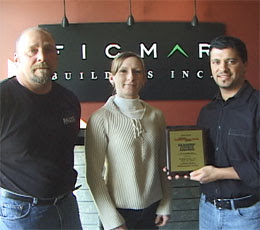
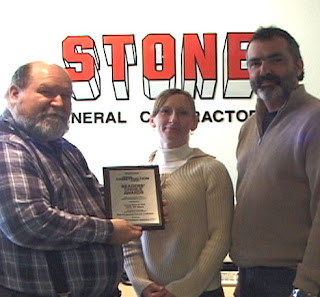
The successful adaptation of new convergence communications models is readily apparent in how two local businesses in Sault Ste. Marie received recognition as Ontario Construction Report Readers' Choice Award recipients.

Local Internet SooNews.ca site sent a videographer to the sites where Northern Ontario Construction News Publisher Leslie Greenwood presented the awards to George Stone and Sons Ltd. and Ficmar Builders. She described how she felt both awkward and excited in front of the camera.

I expect I'll reset this post later today with an embed (though you can click on the pictures for the link to the Soo News page with the video).

This is a great example of how new media converges with old, and may provide powerful clues about your marketing. Multi-dimensional and multi-media approaches are now possible on truly low budgets; whether you wish the formal "television advertisement" or the less structured video interview/communication strategy.

Service costs have dropped so low (in many cases they are free) that you can experiment with the new communications models in your spare time, without draining a cent of your marketing budget (of course you may drain a lot of your time to make this stuff work).

Friday, March 20, 2009

Newspapers, the Internet and construction marketing

The Daily Record in Dunn, NC, has the highest market "penetration rate" in the country -- more than the population of the community it serves? How is it so successful: "Names, names, names". This is one of the most effective ways for newspapers to remain relevant to readers and advertisers alike.

Newspapers, as we know it, are in trouble. The Internet's nearly-free and hyper-specialized opportunities are turning the conventional printed media's former advantages into big liabilities. The cost of gathering news, printing and distributing information cannot be recovered from advertisers, so formerly solid edifices are crumbling.

However, printed media survives and retains value in these places:
  1. Where you cannot practically access online resources (airlines, especially during take off and landing, are an example);
  2. Where the publication puts you in the news (lots of names, pictures, and local gossip);
  3. Where weekly advertising fliers are a tradition (the preprinted inserts seem to be wasteful, but they still work, possibly because readers are in the habit -- and because they can tear out or quickly organize the "specials" sold that way.)
  4. Where the printed media provides enough real value in relationship development and online resources to serve advertisers effectively (that's us!)
So, should you use the newspaper in your construction marketing?

Yes, if you follow these guidelines:
  • Check with your current/best clients and see what they read, like, follow, and respond to. Take them to lunch, or dinner, or sit with them for a coffee, and listen. You want to adapt your marketing to reach more people like them. (These conversations will provide you with an added opportunity, as well, to gather additional business and direct referrals -- and arrange for testimonial notes.)
  • Look in the local media, and in media in similar but non-competitive markets, for repeat, continuous advertising from service providers offering your product or service. In non-competitive markets, call the advertiser to pick brain. You may find another contractor has ideas worthy of borrowing.
  • Set up an effective measuring/tracking system (possibly a special phone number, web address or the like) so you can tell how your ads are actually working.
  • Call the relevant publications and negotiate the best deal you can -- remember, rate cards are not always carved in stone, and extras can be arranged, possibly some additional advertising space, colour, or free editorial/advertorial coverage.
Then, when you've done all of these things, set a budget large enough for a reliable, regular, and continuous advertising. You won't succeed with a one-shot deal; you need to have patience for the print media to be effective. This is why you must complete the first stages of the research -- otherwise you ma be tempted to quit your advertising just before it becomes truly effective.

Thursday, March 19, 2009

Selling and buying


Blogger Gary Vaynerchuk doesn't need to make cold calls to succeed -- he shows how, by demonstrating how to make a cold call in this video posting.

Most of us, most of the time, don't like to sell or be sold anything. However, most of us like to experience things, to share news (gossip?), and to be entertained. So how do you find new and profitable business, then?

These thoughts run through my mind as (a) I initially turned down but may eventually do business with someone who wanted to pay me for a link on this blog, (b) fellow blogger Seth Holdren posts a fascinating video showing how you can "monetize" your blog, and (c) I thought how Gary Vaynerchuk, giving the advice on monetizing a blog, actually is achieving the objectives of achieving his business objective without selling anything. That is, others are now posting and reviewing, and observing the blog, in an ever-expanding network.

We see these contradictions all the time in business. Most successful contractors, architects and engineers, win most of their business through repeat clients and referrals, even public RFP stuff is often wired in favour of one organization or another.

Going out and selling stuff -- actually phoning people cold, or even simply asking for business, seems unpleasant, to be avoided, and disturbing. If only we could make the clients come to us without doing that sort of thing, we think.

So we are paralyzed with inaction when the phone doesn't ring (except for someone trying to sell us something.) Or we seek to buy the answer through advertising: We pay someone else to send out our message, with the hope that potential clients will call us. We measure our success when this happens.

Our challenge then, is to find a way to market like Gary Vaynerchuk, to reach out -- to actually sell -- in a way that transcends the simple one-on-one selling experience, and gives you leverage so that you can, indeed, get people to call you who hear about you from others, who hear about you.

Solutions?

Publicity
Can you hire a publicist or do you have the knack for getting the media interested in your business. The selling here will be the 'pitch' to the relevant media outlet, or the outrageously innovative idea that you can spread virally.

Blogging (passionately)
That's me. I'm good at this stuff and the blog is reaching higher rankings because of its success.

Hiring someone else to sell for you
Yes, it would be nice to get someone else to make your cold calls, but I think you are unlikely to be successful unless you make some yourself -- you can delegate this work, but you can only do that once you really appreciate what is involved.

Initiating community service and networks (being a leader)
Look what Tim Klabunde is doing in Washington.

Wednesday, March 18, 2009

Risk taking and rewards in life, business and marketing

Among my experiences today, I rode the Roslyn Metro Escalator -- At 205 feet, 8 inches, the escalator to street level is the third longest continuous span escalator in the world, an engineering marvel.

Today, as we conducted interviews for writer/editors for Washington Construction News, I thought about the ironies and opportunities that define our lives and choices.

In Washington, we are resurrecting a business that had fallen apart -- yet in its original birth and its resurrection reveal intriguing lessons about risk, failure, choice, and revival.

(What is a Canadian doing in the U.S. capital city, publishing a local newspaper? And how, three years after closing the publication as our business almost failed, could I come back and re-start it in the midst of a major recession?)

I'm here because of accident, experience, and choices made in far away places at far away times.

What drove me to fly to Africa and live out the end of the Rhodesia/Zimbabwe war as a journalist, only to return home just as a major recession in 1980 threatened to destroy the newspaper industry (and, like the current crisis, resulted in the failure of dozens of publications across North America.)

And why, back in 1987, did I decide to exploit a loophole in U.S. immigration regulations, collecting several thousand dollars in revenue as I embarked on my first visit to Washington -- to deliver applications for the first U.S. non-preference visa lottery. (Our initiative proved to be successful in more ways than one: Several of the approximately 300 people who paid us between $25 and $100 for their chance at a Green Card, indeed received one -- I did!)

These observations may seem like brags, and they are, in a way, but my list of dumb mistakes and blunders is equally impressive. Many of my lessons have been learned through the school of hard knocks.

Nevertheless, in Africa I learned an important lesson: Risk is a relative thing -- and perceived risk is often greater than real risk. After all, who really has more job security? The person who owns a business, keeps a close eye on it, and cuts where necessary, or the person with a job who can be cut anytime (or clings to a morale and mind-sapping job just because of "security"-- giving up soul and heart in exchange for a "steady pay cheque".)

If you are afraid now for your future, if you are yearning for security and hope, remember that the biggest risk may be taking none at all. This does not mean I'm advocating throwing good money after bad and investing real cash in an untried business. You need to find a way to start without any money (or very little, if you wish.)

Then, if you have the courage to follow your dreams, you will find opportunities in places and circumstances you least expect.

I'm happy to be thinking these thoughts as I sit in the airline lounge at Reagan National Airport waiting for my flight home.

To Washington . . .

In a few minutes, I head to the airport for a busy day in Washington, DC as we co-ordinate the relaunch of Washington Construction News. I'll be meeting with new publisher Karen Buckley and prospective editors and writers.

If you are in the construction community in the Washington DC metro area and would like to receive a free subscription, you can request it with this online subscription form.

The Ontario General Contractors Association Symposium


Yesterday, I forwarded the following announcement about the Ontario General Contractors Association Sixth Annual Symposium primarily to readers and advertisers in Ontario. This is probably the most useful educational and networking event in the annual calendar if you either are or work with general contractors in Ontario.

We have received the following communication from OGCA office manager Mary Wademan:

Good afternoon all - we are reaching out to those of you who attended the symposium in 2008 to make sure we have reached every possible delegate and non-delegate before the rooms are released at Blue Mountain.

We have attached the registration form for the 2009 symposium, and ask you to complete the registration form, faxing it to 905-671-8212 as soon as possible, then call to book your room at Blue Mountain. The rooms will be released on Friday, March 20, although we have asked for an extension to Monday, March 23.

Brochures have been sent but we may have missed you. If you wish to receive a copy of the 2009 brochure, please let me know. All delegates will receive the brochure in their registration packages.

Hope to see you at Blue!
You can also view a copy of the symposium brochure here.

Tuesday, March 17, 2009

Recovery.gov

For the U.S. federal and state government updates on the infrastructure and economic recovery initiative, you can visit this site, recovery.gov.
By May 2009 Washington Construction News will implement coverage of the progress of federal stimulus initiatives on the economy.

The Construction Marketing Ideas video blog review

You can arrange a review of your own site/blog by visiting http://www.website-reviews.net/
Ouch!

Peter Ericson at The Complete Website, LLC offers free video critiques/reviews of your blog -- and I took him up on his offer. His report of the Construction Marketing Ideas blog is here.

Recovering from the pain of criticism (no one likes to be criticized, of course), I realize he makes some truly good points. I'm a writer (and publisher), not a blog designer. As well, this site is intentionally experimental, especially with advertising placements.

Ericson's offer is an intriguing example of the use of video and free consulting to promote his own services.

In the short term, I've adjusted some of the advertising spots, removing ones that are yielding low results.

I'm not sure if putting the navigation bar outlining the blog history/archives to the top of the sidebar is the best use of space. The links list can be better organized --some sort of categorization will be helpful, I think -- but that takes time and effort which will need to await a major rebuild in the future.

Ericson shows some examples of really well done blogs and this blog would probably benefit from a major redesign later.

Monday, March 16, 2009

Your $10,000 advertising budget: How should you use it?

Regional publications like Ottawa Renovates are effective because of their focused readership and distribution. You need to be thoughtful about where and how you allocate your advertising dollars.

If you have $10,000 to spend on advertising, where should you allocate your funds for your construction industry marketing? That question naturally invites the response "it depends" but you can still find clues in these observations.
  • If you've spent this money successfully in other media (for example Yellow Pages or newspaper advertising), and the ads have worked for you in the past, continue if the ads are still working. It doesn't matter what the trendy or new thing is, if you have found ads that generate worthwhile results on a cost-per-lead basis, you should not dump them until you have validated and discovered that the new and better way is truly new and better for you.
  • If you haven't advertised in the past, and relied on "word of mouth", consider strategic ideas to enhance/build and increase your referral and word-of mouth-relationships before you rush to spend money on advertising anywhere. In other words, develop campaigns and programs to reach and communicate with your current and previous clients -- perhaps holding client appreciation events/dinners, send them e-letters, and (best of all) improve your direct communication and thank you contact with your clients.
  • You can use this contact/communication, as well, to learn your clients' interests and which media they like/respect. You may wish to allocate some of your funds to advertising in these media outlets.
  • If you haven't already done it, spend at least a few hundred dollars to build an effective website. You can use a variety of inexpensive service providers. We paid just $500, for example, to build the Ottawa Renovates site.
  • If you are just starting out and don't have previous clients or a track record, proceed with exceptional caution, especially in the current environment. You can easily burn your budget with misplaced or misguided advertising expense, and you must be very careful in projecting your cost/value per lead. I assume in starting out you have some contacts/connections with previous clients (and are not subject to non-disclosure/solicitation contract obligations with your former employer), and would look at communicating and connecting with these people first.
Remember, that a $10,000 advertising purchase is a drop in the bucket in a larger market, but could be have significant impact within a small, focused community, niche or market area. Focus your advertising where it will do you the greatest good -- not where advertising salespeople urge you to go. Then you can grow your business to where a $100,000 advertising budget is reasonable, if you wish.

Sunday, March 15, 2009

Same product, different approach

In 2005, we thought of association relationships as "selling opportunities." I discovered the Society for Marketing Professional Services just as we were virtually forced to mothball our U.S. business, and sensed a different approach would work much better, choosing to engage and contribute to the association even though there were no local chapters where we operated and so we could expect absolutely no business in return. Come 2009 and there is a chapter in Ontario and we enjoy good relationships with the chapters in Washington, D.C. and in Raleigh/Durham and Charlotte, North Carolina, where we have active businesses. The above image is from a SMPS D.C. Chapter meeting.

The product/service our business provides in 2009 isn't much different from 2005. Our business is growing (in a serious recession), while in the middle part of the decade, the business was declining, almost to the point of collapse.

What changed?

The answer may provide you with clues about how you can defy the recessionary environment.

We learned how to respect clients and the community-at-large and focus on relationships rather than transactions.

In 2009 we want our sales representatives to be "order-takers". In 2005 we wanted them to be "closers". Order-takers get business because people want to do business with us; closers need to force "sales techniques" on prospective clients.

How can this be? The key to the change is my initially painful discovery that we needed to look far beyond the actual selling process and focus much more on how we relate to our clients both before, during and after the transaction.

We know that we are succeeding when the purchase decision is made effortlessly, without any "sign now" pressure, and when our biggest problem is dealing with competitors who use high pressure or abusive tactics, sometimes souring the market and causing people to say "no" to us because of bad experiences elsewhere.

In many cases, after the potential clients compare us to our competitors, they call back and give us the go-ahead. They've checked with their peers and discovered that we do things differently. (A painful corollary, unfortunately, is that some of our satisfied clients receive calls from our competitors and sign on with them, expecting a similar experience to what they enjoyed with us, only to find not everyone conducts business the same way.)

Now, you might be looking for the magic formula, one-size-fits-all answer here to how this turn-around really works. Here are some points:
  • Since 2005 we've given countless hours in community service and free advertising to associations and causes, never with any expectation of financial return. Of course, the associations and causes represent the interests of our potential clients. So the generosity is well-placed and rational.
  • We've learned to be selective, patient, and rigorous in our hiring policies. Representatives with us need to be able to work within the team, but have the spirit and ability to work independently. Our hiring process is systematized, yet flexible and adaptable.
  • The entire client experience is far more important than the ability to get business short-term. Clients receive thank-you notes, personally. And everyone who does business with us has access to the best marketing advice we can offer -- and that advice is rarely to spend more money with us (this blog is part of that process.)
Can you change your business to achieve success with this business model? Yes, if you understand these basics:
  • You really need to know your product/service and be able to deliver it effectively and at a price where you can earn a fair profit Lowering your prices to win business competitively is rarely the best way to go.
  • You must know the basics of effective business management and operations. You need to know your numbers.
  • Finally, you must appreciate your market and marketing. Read, learn and ask questions. Think for yourself. Remember that your success in marketing depends 80 per cent on the quality of your relationships, both within your business and within your marketplace.

Saturday, March 14, 2009

Video in construction marketing: A video


Here is my latest construction marketing video. The topic: Using video for construction marketing.

My videographing learning curve continues to accelerate as I discover how to manage the video editing processes and systems. The notable thing here is the time it took from conception to completion is less than 30 minutes. You can see how, with practice, your skills and quality improve, and time required to make the videos declines.

You can also consider the professional option, as outlined in the earlier posting about yourwebads.com. I advocate you use a hybrid approach -- learn how to do simple videos yourself (or have an employee with a knack for this sort of thing do it for you) and contract with one of the inexpensive professional services. You would use the professional videos in your formal advertising and perhaps to book-end some more personal and individualized videos you can use on your blog or individual client presentations.

Video these days is extremely inexpensive and you will likely be the first contractor in your area to use these tools, so you have a natural marketing edge.

Friday, March 13, 2009

Can you emulate this Washington DC initiative in your own community?

This image is from the home page of the Washington D.C. Design and Construction Network's new website at http://www.dcdcn.com. Could you co-ordiante a similar network in your own community?

“Successful networking is all about relationships, not “links.” The goal of the Washington DC Design and Construction Network is to develop mutually beneficial relationships both online and in person.” (from the Washington D.C. Design and Construction Network website)

The Washington D.C. Design and Construction Network is an intriguing and exciting example of how online and offline resources can be combined to create a vibrant regional networking community. Yesterday, in launching the network's own website, Tim Klabunde, publisher of the CofeBuz blog and Director of Marketing at W.H. Gordon Associates Inc., an engineering practice in Chantilly, VA, wrote:

It has been an exciting past two weeks for the Washington DC Design and Construction Network as our membership has grown to over 550 members! With all that is going on, let me get straight to the three things you need to know:

1) FREE Procurement searches, MBE Directory, Construction News, and Networking Information - The Washington DC Design and Construction Network website is now up! Take a moment to stop by at www.dcdcn.com and you will find a wealth of information including: links to all of the regions procurement websites (aka: get work), today’s Washington Business Journal (updated every 5 minutes), and of course the official MBE Directory of the Network!

Please take a moment to thank Melissa Allen of WFT Engineering, Vicki White of ECS, and Carolyn Evans of Global Engineering solutions for all their work helping bring this together!

2) JOBS - LinkedIn was kind enough to add an additional Tab to our LinkedIn page called "Jobs.” If you are looking to hire someone or would like to post your resume, please stop by! I have already been told that several interviews have been set up as a direct result of our group, so go check it out!

3) HAPPY HOUR – The details of our next Happy Hour are almost finalized! During our last Happy Hour I promised many of you a larger venue, and I am excited to announce that we have arranged to shut down an entire restaurant and use it for our Happy Hour! Yes, you read that right, one lucky restaurant in Arlington will be closed down to the general public and open to the members of the Washington DC Design and Construction Network for our happy hour! So, if you know someone that might want to come that isn’t in the network, be certain to send them this link (http://www.linkedin.com/groupInvitation?gid=926787) and tell them to click “Join Group.” As all of you already know, it is completely free and all that is required is a LinkedIn account.

The network's new website is impressive, with an incredible collection of links and resources for anyone to use without requiring any sort of paid subscription -- and participation within the network is also free.

Notably, the network developed and found its potential in an incredibly short time; just a few months. Online resources such as linkedin.com combined with offline groups and associations can combine effectively to accelerate the process.

The network here succeeds because the leadership and membership appreciate the most important underlying principal of successful networking: You always put yourself second and focus on the interests and needs of your colleagues and others joining the network. While your own marketing and self-interest rewards are indirect, they happen, as your community grows and people want to do business with you.

Could you take the lead and co-ordinate a similar network in your own community?

Yesterday, Sebastien Lessard of Newhomeassociation.ca, a website/portal to facilitate marketing for new home builders and renovators in Ottawa,sent me this email:

Moving forward, we feel that print advertising will continue to play an important role in any marketing strategy but that media groups will have to position it as a complementary solution to on-line advertising services. Until that day arrives, we hope NHA can provide our print partners with additional visibility by featuring their publications to our users, as they can leverage our targeted audience in their sales pitch to sell their print product.
. . .I want to personally thank you for the great blog that you write. You've inspired me to continually reflect on the strategy and direction our business should and could take by sharing your experience and insight on successful business philosophies. What I've retained most of your writing is "make sure your services represent the solutions your clients need". I always thought our service was doing exactly that but my message or presentation was not clear. I've racked my brain for a long time to figure out how I could convey this message and it finally hit me after seeing one of your post on the use of videos for communication strategies.

I'm happy to say that because of this post, NHA is introducing a service to builders we'll call "Virtual Guided Tours". I realized that I enjoyed having the opportunity of seeing and hearing videos instead of reading, and that I probably wasn't the only one who felt this way. So, NHA.ca will be presenting to their users "virtual guided tours" of models homes from all our builder members. THese videos will feature the sales representatives guiding the viewer through a tour of model homes. NHA staff will shoot these videos at no cost to the builders and present them on www.nha.ca and in its "FACEBOOK" group. Builders can also export these videos from our site directly to their own website. THe big kicker is that viewers will also have the ability of "chatting" with that sales representative while viewing the video on nha.ca. We'll literally be bringing the model homes to the home buyers. Because traffic on our site in rapidly increasing while traffic in sales centers is decreasing, NHA offers the "solution" to remedy this problem for builders.

Your posts inspired this solution and that's why I thank you again!
Sebastien has harnessed the power of business alliances and multi-media marketing to build his effective website and service. His observations of how you can introduce video into your marketing picture are worthy of review. Anyone can do simple video productions these days, and if you wish to go to more professional standards, you can use services such as yourwebads.com highlighted in a previous posting.

Karen Buckley new publisher of Washington Construction News

Karen Buckley holds Ford Harding's Rainmaking book at the SMPS-DC gathering in February.

Karen Buckley is the new publisher of Washington Construction News.

She combines years of experience in technology and print media – most recently co-ordinating the advertising sales for a community newspaper in Northern Virginia.

She will work with construction community groups and associations to provide membership building publicity and work with individual companies and organizations to achieve positive recognition for their businesses in the metropolitan D.C. area.

Washington Construction News will resume monthly publication in May 2009. Qualified readers in the architectural, engineering and construction industries in D.C. and the neighbouring Maryland and Northern Virginia suburbs can request a free subscription at http://www.washingtonconstructionnews.com.

Karen can be reached by email at kbuckley@cnrgp.com or by phone at 888-432-3555 ext 225.

Construction television ads in the Internet era


An example of a video ad produced by yourwebads.com for a fee of less than $500 plus less than $20 a month to maintain.

New technologies and services are emerging to allow contractors to produce professional-quality videos at a fraction of traditional prices. Right now, I know of two routes to inexpensive video advertising, a new service from Google, Google TvAds and, perhaps more impressively and of more immediate value to contractors, yourwebads.com, which will allow you to post professional video ads on the web for a modest set up fee with running monthly costs of less than $20.00.

Jeff Uecker, vice president of Burbank, CA based Big Time Productions and vice president of sales and development for yourwebads.com, provided the following news release:


Affordable Web Commercials - General Contractors

Big Time Productions is proud to announce the launch of YourWebAds.com, the next BIG thing for small business.


YourWebAds.com

FOR IMMEDIATE RELEASE

PRLog (Press Release)Mar 10, 2009 – Big Time Productions is proud to announce the launch of YourWebAds.com, the next BIG thing for small business.

http://www.yourwebads.com

YOURWEBADS.COM IS A TURN-KEY MARKETING SOLUTION FOR TODAY’S SMALL BUSINESS PROFESSIONALS.

Challenging economic times require that you get the best VALUE and RESULTS from every advertising dollar!

The NEXT big thing for small business is web commercials. And here at YourWebAds.com, we’ve created an economical mutli-media marketing option that can help grow your business no matter what the financial climate may be.

We create high-end custom web commercials for a fraction of the normal costs. Our multi-media marketing plan includes a custom commercial, search engine listing and a website with your own domain name to house that commercial!

For only $499.00 and a low maintenance charge of $19.99 a month, you will be able to further legitimize your business and services and best your competition by establishing an online presence with your very own professional commercial and website.

Use coupon code CM12 for $100 off your transaction!

Visit the contractor's section of the site today!

http://www.yourwebads.com/c-3-contractor-services.aspx

I asked Jeff why his company had decided to focus on the construction industry, not known for leading-edge marketing strategies. He said one of the company's partners is involved in construction, and knows the challenges of marketing in the current economy. Jeff says the concept is so new that he must rely on early reports for assessment of the service's success, but he has heard reports of early users receiving calls and winning jobs because of the video ads.

He says the difference between his service and Google's offer -- which includes a free do-it-yourself module -- is that Google is focused on developing and placing ads on cable television systems, while yourwebads.com
provides you with ads you can use on our own websites, embed in emails, and other direct marketing initiatives. They'll provide a site for you if you don't have one. This gives you control of your advertising and means you do not need to rely on potentially expensive third-party media for your video ad to be publicized. Of course, you can still elect to receive publicity that way.

Yourwebads.com will provide a $100 discount if you reference coupon code CM12.

Is this video publicity worthwhile? While I wouldn't stake my marketing reputation (and life) on this technology, the risk-reward ratio justifies the expense for most contractors with existing websites set on a static framework.

Here is another example of a video ad produced by yourwebads.com.

Thursday, March 12, 2009

Construction marketing: Another perspective about Free Estimates

Leonard Megliola at Bestline Plumbing in Los Angeles shares his operating manual for anyone who wishes to receive it. He advocates that you take all Free Estimate calls seriously -- you never know until you visit whether the tiny, "cheap" job can turn into a $30,000 project. His arguments are convincing.

Readers here know that I am not in love with the "Free Estimates" mantra, especially for large or complex projects. After all some (perhaps too many) prospective clients abuse the Free Estimates gambit to play one contractor off against another, and the phrase, in practice, has lost much of its marketing effectiveness. If everyone is doing it, where is your competitive advantage?

However, Leonard Megliola at Bestline Plumbing Inc. in Glendale (Los Angeles), California, has an entirely different attitude. In his (yes, free) 101-page working manual, he says the issue is how you respond to the caller seeking the Free Estimate. If you start out with the right attitude, without prejudging anyone, you will be surprised how seemingly wasteful calls indeed become goldmines.

He writes:
Give free estimates for more sales and profit. While we would like to get paid for every estimate, we earn more profit by giving free estimates. The amount we earn, by charging for an estimate, is insignificant, compared to money we lose, by not giving free estimates. You cannot be competitive when almost every service business gives free estimates, including kitchen cabinet installers, window installers, roofers, general contractors, painters, etc.
Megliola offers a calculation about the amount of business you lose when you decline free estimates; suggesting you might lose 40 per cent of your leads. He advocates your conversion rate for an average $6,000 sale remains 70 per cent, meaning a difference (for 100 leads, of gross revenue annually of $168,000.

"I made $168,000 more than you by giving free estimates," he writes. "If that is not a lot of money, then multiply that times 30 years = $5 million."

Tied with this assertion, Megliola observes that you cannot judge a lead over the phone:
People with money put on an act to make you think they are frugal, tight (cheap) and people with money put on an act like they are big spenders. A customer calls you and says he is getting 10 estimates. This could be just an act so you lower your price.

A customer tells you he does not to pay for an estimate and he does not know as much as you about why he should pay you for the estimate. Perhaps, the customer is willing to give you an estimate if you convince him during the initial phone call, but you failed, so you it may be your own fault you lost a good customer, or a $50,000 sale. Maybe you can't do a good job selling him that he should pay for the estimate or diagnosis. Maybe, this guy who does not understand about paying for a diagnosis owns a thousand homes and is a huge spender and you just lost a few hundred thousand dollars because your judgment system was out-of-whack.

Maybe some customers have a low priority for paying for a diagnosis because he does not know the value of what is wrong. Your customer thinks he needs a five-cent washer and he questions why he should pay you $95 to tell him this. Some other plumber, who gives free estimates sells your customer a job for $50,000. Was this customer a tire kicker? You don't know and you will never know until after you give the estimate. Are you really willing to gamble the loss of $50,000 because someone would not pay you$95?

If my boss gives me a call tomorrow and the customer refuses to pay for a diagnosis, I am going to the job to try to sell $5,000, $10,000, or $50,000 anyway. I would think of myself as a fool if I sat in a coffee shop while some other plumber gets the job and smiles as he waves at me through the coffee shop window. For you, the business owner, $10,000 can buy a very nice used truck, pay a few months rent in advance, buy a new jet ski, a motorcycle, or something nice for the wife.

I have relatives who do a lot of gambling. I am always amazed at how they will lose $20,000 in one trip to a casino. Then, my parents would and scream at each other because my mother wanted to buy a $5,000 couch set. Put this in reverse for business. A business owner will utilize most of his time scratching his butt to figure out how to pay his debts when he should be utilizing this time to make so much money he could pay his debts and have so much money left over he would not know what to do with it. My point; Some contractors think the lost of $95 is more important than the loss of $50,000.

You give me a thousand reasons why you should charge for an estimate and I will give you a thousand reasons why you should not charge for an estimate. Who made more money in the previous calculations?
Megliola makes a pretty convincing argument here, I admit. His free manual is a worthy document, especially if you are a mechanical contractor. Forward the link to your administrative assistant, download it and print a copy for your own use. (He has copyrighted it, but has given me permission to share the link.)

Tuesday, March 10, 2009

Reciprocity in construction marketing

One of the basic marketing principals is the reciprocity concept. If you give something to someone, there is a natural human tendency to return the favour. In fact, the right form of generosity results in a return far greater than the original investment.

Matt Handal outlines the way reciprocity works in his excellent posting in Help Everybody Every Day. This blog, of course, also is succeeding in part because of the reciprocity principal. I share marketing insights, ideas and concepts freely here (and increasingly valuable back-links to other blogs) and have started to reap the rewards.

Reciprocity works really well in any situation where you can combine your solid work ethic, quality, and trust, and so the value of the concept is magnified when you are communicating with previous/current clients and relevant associations and community groups.

Clients are tuned in -- expect -- add-on selling and marketing efforts. If you turn the table and give stuff away free (handyman services, a free dinner, gift coupons, or the like) you win allies for life (and much repeat and referral business).

The same principal applies with community groups and organizations. If you are seen as a leader, a helper, and a voluntary contributor within your community, your reputation rises, as does your networking effectiveness. When your work catches the attention of the group's leaders, then your relationship and reciprocity effects are multiplied.

As Handal notes in his posting, the give and take do not necessarily have to be in economic proportion -- you can spend a few minutes/hours of time and virtually no money and reap thousands of dollars in business, if you think things through and create the right marketing message.

To successfully apply the principal, consider these guidelines:

Your generosity must be sincere, respectful, and non-conditional

If you give without worrying about return and give sincerely, you will achieve the best results. Of course you don't need to go overboard; there are freeloaders out there and you sometimes need to draw the line.

You need to focus your generosity within communities/markets you wish to serve.

Top priority, always, should be your existing and previous clients. You can share time rather than money, but free add-on services, sports game tickets, meals and the like work wonders. Use some of your marketing budget for a planned giving program to your existing and previous clients and your marketing return on investment will exceed any new-client advertising.

For maximum power, consider structuring your reciprocity so that you don't want or need to take any return from the people you share with: Just keep giving.

This results in turbo-charged reciprocity. For example, you share your observations and services with someone who is a leader in the community, and he/she says: "Can I do something for you in return". When you respond: "Just being of service is all I need now" you enhance the implicit obligation and can, in the right circumstances, the other person will almost beg you for the opportunity to return the favour. In other words, while reciprocity can work immediately, it can be even more effective if you think long term and truly are patient with your expectations and results.

"Free Estimates" and Sonny Lykos's The Process

Before his untimely death last year, Sonny Lykos sent his answer to the problem of unreasonable free estimate requests. His The Process is a system to explain that while the contractor is quite ready to provide a ballpark guide to costs, detailed estimates take time and effort -- and require a proper design fee.

Of course, once the prospective client commits to the design fee, you have a high chance of completing the work; if not, at least you are paid for your efforts and work in preparing the proposal.

Unfortunately, I lost my copy of his documentation when my hard drive crashed a few months ago -- and the other copy, lodged on our ISPs server -- disappeared when we switched to our new website system.

Thankfully, all is not lost -- in the archives of the Journal of Light Construction, I discovered this fascinating and useful article, Charging for Estimates, and within that article is a reference to The Process, which JLC stored on their own server.

Obviously JLC owns the copyright to the full article, so you will want to follow the link to it and read it directly from them.

The copyright to The Process document itself is owned by Lykos' estate, and since Sonny gave me explicit permission to publish and redistribute it, I am reprinting it here. Read it carefully, and consider whether you can make use of it overcoming the "Free Estimates" challenge in more expensive renovation and remodeling projects. (I've tagged links within The Process document so you can head to the relevant websites directly -- including The Lykos Group's own site in Naples, Florida (Principal Thomas Lykos is Sonny's son.)

(Letterhead)

Date: _______

Dear ____________________:

Thank you for the opportunity to work with you on your pending renovation project. The Lykos Group, Inc., is a second-generation company that was founded in Chicago in 1971 and continued to operate in Michigan from 1972 until 1991, when we made our final move to Naples. Over 66 years of experience is at your disposal.

We are members of the Collier Building Industry Association (CBIA), The Remodelors Council (RC), Florida Home Builders Assoc. (FHBA), The National Association of Home Builders (NAHB), Construction Specifications Institute (SPI), and The Association of Construction Inspectors (ACI).

We have not advertised since June 1991, acquiring 100% of our sales from additional projects of existing clients and new clients from referrals. We feel that this is the best testament to the caliber and value of the services we offer. Our philosophy is that we are a "service provider" first, and only second one that operates in the residential renovation segment of the construction industry.

During those 30 years in our industry, we've learned the dos and don'ts of what is mandated to assure happy clients. There is an accepted "process" employed in all renovation projects that has steps and guidelines to follow and should not be deviated from to avoid chaos.

Enclosed is a synopsis of "the process" — the world of residential renovation. We hope its contents will enlighten you about the way remodeling should be done to make it a pleasant, yet educational experience. You will find us referring to "the process" from time to time as we further discuss your project.

We will call you a day before to verify our appointment.

Respectfully,

Thomas X. Lykos, President

So, just what is a remodeler?
Remodelers take your dreams and aspirations and transfer them into reality. We change an intangible concept into a substantive result.

Please understand that we do this without the luxury and benefits of prototypes or the ideal environment of a factory. We must bring our manpower, equipment, and extremely diversified materials to your home. In addition, we depend on as many as a dozen or more different subcontractors, plus many material suppliers.

Acting as the facilitator of the entire process is an enormous and complex task.

Furthermore, as you see the project taking shape, you will initiate changes to bring it more in line with what you want. Changes are to be expected and are controlled with change orders. Each of us, including you as the client, act as part of a production team and share the responsibility for making timely decisions to ensure that the project stays on schedule.

We cannot emphasize enough the importance of working together with all parties to make sure your desires are realized. Frequent communication, by telephone, e-mail, documentation and in person are the heart of this project.

The following pages will describe "the process" in more detail. By following these accepted industry practices, we can eliminate disappointments and make this a pleasant and educational experience for you.

The Process

O.K. Where do we go from here?
First Meeting

This is a mutual interview — we want to make sure that we're right for you and that your project is right for us. We're both looking for a comfortable fit. We will consider the following, discussed in greater detail below:
1. Your ideas and desires.
2. The project budget.
3. Possible designs.
4. Basic materials.
5. Potential scheduling.
6. The SCA fee.

Second Meeting
1. We obtain a fee for the SCA.
2. We take exact measurements of the area(s) to be renovated — this may include the entire home — and we transfer these into a new CAD-generated floor plan. We create one set of existing and plans and another including the changes. These take anywhere from a few hours to well over a day.
3. Allow several hours for this meeting since I'll be chauffeuring you to several showrooms for product selections.

Third Meeting
1. We firm up the final design, material selections, color selections, and the remaining details.
2. Possibly invite specialty subcontractors (SCs) to view the site for their comments.
3. Discuss and change any other minor items.

Final Meeting
1. Prior to this meeting we create the contract and modify the plans and specifications.
2. Go over the final plans, materials, colors, etc., in detail.
3. Set a schedule — with start and completion dates.
4. Sign and initiate the contract. We receive a "commencement" payment.

So what is an SCA?
A Specification & Cost Analysis is a definitive comprehensive document stating the final costs, allowances, material selections with brand names, and all particulars of the project as agreed upon. All SCAs include a complete set of CAD drawings and plans.

Preparation for an SCA includes evaluation of existing construction and current building codes. If a room addition is involved, site planning is needed as well.

An SCA can be compared to a "brief" in the legal profession, which is defined as "a document containing all facts and points of law pertinent to a specific case." Preparing this document takes a tremendous amount of a professional's time.

Creating an SCA takes anywhere from several hours to several days, when taking into consideration designs, meetings with specialty contractors (SCs) and material suppliers, and estimating, plus the time mandated by permitting requirements.

The "estimating" process of an SCA involves many hours of line-item costing for every single operation of each phase to reach the final cost. It is also based on each SC's fixed bids as well as fixed bids from the suppliers.

Depending on the project and its particulars, the fee for an SCA can be $250 or more for a major bathroom remodel, $500 or more for a complete kitchen remodel, to over $1,000 for a major project or one costing well into six figures. As the cost and square footage of a project increase, so does the time needed to create an accurate SCA, and accuracy is critical.

The SCA eliminates nearly all surprises and ambiguity, ensures an agreed upon contract that is realistic and viable, and discusses everything — on paper.

Upon acceptance of the SCA, we credit you for that fee toward the initial "commencement" payment.

What do you have in mind?
First, give us an overview of what you want to accomplish and why. In doing that, you'll also let us know what you don't like about the existing space(s). We will talk a little about your lifestyle and how we can make your home better. We'll generally discuss what materials or products you'd like to use to change colors and designs and improve spaces.

Tell us your "ideal" scenario — your desired finished look.

After ascertaining the general "scope" of what you would like to do — as mentioned earlier — we'll make a CAD-generated set of plans of your
existing home and a set of revised plans showing the proposed renovation.

Let's also consider options. Later we can change them or eliminate those deemed not viable. This is an exploratory time.

Let's talk about your budget.
Budgets are the foundation from which we proceed; and, therefore, nothing can continue until a budget is established. We provide a "ballpark" price at no charge, but since there is a fee for the SCA and design work, this is another reason to discuss a budget — to save time.

By talking about budgets up front, we ensure that the project scope is within the realm of your desired budget. Time is saved for both of us. When you look at a new car or home, the price category of what you're looking at lets the salesperson know your financial commitment. We don't have that information unless we talk about it first.

As any remodeling project materializes and walls are being built, electrical is being run, etc., there are always things the owners want to change, which is important to make sure you get exactly what you want. Also, when the time arrives for an inspection by the permitting department, the inspector may mandate one or more minor changes; each inspector has his own "druthers." Consequently, plan your budget to include at least 10% more for changes. It's all part of the process.

Designing — the fun part.
This part is trial and error. Like trying on new dresses or suits — longs and shorts, heights and their relationships
to other things, form and function. Think in terms of traffic
patterns, sound transmission, lighting effects (natural and artificial). Visually walk through each area that's affected. Don't forget ventilation.

Look for at least one area, if not the entire project, to offer a dramatic effect, while still being usable.

Actually, the designing part should be fun for you. For us it means back to the computer and the CAD program, but it's worth it. We like to see the smiling faces of our clients.

Materials & Products: Boy! There's so much to choose from.
We know — but we'll help you along the way. Again, keep in mind colors, textures, maintenance, individual design, coordination, and ease of use. Just like selecting a contractor — does it feel like a good fit? Touch it. Try it. Not the contractor — the products. Think in terms of drama, or a little "pizzazz."

Let's coordinate the colors and textures. What trim and accessories work best? A little at a time — it will all come together.

Try to visualize the finished area(s).

The role of subcontractors
Subcontractors are those contractors who provide their own specialty services to your project. In addition to those folks, we must also consider the various material suppliers involved. They are all part of the "production team."

Collier County issues the largest number of building permits in the entire U.S.A. Yep, not just Florida, but the entire country. To that fact, add two more: Kids are no longer entering the trades, and the average age of the person getting out of the trades is at the lowest ever — 33 years old. Consequently, the construction industry has had a skilled labor shortage for several years, and it's getting worse.

So add to the above the local booming economy and you can understand why all contractors are literally swamped with business. That means we must allow for what we call "lead" times, just how long it will be before a subcontractor can start on your particular project. The delay of one subcontractor can mean several more delays down the line, like a domino effect.

In addition, special-order materials may take as little as one week, or, in the case of cabinets, for example, up to16 weeks. Special countertop materials like Corian and granite may take up to several weeks to obtain, not including their installation timeframes.

Patience in this "category" is recommended. Again, it's all part of the process of remodeling.

O.K. On to the "almost" finale: Bringing it all together.
The scheduling is decided here, not by a pending special occasion or when "we" want it done, but by the process. You see, this process too is subject to Murphy's Law.

Once everything has finally been decided upon, we contact each subcontractor and check their lead time and their deposit and payout requirements. We also check with the material suppliers and their lead time for any special orders.

Next, we create the contract. The contract contains several sections, and its financial arrangement is based on the requirements of the subs and vendors as well as our own requirements.

Adhering to the payout dates is crucial to maintain our relationships with your subcontractors.

When payouts are delayed, subs may start another job. Then we must wait for them to return — on their terms. In other words, when payouts are delayed, a major interruption occurs in the process. It's not unusual for work to come to a halt.

The contract also includes all material selections, model numbers, colors, etc., and the agreed upon schedule — see the next section.

Finally, the schedule: When will it be finished?
Because of the critical labor shortage and Collier County's tremendous construction activity, and for several additional reasons, we allow plenty of
time for each project, considering the following:

1. Emergencies. A sub might be detained on another job due to the bane of all contractors — change orders. You will initiate some of them as well, as we mentioned earlier. It's just one more part of the process.

2. Miscommunications from one employee to another. Remember, we're not building washing machines here in a factory, where hundreds are made daily on the assembly line. We're building a single, customized "prototype" that's never been made before.

3. Delivery of a defective product.

4. Waiting for building permit inspections — as many as a dozen.

5. Mistakes — they happen — both yours and ours.

6. Weather, if exterior construction is involved during our rainy season.

7. Change orders. As the project takes shape, you may decide to make a change, or you may say, "While you're here, can you also…?" Contractors call them, appropriately, the "While you're heres." Hidden problems or a building inspector's demands may also require a change order. No change order work is initiated until you have approved and signed off on it.

Prior to starting your project, we create the schedule and give a copy to everyone involved including you.

Glitches & changes
As we mentioned earlier, they happen. That's why a project that would normally take 6 weeks is scheduled for 8 weeks. We don't want to promise or deceive you, and we feel that being above board is critical to what is really our limited "partnership."

Communication is imperative. This can be a fun venture, but only if we are all realistic about the entire process, its highs and lows, understanding the entire process in advance.

Again, please keep in mind that changes and delays are not unusual but typical when building a prototype, which every remodeling project is, and especially when involving so many companies and people other than our own staff.

One of our #1 problems involves clients who do not make timely decisions about product selections. Planning is crucial and cannot be dismissed in a cavalier manner.

Well, we hope that we have explained the process to your satisfaction. Please be neither apprehensive nor anxious about it. We will guide you step by step through the entire journey.

The purpose of this "synopsis" is to provide you with the basics of standard practices in the remodeling industry, as well as our own preferences, to ensure a smooth flow of the work to be done.

As kids we were taught to be nice, fair, honest. Some things shouldn't change as we become adults. In fact, a key word in The Lykos Group, Inc.'s culture is "ethics" — an old-fashioned value we guard carefully.

Upon completion, the thing we want to hear from you is: "I'm thrilled with everything. It's been swell, and here's your final check. We'll see you
In a couple of months for the first warranty inspection."

From all of us at The Lykos Group, Inc. — where "ethics" is defined!
P.S. Here aresome earlier postings in this blog where I reference The Process. You can review these postings for additional insights and comments into its practical use. (Some of the links within these postings may not work because they are quite old.)

The Process
The Process (2)
The Process for Smaller Projects

Monday, March 09, 2009

Twitter, Facebook, Linkedin, Craigslist, Google Local, and more . . . you need them all

Yes, I know it seems strange, but if you are serious about construction marketing, you should now have a Twitter account and be exploring the microblogging space.

And you should be learning art of blogging (full scale) and video, and have Facebook and Linkedin accounts.

And understand Craigslist, and Google Local, and search engine optimization, and more.
You also need a presentable, effective and prospect-friendly website.

Is any of this stuff going to bring you business the way of the old fashioned Yellow Pages, conventional direct mail, newspaper classifieds or the like? Probably not, at least initially.

But these resources will cost you little if any money, and will (if you do things right) allow you to find number one space within your niche, as you are likely to be the first or one of the very first construction industry people to use them. And once you are in first place, it is hard to be dislodged.

Oh yeah, this stuff also can powerfully and quickly extend your word of mouth referral and networking opportunities. Goes without saying that you should only use these resources if you do really great work which generates positive word-of-mouth publicity on its own.

Stay away from the Internet if your actual work is crappy or you are running anything that could be seen as borderline. It won't take too long for you to be exposed in ways you don't want to be seen, if you do.

Sunday, March 08, 2009

Free or not so free?

When should your generosity end in construction marketing, and business begin? You hardly will have a viable business if you give all your intelligence, services, and estimates away for free, right.

Then you turn your head and say: "What about this blog and my offer for free insights into construction marketing, and which specialty trade contractor do you know does not actually offer free estimates?"

I wish I could offer you a black and white and simple answer to the contradictions here. Instead, I'll suggest guidelines based on my experience and observations.

Free is good if it leads to further relationships; it is bad if it is a gift to your competitor.

You know the story of the contractor fighting the competitor who says: "Send the competing estimate once it is completed and I will undercut the price." How can you be sure the person who calls you isn't going to turn your estimate into a price-shopping tool?

The best solution here appears to be to use the ballpark estimate approach on initial contact: Then you can size up the potential client: If the estimate requires much time and effort, expect a design fee (see The Process by the late Sonny Lykos). Of course you can elect to waive this fee if you believe the client is sufficiently respectful of your time and cost and is serious about doing business with you.

Alternatively, if the cost of providing a final estimate is relatively low, go ahead, but build enough value-added (free stuff) within the estimate. You might go all the way of the roofing contractor who provides video documentation with the estimate; or make sure you see the prospective client in person to build rapport before measuring, inspecting and estimating.

Consider whether you are one of few, or one of many?

Obviously if you know you are going to win the job because your relationships are strong (and you have received explicit or implicit guarantees), you need not fear pulling your stops out in developing a full-scale proposal or estimate. But you don't want to waste your energies on "free" proposals from public competitions where you are one of many, unless you have a real edge. In any case, this consideration also applies to your marketing thinking: If you can offer something free that is unique (but doesn't cost you very much) you have a real marketing edge; but if "everyone" is offering the same free service, ("free estimates") where is your edge? Without differentiation, you are just playing a mass game without much imagination. Consider something different.

"Free" makes sense within your community contribution program, and with your previous and current clients.

On Friday, I offered thousands of dollars of free advertising to the local community college, which is seeking industry support to complete construction of a multi-million dollar trades training centre. The chair of the fund-raising committee happens to be the chair of the local mixed construction association, who made a personal contribution of $100,000 for the project.

Clearly this generosity makes business sense: It helps build relationships, provides a useful community contribution, and doesn't cost us much in hard cash but has great value to the receiving organization. Consider your generosity within these frameworks: If you can offer goods or service in kind which enhance your brand and support your community, why not?

"Free" is good if it leverages existing resources without draining your cash.

We donate advertising, you may donate in-kind services; but unless you have the resources and reserves, (you might) be careful with your cash. Equally, of course, consider your time cost. It is one thing to produce a quick ballpark estimate; but quite another to produce a detailed proposal with comprehensive plans and objectives which can be shopped to your competitors. The more time and cash the "free" requires, the more you should be sure that you really want to go that way (but alas, I don't have an easy or simple cut-off point here because the right answer is "it depends.")

"Free" can be an effective part of your marketing strategy if you know where and how to convert free to paid services.

We, for example, offer free editorial profiles to qualifying businesses and organizations in exchange for the right to invite their suppliers to advertise support for the project. Naturally, we have set up some qualifying guidelines and rules -- this offer would bankrupt us if we provided it freely to every small business. In our proposals we make clear that we need to earn at least enough revenue to justify continuing the project (though no who qualifies has to pay us for trying), so we can drop wasteful efforts quickly.

"Free" is the best way to thank people who have given you business and support.

Again, in our own business, once you actually give us some money, you will not be pushed to spend more money -- instead, we'll go out of our way to give you added (unexpected) value, ranging from thank you notes, to free consulting advice, to gifts and rebates.

Yesterday, my wife asked me: "When are you going to start charging for your consulting services." I told her: "In time -- right now, the focus is on providing support and value to existing clients, and building our business reputation and brand." So the construction marketing advice here is free, and if you are a current or previous client, you'll receive even more support.

And if you are a general reader of this blog, and wish some free construction marketing advice, feel free to email me at buckshon@cnrgp.com. Will I draw the line and expect you to pay, ever? Sure: If your request is for your individual gain, requires a significant amount of time and effort, and is unlikely to relate to larger business objectives. Then I'll provide you a free estimate of the cost.

Saturday, March 07, 2009

The Construction Marketing Paradox: Easy work or hard effort?

One of the most important paradoxes in sales and marketing is that you are most likely to succeed if you need to put the least amount of effort into the process.

In other words, if your marketing or selling are hard to do and require much thought, time, and physical and mental energy, you will more likely fail than if you can achieve your results almost without trying.

Yet, almost inevitably, unless you are very intelligent about it, when you give up (fail to persevere) because things are too hard, you fail.

I've seen this paradox countless times over the past few years. Here are some examples:

The great feature or the crappy one

Most of our revenue arises from special printed advertising features profiling businesses and organizations. Suppliers are invited to support their client with advertising. The great features almost seem to sell themselves -- we send the notification to potential advertisers, and they call, email, or fax in their order right away.

My sales reps are jubilant, of course. I tell them: Put some extra effort into that feature for anyone who doesn't respond. It will seem like a lot of work, but you'll sell more.

Conversely, some features just don't work. The company isn't well respected by its suppliers, and they are simply not interested. Sometimes out of many calls and much effort we can coax a few sales. But the whole thing is more a waste of time than anything else.

The fast yes or the slow 'no'

Similarly, in setting up the features, some companies who qualify for the service say "yes" quickly (Others who don't qualify also often want the service -- we need to know when to turn these potential clients away to avoid the bad results in the first example above). Others who qualify hem and haw, finding one excuse after another. Sometimes these difficult potential clients are worth pursuing, but I often see the extra effort produces diminishing results.

Who is more responsive?: The inbound referral or repeat business call or the outbound sales call or blind RFP submission.

You know the answer to this one already. When someone calls you (sometimes out of the blue) and asks for your services because they have done business with you before, or been referred, your chances of success -- at your price -- are high; when you have to seek out the business, they are low. This is why things are often frustrating to established businesses with backlogs who have been relying on repeat and referral business and now have to begin marketing and selling their services. What had been easy becomes hard, and expensive.

So you may be tempted to give up. And that leads to the second part of the paradox: If you don't try hard enough -- if you fail to persevere -- you will often fail as well. This is because, if you trace the roots of your success, you can see seemingly easy business links to genuine perseverance in difficult conditions.

As an example, one of our major ongoing contracts originated during the height of the early 1990s recession. It was an easy call -- the organization representative phoned me -- but only occurred because I had remained in business through some really hard times, doing really sloggy work and selling, just to scrape by. If I had closed my doors before the easy call had arrived, I would never have received it.

Is there a solution to the paradox? Yes, and the answer can be summed up in this phrase:

"Do what you love doing, and do it really well."

The idea is to create circumstances where what would be hard and risky work to others actually is both easy and enjoyable for you. You simply need to align your personal interests and passions with your market's and then you will find it easy to attain great results.

This blog is a great example: I enjoy journalism and writing (and although I can use some excellent editing from people around me, including my wife) I am reasonably good at the writing craft. This passion led me into the publishing business and allowed me to keep going, even when things got really tough, when I needed to roll up my sleeves and write even more intensively and competently. In hard times, people have called and done business with me because of this ability and passion.

If things are getting difficult for you, take a few minutes to think about the activities, experiences and hobbies or vocations you really enjoy. You should build your business and marketing around these interests.

Your challenge is to then find ways to connect your passions with your potential clients. This is why I like association-based marketing so much because in any sizable group, at least some members will share your interests, and you can participate in (or even better, start) a committee or sub-group to express them.

If you follow this simple suggestion, your hard effort will actually become easy -- and you will have learned the answer to the Construction Marketing Paradox.

Uncovering the deal breakers in your contracts

Sub trades and contractors especially will find value in reading this posting by Virginia lawyer Chris Hill in Matt Handal's blog Help Everybody Everyday.

Hill, in Contracts: What to Look Out For, provides a simple checklist of things you should consider deal-breakers, risky, or worthy of a work-around. Hill's advice is worthwhile no matter where you are based.

I'm also setting a permalink to Hill's Construction Law Musings blog at constructionlawva.com.

Friday, March 06, 2009

Surviving the recession (video)


This video, again, isn't ready for prime time -- but the interesting thing is that it took only a few minutes to produce, now that I've learned some of the basics of the Mac's iMovie software and uploading on YouTube.com.


A few days ago, a reader responded to the second Construction Marketing Ideas video with this note:

Hi,
I've watched your video on YouTube today and was very interested in some of the strategies that you described. I currently own and run my own construction business but I've only been in operation for a few months.

Currently, work is slow and it does not help with the current economic markets as they are and that is why I've begun to research better methods of enlisting new clients and work.

I was very interested in the strategy whereby you send customers letters/brochures/flyers etc stating an hour of labour for free and i would be interested to giving it a go. As i have not many previous clients, how would you recommend I carry out the task ie how do i approach the client in the flyer and what information do i need within it.

I would be very grateful if you could shine some expertise on this area of your work and provide me with some tools that i can use to gain more clients. Thanks for your help and i hope to hear from you in the near future.
Unfortunately the person who responded didn't understand the important point that the free service offer is valid for well-established businesses seeking to maintain or expand its client base; I don't think anyone starting out should rush to offer free services especially as a primary marketing strategy (this may invite people to take advantage of you, and nothing else.) Here is my response:
I think this free service approach is only valid if your business is well established and you have previous clients and wish to attract more or referral business from them. I do not recommend it as an approach to attract new business from people who have never done business with you before! You will spend much time, I fear, doing free work and not receive proper compensation for your efforts.

The challenges of building your business from scratch are more complex. Your best potential clients to start are going to be people with whom you have done some business (perhaps as an employee of another contractor). In these cases, I think you should first note who they are, and then get in touch with them. One approach is to ask for advice on the best way to get started; or for recommendations to relevant groups or associations. In your conversations, if possible, obtain testimonials about your work -- you will need these references to attract other new business. You really need to understand pricing -- rarely is it wise to build your business by being the cheapest: many people starting out under price their services (I certainly did).

In the early goings you will need more face to face and less 'marketing materials' but of course you should have a website etc. Also, be careful to ensure you specialize in a defined niche -- you must not allow yourself to be one of many!

You will find many clues in the blog and also at sites such as contractortalk.com but there is not 'get rich quick' approach here.
Now that I've learned the basics of handing a simple fixed shot video, it is time to progress to something a little more creative and complex -- and use the video resource to tell stories effectively and inexpensively.

Thursday, March 05, 2009

Making connections at connections cafe


At the CSC Ottawa Chapter Connections Cafe, Donna Hicks, Habitat for Humanity NCR CEO, Diane Finley, Canadian federal Minister of Human Resources and Skills Development, and CSC Ottawa Chapter President Paul Butcher. Clearly connections are working here.

Probably one of the most intriguing and valuable networking and business development groups in the construction industry is the association representing specifications writers, Construction Specifications Canada and in the U.S., the Construction Specifications Institute.

Spec writers have the crucial responsibilities of drawing up the construction documentation for new projects, meaning they have practical influence far greater than their academic degree or formal status (they can be technicians within architectural offices, for example).

Spec writers clearly have information of value to downstream general contractors and sub-trades. If they are involved, something is about to be built, somewhere, and if you know this fact, you can work to be on the invited bidders list.

Building materials manufacturers/distributors and technology providers also want to be on good terms with construction specifiers. If specific materials or technologies are specified, it doesn't matter which general contractor or sub trade actually orders the materials or technology; the deal is sealed and the sale is made.

Not surprisingly, this influence -- and the interdisciplinary environment of the specifiers' associations -- create an ideal marketing and business development opportunity for many specialists within the construction industry (including, of course, publishers like us who really gain a lot from connecting with other marketers).

I felt this symbiosis at last night's Connections Cafe, one of the CSC Ottawa Chapter's major events. Although I am always socially awkward, I know enough people in the room to connect well -- and the specifications writers not surprisingly appreciate the free publicity and support we provide in our publications.

We met former clients who will do business with us again, and provided some tangible support to the local Habitat for Humanity chapter. Best of all, I uncovered a new source of leads for our own business.

I asked a building supplies distributor who makes it his business to go out to construction sites and trailers to find and quickly serve building clients if he could let me know of the major projects in town under early stage construction. These represent ideal subjects for advertising-supported features in our publications. With a long-standing mutually beneficial relationship, the representative took all of 10 seconds to agree to the proposal (we will provide him with free advertising for leads which pan out).

I imagine if you are a general contractor or building technology supplier, your connections with architects and spec writers would allow you to develop similar inside-track relationships and leads if you choose to get involved and work with your local CSC or CSI chapters.

Remember that connecting and business development need not cost you much money if you find the right points of influence and relationship development, and CSC/CSI could do just that for your business.

Loyalty and longevity

On Tuesday, I had a fascinating conversation with a mortgage broker who put a new spin on a very old story. For legal reasons, I'm not going to name names, but people in Ottawa might guess the subject of the conversation.

Way back in the early days of my business, in the late 1980s, an Ottawa mortgage broker revolutionized the industry with aggressive and creative marketing. He changed the idea of using a mortgage broker from a place of last resort, to a mainstream alternative to the banks, who then controlled the entire market.

His advertising account represented a prime 'catch' and I knew my business had reached a level of credibility when he called to start booking double-page spreads.

Then, as the 80s real estate boom turned to bust, his business crumbled, and failed. He went bankrupt. Investigators discovered that he had pooled mortgages, and paid out mortgage lenders with bad mortgages from funds earned through good mortgages. Facing several counts of fraud, he pleaded guilty and went to a minimum security federal prison. (As this drama unfolded, someone slipped a brown envelope under my door with his personal tax return for the previous year, showing he had reported a rather handsome income -- but clearly he wasn't evading his taxes!)

I decided to arrange an interview with him in prison, and after securing the necessary clearances, headed to the pen. The interview proved to be both fascinating and disturbing. My sixth sense told me he wasn't all right -- there seemed to be something odd in his remarks which spoke of guilt rather than innocence.

I wrote the story, and then forwarded it to him through the prison's correspondence unit for his review before publication. In perhaps the most memorable call in my publishing career, I received a call from the prison warden, who then put the jailed mortgage broker on the line to me. He pleaded with me not to publish the story; he said he accepted the interview as a friend not as as journalist. Weighing everything in total, I spiked the story. But I never changed my opinion about his guilt or innocence, until Tuesday.

The mortgage broker I met this week, who had worked the convicted broker but after the crisis set up his own business, has remained a part of the community for the past 20 years. He has a positive reputation and is well respected.

"Look, if (name of his former employer) was guilty, why did it turn out that after all the receivers went through the books, and all the legal and accounting fees were paid, that most people received most of their money back," he said. "How could this represent real fraud?"

That remark reminded me of the rather strange call I received from the mortgage broker's receiver about five years ago -- 15 years after the failure of the original business -- saying they had a cheque for me representing the final asset distribution. It took some effort to cash the cheque; it was in the name of a former business which had been merged into two successive corporations, but it is the first time as an unsecured creditor in a bankruptcy I had received so much money on such an old account.

The mortgage broker gave an explanation of why he thought his former employer had been brought to what he feels is unfair justice. I won't describe the details because they would put another person, with a very good reputation in the community as well, under a negative spotlight.

I haven't been able to verify the facts of this story but I share it here to show the complexity of reputation, business truth, loyalty, and impressions.

  • Did I unfairly draw conclusions about someone because of my first-person jailhouse interview; or did I see truth first hand (after all, I was there -- this isn't some third-hand observation?)
  • Did the person I met on Tuesday show what loyalty and friendship is all about; sticking through thick and thin, and believing in the integrity of his friend and former employer, regardless of the circumstances (or did he see something that I never appreciated in the former mortgage broker?)
  • How much truth and myth are combined in our collective business knowledge and history; and how can we gain an understanding of what is right, effective, and honorable?
This is one of those stories where you cannot find a black-and-white solution; I share it with you to show the questions that sometimes make business principals and ethics truly murky and complex.

The selling message: Establishing equality

Michael Zenga of ZN Custom Builders in Boston started an intriguing thread on contractortalk.com, The Best Sales Technique I Have Ever Used. In it, he outlines a construction marketing model of asking a couple of key agenda-setting questions on first meeting prospective clients.

Look at this wording:

When someone comes into my office - I build Modular Homes - before anything happens, I say hello and then "I really appreciate you coming to meet with me today. Would it be ok if we were to set an agenda for our meeting?"

- They always say ok

"Great. We meet a lot of people and typically on a first meeting we are just trying to find out if we might be a good fit. You will have some questions for us about design options and price, and we will have some questions for you about your ideal home, time frame and budget. At any time you might realize that we are never going to be a fit, and if you do that's ok. Will you tell me if that happens?"

- always get an "oh sure."

"And is it ok if we tell you if we think it isn't going to be a good fit?"

- certainly!

"Ok so all we ask is that if we get to the end of the meeting and we think it might be a fit that we take 5 minutes at the end of the meeting and figure out what a next step might be, is that ok?"

- No problem!

Aha, the contractor is now establishing equality with the client, not subservience, and the prospective customer knows that the contractor can -- and will -- be ready to walk away if the client isn't serious about doing business.
Fair enough, but how do you establish your brand sufficiently to pull this off? After all, you have to attract enough potential clients -- leads -- to comfortably know that when you meet one potential client and turn him or her away, there is always another to follow. This gives you confidence and prevents you from looking desperate for the business. (Sure you can fake it even if you are desperate, but it is much easier to be real and know that indeed you can walk away anytime you aren't happy with what you are seeing.)

Here, I looked into the background of why Zenga posted this thread. He is offering an e-book on Internet marketing (free) , Insiders Guide to Expanding Your Business on the Internet, which I have a sneaking suspicion is a brand-building initiative to attract consulting clients and maybe to build traffic for his own business (though I couldn't find any overt selling of this sort on the materials I reviewed.)

In his materials, I found he makes effective use of the ballpark estimate technique. That is, in exchange for receiving client contact information, he will provide a price range for his potential services large enough that it isn't firm, but clear enough to show the potential client what to expect. This is a good approach, I think, because it weeds out people who are unrealistically low in their pricing expectations, while not tying you down to a specific number until you inspect and determine what is right.

Zenga's e-book contains other materials including advice on how to avoid using the conventional Internet leads services, the effective use of video testimonials, and the like. It is worth your review.

Tuesday, March 03, 2009

Relationships, resources and marketing: How you can connect with associations and groups

At the reception of the Ottawa Construction Association's Annual General Meeting in February. It makes sense to belong to your relevant construction/trade association, but if you really want to gain marketing power, consider joining relevant client-focused associations. How can you determine which associations to join? Invite your best clients for lunch and find out which groups they support.

This month's Publisher's Viewpoint in Ontario Construction Report

By Mark Buckshon
President, Construction News and Report Group of Companies

When times are good – either for the overall economy, your business, or both – you don't have to work too hard for your business. Clients are calling you, there is more than enough business for everyone in the marketplace, and you can focus on your trade or profession and (maybe) solve labour shortage issues.

When times are tough, even the simplest processes seem to be much more difficult. You are running low on work, and new business isn't flowing as you wish. So you decide you need to reach out and promote your business, to advertise or review leads service reports for whatever opportunities arise. You spend time, money and energy – but find you have even more competition, and even less chance of success.

We certainly cannot change the external economic environment (if we had that kind of power, we wouldn't be writing or reading articles like this), but we can take some measures to create an effective “good times” mentality in your marketing, even though things are less-than-perfect out there.

To achieve great results, you need to appreciate that it isn't what you take, but what you give, that counts; and your objective should be to forge and develop relationships so that your personal and business reputation are so strong that potential clients call you without worrying about the price or competition. The marketing word for this is “branding”.

How do you achieve these results? I've found by far the most effective route is to connect with associations or groups representing the interests of your current and potential clients, and give your heart, soul and spirit to the groups. (You can give your money as well, but you don't need to spend much if any cash here to succeed.)

After a while, your generosity will be recognized by the groups' leaders – and their influence is strong among the members-at-large. With the buy-in at this level, you will find you tipped off about projects. Where bidding opportunities must be competitive, you find you end up with the subjective edge in the selection process.

Remember, from a marketing perspective, your contributions should be to the groups you wish to market to, more than your own trade group or organization (though of course participation and support of your own industry or trade can be healthy and rewarding for you and your business.) If you are wondering which groups to join, take your best clients for coffee or lunch, and ask them which groups they respect within their industry. They may provide introductions to you to help speed up your acceptance among their peers.

Do you have thoughts or questions about this posting? Please feel free to post a comment or email me at buckshon@cnrgp.com.

Changing times: When things stop working right

Retired specifications writer John Jensen at our CSC Toronto Chapter No Frills Trade Show booth. Attendance and visitor interest have declined in recent years -- I think because the show organizers have not adapted their event to the online communications environment

A decade ago, you needed to wait in line for the opportunity to exhibit at the CSC Toronto Chapter No Frills Trade Show. Exhibitors and visitors packed the hall at the Metro Toronto Convention Centre and show organizers (wisely) capped the number of booths, creating the ideal marketing environment -- the scarcity of opportunity increased the value of the booths for anyone present, and increased demand even further.

About three years ago, however, the slowdown became visible, and last year (for the first time in decades -- the show has been around 31 years), the organizers failed to sell all their booths. This year, even fewer exhibitors participated and (most disturbingly to the show organizers) the number of guests attending the event dropped even more. Exhibitors began packing up their displays well before the official evening closing time.

The show is a voluntary event, and supports the activities of the CSC Toronto Chapter. CSC -- Construction Specifications Canada -- is the Canadian counterpart to the Construction Specifications Institute -- the multidisciplinary organization dedicated to specifications writing. Manufacturers representatives and service providers traditionally have valued relationships with the spec writers because, if your building material or technology is written into the specifications documentation, you are assured of a fair shot at the business, regardless of who actually builds the project.

The marketing challenge for the CSC show committee is to figure out why the show has stopped working the way it succeeded in the past. I had several conversations with show organizers through the afternoon yesterday to explore the possible reasons for the show's difficulties, and then to see if we can find solutions.

Show organizers say part of the issue is industry consolidation and (more importantly) the fact that manufacturers representatives are covering much larger territories. As well, fewer students attended than in previous years -- this could relate to the slightly later show starting time and the nearness of the show date to exams.

But I think the bigger issue -- and challenge for the show as for other conventional businesses and events -- is the generational shift in technology and the powerful impact of online resources and methodologies on industry practices and relationships.

Specifications writers, for example, today can access virtual libraries online; in fact many are working in the BIM (Building Information Modelling) space. As well their communications and relationships are developed and maintained much more online.

The show organizers, it seems, promoted their event with some limited on-line publicity (one marketing piece sent by a co-operating publisher, unfortunately contained the wrong email contact information), but the entire framework of the show and is general approach to promotion is similar to the past, with more conventional publicity and mailings.

But I don't think just "some online marketing" is all that the show needs to thrive. More, the show organizers need to recognize the changes in the thought processes and business methodologies of specification writers and the organizations wishing to sell to them.

I'm more convinced than before that online media are the primary entry points for developing and maintaining relationships; but that print media, shows, and other resources are no less important in the marketing picture. You however, need to truly connect online first and frame your marketing approaches around the electronic resources, including blogs, great websites, relevant social networking sites and Internet forums, and permission-based email marketing (not spam!)

There are generational aspects here -- young people generally have caught on to the new way of thinking, but I and many others with quite a bit of grey hair also have been able to adapt and embrace the Internet.

My advice to the CSC Toronto Chapter show organizers: Think interactive, think electronic, and think year-round. Then the event will recapture the imagination of younger people and others wishing a useful resource for specification and building technology information.

Monday, March 02, 2009

The CSC Trade Show


If you are in Toronto today, you should consider visiting the CSC Toronto Chapter's No Frills Trade Show at the Metro Toronto Convention Centre (North Building).

This show has been around for 31 years. I'll be there. The show starts at 1:45 p.m.

Twitter at the tipping point

Authority Blogger Chris Garrett outlines the the basics of business blogging -- and how Twitter fits into the picture -- in this slideshow for the Social Media Congress

Twitter has reached the magic tipping point where it is no longer a specialized or 'ahead of the time' resource, but has become a business essential for leading-edge marketers. I certainly had been aware of the idea of the instant blogging/SMS/email/phone resource some time ago but thought: "Who needs this? I'm not interested in tracking and receiving dozens (or hundreds) of daily messages through my cellphone."

But last week, our neighbour Dave Thorpe (aka Dave the Tiger) told me "You've got to do this" as our sons got ready for their minor hockey game, a large business page article on Twitter appeared in the Globe and Mail, and I understand from Chase, he learned about Twitter at the Canadian Home Builders' Association Conference this weekend (and signed on).

If you are like most readers of this blog (in the construction industry) you aren't quite ready for Twitter yet. That's okay. I've found I tend to catch onto marketing/technological resources about a year before most of the industry served here appreciates these resources -- and then, wham, others follow (often doing the actual work better).

You can see this in the blogging community, for example. Back in November/December 2006 when this blog started, you couldn't find anyone else in the Construction Marketing space blogging -- now you can see hyperlinks from here with truly high quality blogs.

I still need to get good enough at video blogging to consider the work sufficiently suitable for mass audiences -- and Twitter skills will also take some time to develop (but I sense it will be easier to learn how to Twit (or is it Tweet?) effectively than set up video messages).

Should you engage these resources? Yes, while remembering the core values and essential elements of marketing are not the technology but your attitudes and how you connect with your clients and potential customers. After all, I'm only 'on' Twitter because of the in-person recommendations of my neighbour.

Follow me at http://twitter.com/Publisher10 if you wish. I will certainly be happy to follow you!

Sunday, March 01, 2009

Construction marketing: How to get rich fast (the slow way)

How tempting it is that you could just phone an 888 number, or send an email with your credit card number, and find the answer to your questions. You need business fast, and there has to be a way to make money quickly.

In fact, I felt some of those urges in the past week, when the financial reports indicated our business has reached a red line. But I know the real answer: Fast, quick money is possible -- I've earned it many times in the past 20 years -- but it only happens when you forget the get-rich-quick mind-set.

Perhaps the best example comes from my life's most fundamental experience. My living standards skyrocketed within two years at the height of the early 90s recession when I learned how to focus on what really matters in personal relationships, and forgot about the money. (We celebrated our 15th anniversary last November.)

Conversely, last week I enjoyed an entertaining get rich quick video on the Internet promoting greedy opportunity-seekers a course explaining how you could play an arbitrage game involving Amazon.com and Google Adwords to make some quick money. Just send the online promoter a few hundred bucks, and you will have your fast answer, the video promised.

Digging just a little further, I learned this arbitrage technique had worked in the past, but after several people got in the game at the same time, the opportunity has narrowed so much that it doesn't work any more -- except to those selling online get-rich-quick schemes. After all, if you have half a brain, you know that if the idea really works as promised in the online postings, you would just continue or expand your existing business rather than selling the secret to thousands of potential competitors.

Nevertheless, you may still wondering if you can get rich quick. You can, but you need to think slowly and selflessly. Here are my three quick money making solutions (and I'm not charging you a cent for the ideas here.)

Focus on what you can give, share, and how you can respect and help others, rather than how much money you can make (but do this in a community and environment of potential clients).

The reciprocity principal is powerful -- you reap what you sow -- but only is effective when you put aside your results expectations. You need to focus on sharing generously within the relevant community. Eventually, you will connect to the mega network and lead providers; and because your selfless reputation is so strong, you'll find you can in an emergency call on favours quickly. Often real money arrives really fast seemingly without effort when people phone or email you with business you didn't expect to receive.

Learn how to advertise systematically and effectively.

You may be successful with a quick advertising hit -- but more likely you will discover your successful advertising strategy through some trial and error. However, you can gain clues about what is likely to work through a combination of resources: Conversations with your current and previous clients (they will tell you what they like, read and watch), really good advertising representatives who will counsel you appropriately, and Internet forums and sites such as this blog can provide some guidance and assistance.

(See the free offer on the sidebar -- and note the previous point which explains why I provide this service. I will share ideas even if you are not anywhere near the market areas served by our publications. You might also wish to consult Michael Stone who has thought the advertising options through carefully.)

Once you have a successful advertising formula, you can moderate the lead-generating tap to provide enough business regardless of the economy. If you need more business, you simply buy more advertising.

Treat your current and former clients with respect and provide incredible, memorable service.

Last night (yes, at 8 pm on Saturday), a recent client emailed a request. I happened to be watching the hockey game on TV with the laptop in hand (alas the Senators lost in overtime), and could fulfill the client's request immediately and exactly as he requested, with a few clicks of the button. He emailed to thank me, noting how self-employed people are often on the job Saturday night -- and said he wishes to place a full page ad in the next issue. So I can now say: "I made money quickly at my computer while watching television." Sounds like one of those Internet get-rich-quick ads, doesn't it.

Remember, your employees represent your business all the time. Encourage them to think the same way about their work and their clients.

No, I don't expect employees to give up their weekends for the business and be on call 24-7. (We have a rule that it is okay to send emails over the weekend, but no one has to reply until Monday a.m.) But I know things are right when they connect, share, communicate and work with their clients in mind, while maintaining life balance. One employee is at a national conference now, for example, with his wife. It is something of a budget breaker expense that could be seen as difficult to justify in the current economy. But he is meeting with movers and shakers among the client base, and has reported between social events, meetings and dinners on the connections and business he has developed there.

So, you can can make money fast, but you will only succeed by taking the slow approach. Respect others, deliver genuine value, and respond quickly (including after hours when it doesn't sacrifice your life quality) and you will succeed.

You can test how I apply these principals by writing a comment or emailing me at buckshon@cnrgp.com.