Discover your free Construction Marketing Ideas Email Newsletter
Showing posts with label consulting. Show all posts

Sunday, October 14, 2012

More or less: The law of diminishing consulting value


This posting may appear to go against the grain, but the assertions may surprise you. You can easily spend far too much on consulting and business advice, but equally, by refusing to invest enough, you may be spending far too little.  The challenge is drawing the line between frugality, carelessness, and strategic commitment.

Here is an example. Tomorrow cnrgp.com employees and contractors will gather for an annual two-day planning meeting. A former consultant suggested that these meetings are essential for business success and helped us out with an offer difficult to refuse: "You'll only pay me if you are successful."

We needed the advice. Our business, floundering in a death spiral, needed a lift upwards -- and some basic systems common to virtually every successful, well-established organization.

Eventually, the consultant appeared to achieve his goal. He had obtained a profitable paying client, generating upwards of $20,000 in annual fee income. Then, about 18 months ago, the relationship unravelled. My wife, who I respect and trust, said: "This guy is blowing hot air."

Indeed, while the consultant had offered some truly solid business advice, he had some philosophies and attitudes that didn't quite add up. One of the best examples of this, (and perhaps the eye-opener to me) proved to be his assertion: "I've written 12 books."

It isn't easy to write one good book, and only a few truly exceptional professional writers can produce 12 really worthwhile tomes in their lifetimes. However, with some success with the  Construction Marketing Ideas book, I decided to go out on a limb and publish one of the consultant's 12 books for a fee much lower than he had paid the vanity press for some of the others.

We edited the book professionally, hacking out about half of its content, removing the excessively detailed appendices.  We designed a professional cover.

Time to start marketing it . . .

I asked the consultant to send it to his clients, friends, colleagues -- anyone he thought provide a positive recommendation. After several weeks, one person had written a lukewarm review on Amazon.com. The my wife, at a mid-year planning meeting dinner, sat next to the individual.  The next day, she delivered her (negative) verdict.  "He's full of hot air," she said.

I don't think the consultant had bad intent; nor do I blame him for the cost and effort in publishing the ill-fated book.

The consultant went from a contingency fee arrangement, to a lucrative cash-paying contract with spin-off opportunities, to (abruptly) the edge of nothing -- all in a matter of a few years.

What happened?

Simply put, while we bring differing skills and experiences and knowledge to the community, our services only are worthwhile if they add real value. Undoubtedly, in the early goings, the consultant provided value by teaching some of the basics behind standard business processes and operations.  You'll find "Annual planning meetings" and ongoing planning/operations systems in virtually every successful business.  The consultant also taught us how to operate regular weekly meetings efficiently.

After a while, however, we didn't really need him to facilitate the meetings at truly high fees. We could do this work ourselves.  We certainly didn't need his 12 books.

Now, the question is, when should you spend "more" on consulting services, and how do you decide on what works best?

My view is the big name consultants -- the ones with fame, fortune, and power -- are probably way to expensive for most of us. Read their books, listen to their presentations, and borrow their ideas, but I wouldn't rush to participate in their coaching or support programs, because you will almost inevitably be shunted to a junior and a scripted approach to implement the materials you could learn from books and websites.

However, you may want to spend real money for a "middle name" specialized consultant -- one who has enough reputation that you can verify his or her effectiveness, but know that you will be learning new ideas.

Finally, of course, you can see if you can work on trade-outs or contingency relationships with the consultants. You may not always get the top person, but if you are lucky and careful, you can discover a rising star.

Test your assumptions about consulting. Sometimes, indeed, you should spend until it hurts -- because you'll learn quite a bit and absorb every word of advice. However, maybe you can find the advice in an e-book, or even in a remainder bin, and perhaps your best advice may arise from surprising places and unique networks where you will need to spend little or no money to achieve great results.

You can read this blog for free, and two books for as little as $20.00 but not for more than $45.00.

Tuesday, September 11, 2012

The fabric of business: Discovering a consultant to become a consultant


Today, I had the opportunity to be creative -- working on two problems, one immediate, and the other longer-term.

The immediate challenge is discovering an economical and reliable method of generating interesting and relevant editorial content for a revitalized network of U.S. construction websites -- the foundation for our business regrowth south of the border.

This project dates back in original concept to 2005 -- when I registered a diversity of domains, contracted with offshore developers to design a content-management system, and envisaged soft-touch site maintenance with revenue from Google AdSense.

The project then never succeeded.  The Pakistani and Indian-built sites (yes, I actually had sub-contractors in both 'warring' nations working on the project), produced sites minimally to my specifications, but utterly useless in quality and design.  In any case, I didn't have any useful content to put on the sites, so they languished.  Foolishly, I left the AdSense code in place -- earning virtually nothing from the horrible under-construction sites, while I made a modest income from my active blog and core sites associated with our printed publications, which we maintained reasonably well.

Then, Google lowered the boom, disabling my business account with a "significant risk to AdWords advertisers message."  I didn't know at the time how the fact that I continued to have a valid personal AdSense account tied to my blog would change my life, and result in me becoming something of an AdSense expert a few years later (though the money from AdSense is still insignificant in the overall business.)

Well, now we are planning to restore these defunct domains to life, but we will take a gradual approach, building some useful content, looking for qualified local representatives, and tying the sites into creative and well-respected industry-specific live networking events (especially co-ordinated by the Design and Construction Network (mydcn.com).  We have a plan for a high-quality (but not wildly extreme) design update to increase the sites functionality and cross-media usefulness.

The unanswered problem, though, is content.  The sites need current news, updated with some frequency, and solid features to attract and retain readers (and ultimately local advertising representatives and advertisers.)

Accordingly, I've been casting my net for qualified writers to take things forward.

I started with the job board at our local Carleton University, receiving two applications.  I also posted on the Service Canada job bank -- so far no responses.  This afternoon, I tried another service, odesk.com, which provides an employee-type independent contractor system, where work is billed by the hour.  (You can also bid by project at fixed rates, but here, odesk competes against well-established project services such as elance.com).

The service attracts workers/contractors from around the world.  Not surprisingly, hourly billing rates are far lower for offshore suppliers than North American ones.  However, we need writers who can understand the nuances of the North American construction industry, write clearly and effectively in English, and generate relevant content geared for specific local communities and regions.  It is a tough challenge.

So far I've received six applications.  I'm taking a simple approach.  Each applicant will receive a three hour paid assignment at the rate the individual specifies (whether it be $3.00 or $22.00 per our.)  I want the writers to suggest three locally relevant stories, and write one 500 word piece.  I give some optional additional assignments, as well, without hourly compensation, to see if any of the writers will go beyond the minimum.

I'm not sure what results we will achieve, but at an average cost of less than $15.00 per hour for, effectively, 18 hours of work, the research budget is about $250.00.  If all goes well, I will have six decent stories, at a cost of $45.00 a story, relatively inexpensive compared to the usual freelance rates.  Of course, it is quite possible that the contractors will deliver garbage, or "work" without producing any valuable results.  This is a risk I am prepared to take.

The larger picture relates to our overall business strategic direction, succession planning, and growth, of which the U.S. expansion project described above is just one example.  The consultant had been recommended by another successful business owner.  He told me that he gets all of his business from referrals (something I think you can understand from your own experience).  However, he hit the right nerves when he suggested that one route for me to go as I advance in age and prepare to relinquish day-to-day responsibilities for the business is to become a consultant -- one who can and should earn upwards of $300,000 a year.  Not bad for a part-time "job".

I'm a long way from there.  In the meantime, we'll continue to build, experiment, grow and seek out better ways to find employees and contractors, develop content, and enhance and build the business.

I enjoyed the day.

Wednesday, August 22, 2012

Easy going, hard going for construction marketing

In the past two days, I have enjoyed fascinating meetings with two successful renovation contractors.  In many respects, the two competitors have contrasting business styles and practices. Both share an incredible intensity and depth of thinking, and an extremely assertive attitude towards their businesses.

Both have done all the easy things.  Now the challenges are intensifying.  I won't go into details in a public posting, but there are scales of energy and effort and work involved here which would blow most of us away.

Construction marketing, I've grown to appreciate, can be handled on three levels.

The first, "we don't market" level is unfortunately where most people in this industry operate.  They "rely" on word of mouth, or chase low bid jobs like lemmings.  If they do any marketing at all, they generally throw their money away on scams, telemarketed "advertisements" and other garbage.

If they took just a little bit of time and some simple thinking (perhaps by reading my Construction Marketing Ideas book) they could easily grow to the second level.

Here, they would have a simple but modest marketing budget, focusing on building a reasonably good website, developing an organized system to capture and encourage repeat and referral clients, and (depending on the market), some association and public speaking initiatives.  The true cost of administering this type of marketing would be minor and, with some sweat equity, you probably could build a really good set of marketing processes for less than $5,000 a year.

The third level, the type of marketing practiced by the competitors I met this week, is at another level.  These guys might spend 10s or even hundreds of thousands of dollars a year on marketing. It is thoughtful, strategic, and carefully measured.  These businesses have picked off all the low hanging fruit from repeat and referrals and simple website and association marketing arrangements.  They need to spend quite a bit more to get to the next level, but their businesses are well enough organized that they can afford the costs.

These businesses, also, will soak up professional advice, consulting and other resources -- to a level that would probably exceed the basic frugal marketing budget you need to succeed.

Which way is best?  Well, clearly the first, "no marketing" methodology is stupid.  You might survive in business, but you won't go far, and you certainly won't achieve your potential.

Reaching the second level is quite economical and should allow your business stability, security and even the capacity to survive truly hard economic conditions.  It is a good place to be if you aren't terribly ambitious to reach the top.

The third level takes more than just marketing drive; you need to think on a whole different and much more challenging and higher level.  One thing is certain:  If you try to go to the third level before you know what you are doing, you can be burned -- and so you should be very cautious before dumping huge sums of money into rapid marketing and business expansion projects.  Things can go wrong, fast.

Thursday, July 16, 2009

Consulting: Which way to turn

I'm sure most contractors (and for that matter, publishers like me) would not mind earning $250 an hour or more as a consultant. It's pretty good money for sharing your knowledge, insights, and experience.

The question of course, is it worth spending that kind of cash especially when things are tight and your business is faltering?
The answer, of course, is "it depends".

If you are fortunate enough to find an honorable consultant who minimizes his time waste and knows how to help you solve your problem, the hourly fee is not only reasonable, it could be your wisest bargain.

But you can also get caught in the trap of paying large dollars for self-serving advice, or boilerplate business management stuff you can pick up just as well by reading a few books or attending a local community college course. Finally, if you are lured by a big name expert, you may be shunted to a "coach" who has been trained in that guru's systems, but lacks the brains or independence to actually understand your business.

Consulting, after all, comes in many models. There is nothing wrong with a consultant having an agenda -- as long as you know it correlates with your best interests.

For example, Michael Stone in his latest newsletter outlines what he thinks are the essentials in choosing a consultant especially if you are a smaller scale or residential contractor. His advice is unabashedly self-serving, but there is nothing wrong with that -- he is marketing his own services, and they are undoubtedly worthwhile. I recommend him. I'm confident, that when you write the cheques for his $1,000 for four hours service, you will receive far more than that in value -- and you may solve your crucial problems, quickly.

Can you obtain the advice you need for less money?

Sometimes free consulting is part of a package to serve the interests of marketing a particular product or service.

Here, I make full disclosure. We sell advertising, and promote editorialized advertising features in regional and national (see The Design and Construction Report) publications.

I started this blog two and a half years ago when I realized our business was falling into the trap of some scuzzy publishers who, using relationship and supply chain methodologies, were roping subtrades and suppliers into advertising costs for editorial features, but giving them nothing in return. It didn't feel right to me, so I sought to share everything I knew about marketing with our advertising clients.

Since we charge between $285 and $485 for a small ad, the blog seemed a good, fast, and inexpensive way to deliver this client service. (Of course, all clients can call on me for personal advice and guidance; thankfully relatively few take up the offer, or I wouldn't have time for anything else, but the service is always there for them.)

Meanwhile, I researched success stories, best marketing practices, and achieved certification through the Society of Marketing Professional Services (SMPS), while contributing on the editorial board to the associations' national magazine, The SMPS Marketer. In other words, I've achieved the level of expertise to be a valid consultant for the construction industry, at least as far as marketing is concerned.

While we don't charge $250 an hour -- and often our services are provided to you without any cost at all -- we still make money in the process, and that is fine, because when the dust settles, you (and your suppliers) will achieve more value than you invest.

I know of a few other businesses which provide this type of service. Consider Jon Goldman, for example, whose business markets promotional items and campaigns. You can elect to purchase his services or not, but he offers really useful ideas and insights in his marketing materials.

I'll conclude this posting with a thought: Could you be an expert consultant in your area of knowledge and experience? I hope so; after all, you should be really good at what you do to be n business, especially in the current economy.

Can you leverage this knowledge and insight into your marketing strategies, perhaps by contributing and speaking to relevant community and business groups or associations, and writing articles, starting a blog and expressing your thoughts?

Will sharing your expertise this way help you in your marketing? Absolutely.

Saturday, May 30, 2009

Buying, marketing and selling -- an explanation of why the best contractors are often the least successful at marketing

Readers here may recall this rather fascinating piece of literature I received in the in-box a few weeks ago.

You are an idiot. Remove me from your sophmoric (spelling as sent by Arthur House/ed) trash!

You should attend my seminars - and maybe you should have attended my construction marketing classes at FIU (Florida International University/ed)

But you probably are not MBA material. What a bunch of crap you spew!

Respectfully;

Arthur T. House
207-338-5285

www.arthurhouse.com
What provoked this rather amazing observation?

I had tried to turn my e-letter and blog into a selling tool for a truly ill-conceived Construction Marketing Course, something you would actually pay me to receive. House, with some legitimate teaching credentials, thought this laughable, and wrote his response. (Incidentally, no one took me up on the original offer -- perhaps two people tried the email address in my marketing piece, on a list of about 10,000 names, but they certainly didn't say 'yes' to my proposal.)

Yesterday, Susan Simion provided a clue to what provoked House's negative outburst and the lack of positive response when I actually tried to sell something here.

What makes people almost buy? What makes them get most of the way there, then drop out of your shopping cart at the last second? What makes them stare at your landing page, wanting what you have to offer, and yet, ultimately, close the page and move on to something else?

It turns out there’s a hideous troll hiding under the bridge. Every time you get close to making a sale, the troll springs out and scares your prospect away. Get rid of the troll and your copy will start converting better than it ever has before.

The ugly, smelly, dirty, bad-mannered troll is prospect fear. And it’s sitting there right now, stinking up your landing page and scaring good customers away.

She goes on to describe a variety of marketing tools and techniques designed to entice you to part with your money, only to find the entire experience disappointing. It seems the online (and real) world is full of scams.

One of the classics around is the variants of the "Google ATM" offer, in which people sign up for a "Work at Home" opportunity to make big money passively by running Google Adsense on their websites. (Like all good scams there is a grain of truth underlying the rip-off. Google Adsense provides great passive income for really well established and successful websites, but you certainly aren't going to get rich quick with a new home-made endeavour, and Google doesn't charge a cent -- certainly not $70 or so a month -- to set you you up in the business.)

Once burned, twice shy; twice or more burned, you are totally turned off by most marketing and sales conventions. You don't want to do that sort of stuff, do you?

So you don't. You build your reputation for quality, to the point that clients call you, refer friends, and you feel great about your work. Periodically, telemarketers break through your resistance, offering seemingly irresistible leads services or advertising opportunities. You "bite" only, always, to end up disappointed. You vow, to yourself, that you will never stoop that low; you will never waste money on marketing and sales, and you will continue to rely on word-of-mouth.

Then your business dries up. You are desperate. And perhaps you listen a little more closely to those marketing guys who call you (and who you listen to, because no one else, certainly not clients) are phoning you these days. Maybe, just maybe, it will be different this time. But it isn't. And you are worse off than before.

Maybe you think you are an "idiot".

You aren't. But you will have to get around some fundamental resistance whenever you go out to seek business, rather than passively wait for it to come to you. Susan Simion certainly has part of the answer in her blog posting, and this resistance explains why, whenever I try to "sell" using this blog, I end up disappointed. Similarly, you can see the consequences whenever you go out against competition in the marketplace, trying to entice people to respond quickly to your advertising or marketing messages. Fear, and bad experiences, build resistance and make it harder, much harder, to break through.

There are answers, however and here are some worthy of consideration.

You can use word-of-mouth in making your marketing choices, much like you like word of mouth referrals for your own business.

This is where forums such as contractortalk.com and your local industry associations are really helpful. Members share their best experiences, and biggest problems, and (with this information) your risk of disaster is much lower than if you go out cold.

You can certainly work with your current clients,and learn from them, about what they read, like, and care about. This gives you ammunition in deciding your best course of action.

You can set up a plan, budget, and disciplined approach to marketing expenses. And within this budget, you can try different approaches, gradually gathering a group of tried-and-true methods that are effective in most conditions. Then when someone calls you with a brilliant construction marketing idea, you can elect whether or not to reallocate some of your budget or (more likely) decline the unsolicited offer, unless you only need to pay in arrears, if the great idea is truly successful.

These ideas work, I'm sure. But what about this blog? I can't get you to buy anything from me here, right? No, but I've told my wife that in 10 years I will be a highly paid Construction Marketing Ideas consultant. (If you click on the Construction Marketing Ideas consultant link, your email browser will open, and you will be free to write your own "idiot" email -- or ask for my insights into your biggest current marketing challenge, free.)

Years of accumulated experience, insights, and knowledge, coupled with practical understanding of what works and what doesn't, will achieve the results no get-rich-quick scheme can achieve.

She remarks: "But you are giving everything away for free."

Yes, with good reason.

Monday, January 19, 2009

The DIY Consultation


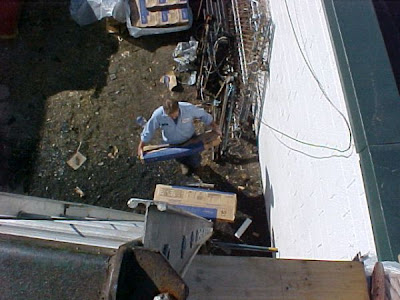
This image from Richmond VA roofer Frank Albert shows him at a home owner's site explaining how to manage a do-it-yourself roofing project. Why offer to help homeowners do their own work? The consultancy leads to referrals and leads -- and you are paid for your time.

This contractortalk.com thread raises interesting possibilities and questions for residential contractors. The original poster, Silvertree (Paul Lesieur, in St. Paul, Minnesota) observes in the first post:
Clothes make the man!

I don't believe this is entirely true. But I posted back in early December that I got outfitted with new dress clothes. All of them the best. I believe that showing up looking like a page from Esquire helps with the price issue. You look like a million bucks and people know you ain't gonna be the cheapest guy.

On top of that, on my DIY website page I offer remodel consulting for $125.00 an hour. I don't expect that to be my bread and butter, but once again I am not selling myself cheap. I understand that consulting carries some risk so I have a disclaimer, I will help HO's find a solution to a snag in the process, but I will not offer advice on how to do the job, I will inform and steer people to finding the solution, including referring a plumber lets say.

Anyone done this, or thinking of something similar.
The discussions that follow focus less on the clothes than on the idea of providing a consulting service for do-it-yourselvers.

One poster, Frank Albert of Albert's Specialty Roofing in Richmond, VA, introduces his own version of a special DIY consulting site, http://www.rentaroofer.com.

Do-it-yourselvers, in this model, pay the licensed contractor for tips, guidance, and reassurance they are on the right track. The trade professional is paid a reasonable professional fee for the consulting (after the homeowner signs a liability release, and pays with credit card or cheque).

Why do this?

Leads, leads, and more leads. The consultation often results in the homeowner deciding that a professional really needs to do the work, and who is best placed to win the business -- you can see how this gets you far away from the 'free estimates' space since the homeowner is actually paying you for your time. Often the homeowner doing work personally who is skilled at the job actually has some friends or colleagues who need a professional, and again, who is likely to get the business? And as the posters in this thread note, you use your off time, your spare blocks, and you can certainly qualify and screen people before seeing them.

Friday, September 19, 2008

Consultants: Using Internet forums for your marketing

Tim Nagle, in the Richmond VA area, has started promoting his consulting business through provocative contractortalk.com postings.

One of the most effective ways for you to market professional and consulting services is to achieve expert status on relevant Internet forums. As you contribute and post your insights and observations, your reputation will soar -- if you do it right.

If you do it wrong, you'll be seen as an opportunist, or worse, as a spammer. Forums have their own rules and personalities -- and unless you really know your way around, you risk a flame war or, worse, banishment.

Several months ago, for example, and relatively early in this blog's history, I stepped over the line at contractortalk.com, when I invited readers to participate in a survey. You can avoid similar mistakes by reading the forum rules, which are usually clearly posted.

Humbled by the error, I set out to correct things, always checking with the forum administration BEFORE posting if the activity could be seen as stretching the rules.

Sometimes, new people arrive on the scene with a real splash. Tim Nagle, who goes by the user ID "Remodel Bud" joined the fray with some provocative postings beginning with this thread, "Sales Training Instruction 9 - 2 - 08". Intrigued, I phoned Nagle, whose RemodelBuddy weblink takes you to a regional leads referral service for the Richmond, VA area.

Before starting out on his own as a consultant/local leads service provider, Nagle says he had been a partner and successful manager of the Champion Window, Siding and Patio Room branch in Richmond, which he turned from a money-losing business into one of the most successful branches in the Champion network, generating upwards of $10 million in sales each year. Nagle says Champion decided to use his location as a training centre for other location managers, who could see first-hand how to do things properly.

He's now setting out as an independent consultant, and naturally, his clients are likely the people reading the contractortalk.com forums (and this blog).

Nagle believes contractors should hire only commissioned sales representatives. (This point is debated by many pundits -- but the consensus seems to be for retail-focused direct to consumer sales, commission sales appear to have the greatest industry acceptance.)

But where/how do you find the great salespeople you need to run your business?

First, says Nagle, make the business truly appealing -- show the representatives you are planning to hire the quality of the environment and the existing sales force. (When he took over responsibility for Champion in Richmond, this meant a few months of house cleaning, as many lower performing people left.)

"The hiring process starts before you hire anyone -- you are building the culture in the office; a great environment leads to great success," he said. "Whenever I interview a salesperson, I let them interview the other salespeople in the office -- and they want to work there."

To find new representatives, "you are out looking for people actively, networking, checking other companies, home shows, contractor businesses, that's generally the best means of hiring.
"Building a sales team is a constant work in progress," Nagle said. "You have to be working (at recruitment) when there isn't a need to look."

For his consulting service, Nagle said fees vary depending on what is required. Some people, he said, just need phone consultations, and these can be accommodated for $50 per week. In other cases, Nagle said he is asked to conduct full-blown on-site sales training and hiring -- and this of course will be more expensive. He is selective in the clients he works with; a young, struggling contractor with a brain on his head and willingness/eagerness to learn will receive his services for lower fees; he will decline doing business with people who don't want to learn and listen.

Is Nagle worth his fees? I can't be sure -- but his writing and communications suggest he knows what he is doing -- and of course you can check his references and validate his abilities in the early going of your relationship. One thing is certain: Some solid consulting from experts who really know their stuff can save you much agony, frustration, and wheel-spinning as you build and maintain your business. And you can learn something from Nagle about marketing your business by connecting with Internet forums relevant to your potential client group.

Wednesday, July 23, 2008

Wisdom: The challenge of choosing a great consultant


Should your business hire a consultant (or consultants), and if so, how do you decide whether you need one, and if you do, who is the right person for the responsibilities?
The answer is you most likely will achieve some incredible value from consultants -- if you choose the right one.

Great consultants bring wisdom, practically framed, to your business. They've "been there, done that" and -- if they've earned their stripes through enough years and grey hairs -- seen enough business cycle ups and downs to be able to read the tea-leaves of the current environment accurately. (Conversely, however, a very youthful consultant may be the best person to hire if you wish to connect with technology, new media, or youth markets.)

The problem you have in selecting a consultant, however, is that the best marketers of consulting services are often NOT the best consultants. The bonafide success and fame of the widely known experts means, if you can get any of their time, it will be very expensive, or distilled through underlings who may have been trained in their systems, but don't have consultants' own magic leadership abilities and insights.

Similarly large consulting organizations -- and many freelance consultants -- will trot out tried and true (but boring) business planning and procedure methodologies, almost as if they are lifted from the textbooks. In part they are right -- the basics are the same, regardless of who you use or pay; you'll probably be educated in a planning/systems process, SWOT analysis, and the like, and these templates apply for everyone.

Word-of-mouth referrals, of course can be excellent sources of insight into the quality of consulting services, especially if these relationships are built through your relevant trade organizations and groups (where smart consultants make a business of networking effectively). The advantage here is that the consultants you use really understand your specific business -- and, yes, there are differences between a residential roofing contractor and a multi-city architectural practice!

You can of course elect to contract with a general business consultant, or hire specialists for specific responsibilities/problems, or use both approaches. A good generalist consultant (with knowledge and understanding of your specific business sector) will be the best, in my opinion. You could supplement the consultant's resources with other services.

How much should you pay? Here things get a little interesting, because I think you can 'pick the brains' for about 60 to 80 per cent of the consultant's real value for free! Most good consultants offer free seminars, inexpensive books, and other resources which distill their thoughts and approaches to business in an easy-to-understand format, and they are usually available for some basic free phone or email consultation. It is simply good business for them to provide these services -- they know that they may impress you, and build enough of a relationship with you, that you will contract with them. (Incidentally, this is how i would work with the big name or famous consultants, people like Michael Gerber or Jeffrey Gitomer: Buy some of their books, perhaps, read the free stuff on their websites or e-letters, but don't rush to spend thousands of dollars for their more complex and expensive programs. You will be far out of their league, I expect, to get really powerful direct and immediately relevant insights for your particular business from them.)

Finally, remember that even the best consultants are not always right, all the time. Be willing to trust, and accept the advice, of consultants you respect, but bring your own thinking into the process; listen, respond, consider, and reflect, then act.

(A personal plug: Could I be a qualified construction marketing consultant? No one has paid me for the service yet -- so maybe it is a little premature. Then again, I'd be happy to work on the condition that you pay only if you are satisfied that you receive real value. You can reach me by email at buckshon@cnrgp.com.)

Wednesday, May 07, 2008

Motivation, sales and construction


Most of us have heard the name Zig Ziglar -- motivational speaker and writer. However, probably few of us know that Ziglar traces his success to the motivation provided by Dr. Emol Fails, founder of FMI Management Consultants and Investment Bankers in Raleigh, NC. FMI now asserts that it is the largest consultancy/investment banker serving the construction industry, with almost 200 employees in four offices around the U.S.

I've just interviewed FMI President and Managing Director Hank Harris, but you'll have to wait until the summer to read that interview in our North Carolina papers (and, I trust, by then, our revitalized websites.)

So what do Zig Ziglar and FMI have to do with construction marketing? Well, especially if you are one of the larger generals or subs and need consulting services, the consulting will largely revolve around marketing issues and I expect sooner or later you will hear about and consider using FMI.

But the other issue here is the nature of references, stories, and evolving history. Ziglar started out as a protege of Fails -- but now FMI uses the Ziglar story as part of its corporate history and credibility. The protege has, in essence, become the endorser.

Greatness happens in many ways and, as you read Ziglar's observations about Fails, you can see that the Professor understood how to recognize the strengths and capabilities of the people working with him -- because these strengths and capabilities were both real and well deserved. Ziglar might have suffered from low self esteem, but Fails saw and appreciated his talent -- and helped him develop and gain confidence.

Some people I'm sure still associate "marketing" with advertising, canvassing, and nuisance surveys by telemarketers (I received another inbound call today and courteously, again, declined to respond.) But really when you come down to it, marketing is all about how you respect and treat the people around you; your clients, your employees, and ultimately your new clients. Marketing success is achieved when you meld all these elements into a cohesive vision and successfully implement it.

Tuesday, October 30, 2007

The right way to use the consultants!


Sonny Lykos has posted a useful and valid comment to an earlier posting on Michael Gerber's services. You can read the original blog entry and his comments here:

http://constructionmarketingideas.blogspot.com/2007/05/michael-gerber-are-marketing.html

I agree entirely with Sonny's respect for Gerber's essential point about the value of systematisation. But I equally agree with the amount Sonny paid for Gerber's material. Spending $80 is a whole lot better than $8,000 -- or more, which is how much you may pay Gerber for "coaching" and materials if you go all the way with his organization. (And you'll be getting the work of someone who is following Gerber's system for consulting, rather than his independent, creative thinking.)

My point with Gerber is the 80/20 rule clearly applies here -- you may get about 80 per cent of the value from his program with his books and perhaps tapes and CDs (maybe purchased inexpensively -- try Ebay!). If you wish to go the whole way -- spending more money -- you will gain additional value and insights, which may give you a true competitive edge. Then again, you could call Sonny, offer him some money for consulting services, and probably get a whole lot more value, especially if he matches his offerings specifically with what you need.

Sunday, October 28, 2007

The Lykos Group serves Collier County, Florida. It may be a model for you to emulate in your own area
Sonny Lykos has smarts. The semi-retired contractor sold his business to his sons, but he didn't leave the scene -- he started a 'modest' business serving condo owners for simple jobs in the Naples, Florida area.
He believes in branding. Not branding in the stereotypical big-advertising-budget image; but in the rather simple concept that if your potential consumers in the market perceive your brand has value, they will pay more.
See this posting in a contractortalk.com thread from last spring (he also recently posted a comment in response to my posting on Friday, "So you are looking for that magical, quick answer." In his contractortalk.com posting he rebuts another poster who suggests branding relates to advertising and expensive marketing:

I didn't know that. I'll have to tell my son, Tom. I sold my remodeling business to him and his brother in 1999. About a year or so later he bought out his brother, and his brother started his own remodeling company. I started it shortly after moving to Naples, FL in 1991. My advertising in our newspaper started in Feb, 1991 and I stopped it in May, 1991 and never again had any more ads. In 1999 when I sold the business we did just under $1M in sales. Last year The Lykos Group, Inc. http://lykosgroup.com/ Did about $6M in sales - all from "Branding." Among other awards Tom received the Remodeler of the Year Award for the state of FL.

I guess it's true what they say: Some people succeed at doing something because they didn't know it couldn't be done. And since I'm now semiretired specializing in only very small remodels and a lot of repairs, while most of my so called competitors base their prices on labor rates of
between $35 to $65/hr, mine are between $85 to $125/hr and I and my part-timer still can't handle all of the work. When I started my small new business in 2000, I never advertised. Still don't. What son Tom and I do is the result of "branding", not luck, advertising, or marketing. And by the way, Tom's "net profit" is consistently double to triple the national average. Mine is about 40 per cent. But maybe you're right, and we really can't do what we're doing. So I'll not comment about it again.

I requested (and he graciously provided) some copies of his simple newsletter he uses to promote his condo service business. You can view a copy at this link. In his email to me with the newsletter copies, Sonny notes:

My pleasure, Mark, and if it can help others, go ahead and reference it on your blog. About half of my sales are for condo associations, so the front page is for them and the back page for condo and home owners. They were tremendously effective. Created on my word processor - nothing fancy, just very informative.
Attached in pdf format. I keep hard copy files with articles from various trade magazines. Keep the files by trade. I do the same on my computer with articles from various trade association newsletters and also mfg. web sites. I just hang on to them for future newsletters I would send. I also used what I had up here in my head from my expertise and experience. And by using the same newsletter format, all I had to do was pull up a previous newsletter, erase the text in the particular block and type in the new info. Maybe the most it ever took was one hour, so for that minimum amount of investment, where the heck could we get such positive feed back?
Good luck with your own. Incidentally, one guy I know used to get verbal approval from a past customer to use their name and photos in a newsletter, and show the before and after photos with the owner's name (no address or #) and brief description of what the remodel entailed. People like to see their names in print. Makes them feel like a celebrity.
Anyway, quick, cheap, and very effective. Just remember to keep a couple dozen copies in your truck to give away to any customer's neighbor you meet. I bought a HP color copier and printed them on both sides of the sheet. I think it was cheaper than using the computer printer. And you can use a heavier paper, glossy or other wise. I used a heavier flat paper - no gloss at all. Sonny.

Aha, note some wonderfully simple yet effective things here.
  • Sonny has a niche. A defined market segment, which clearly needs his services (and which you may well be able to replicate in your own market area. I would recommend offering to pay Sonny for some consulting advice in this regard -- he is doing it successfully in Naples; why not in virtually any other community in North America.)
  • He doesn't waste money; he uses a newsletter to provide simple, valuable information, relevant to his readers, and information which you likely will have on hand in your own format with your own resources.
  • This high perceived value -- the nature of a 'brand' is only possible if he actually delivers the service to the level clients expect. A good brand, he notes, allows you to get away with occasional errors (provided you rectify them quickly) and command a price significantly higher than the commodity level. You make more money, with less stress.
Finally, note the wonderful long-range implications of giving without worrying too much about 'return' on your knowledge. You don't need to call or pay Sonny to emulate many things here -- and if you do, you will likely succeed. But if his business matches something you think you can do, offer to pay him for his services. I think your return on investment will be staggering.
Note: Sonny sent me a couple of additional copies of his newsletter, which you can request by email from me at buckshon@constructionnrgroup.com.