You will find some simple truths in this blog posting, Rain Making by Deduction, from Ford Harding. His basic premise: Relationships are the key to rainmaking success, and successful relationship development (and maintenance) is found in both the quality and quantity of your relationships. He also asserts you can't build a relationship without personal contact.
For marketing, he writes:
Marketing Properties
The goal of marketing is to help you meet people and develop relationships with them (by giving you reasons to contact them).
Marketing efforts that don’t do one of these two things are probably not worth the investment.
The advice is simple: If you wish to use an outside recruiting agency, be prepared to pay upwards of $30 to $60,000 in fees, and if you wish to do it yourself, the best approach is to work your own network and connections -- and be aware that the process can be long and slow.
Kreiss makes an astute observation that while business for recruiting agencies has not surprisingly dried up for most construction personnel in the recession (there are lots of qualified project managers, superintendents and technical personnel looking for work), AEC businesses are still hunting for rainmakers, generally combining the requisite professional qualifications and several years experience and a proven track record in bringing in new business.
In the article, I also outline our method for recruiting and hiring non-rainmaker sales personnel; that is, individuals capable of bringing in new business but without necessarily having professional qualifications. The rules are different for this type of recruiting.
More than 100 architecture, engineering and construction marketers attended the SMPS DC Chapter's lunch meeting yesterday. Ford Harding, author of Rainmaking: Attract New Clients No Matter What Your Field, gave a speech -- and signed copies of his book given to everyone attending the meeting.
Yesterday, I headed to 7th Street NW near Washington D.C.'s Chinatown neighbourhood for an interview with Rainmaking guru Ford Harding, a SMPS D.C. Chapterlunch, and some key meetings and conversations with the person who will likely be the new publisher of Washington Construction News.
I will share more from Harding's observations in the days ahead, but the singular magic of the day comes down to one of the most important cornerstones of success in marketing -- you will always do best at the work you enjoy, and if you can relate your marketing to that process you are likely to be successful.
Of course, sometimes you need to do what you need to do to survive in business. One of Harding's best examples is of a person who started out in his own business, with the understanding that his largest client at his previous place of employment would continue working him. However, shortly after the new business owner opened his door, his first and only key client disappeared. The business owner had only one choice to survive: Learn how to sell!
Not surprisingly, many people who chose careers in architecture, engineering and construction want to practice their trade or profession -- not be some obnoxious sales person. As Harding noted in his speech, many people have perceptions and standards and expectations of what selling is about which are inaccurate -- or if they are accurate, represent only a part of the picture.
For example, you can expect virtually every individual sales activity will not result in business -- but if you don't engage in all the necessary activities, you definitely will not get any business (and if you do the right thing, if you, as Harding suggests, "get it", you will succeed.)
Fortunately, if you are unfamiliar with marketing, if you are looking to learn how to acquire the necessary skills, you can connect with your local Society for Marketing Professional Services (SMPS) chapter. You'll gain access to resources, connections and a business network which will help you develop your skills an overcome your fears about the marketing process.
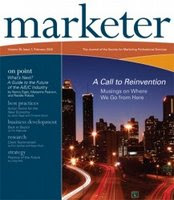
Through this whirlwind day in the U.S. capital, at back of mind is Friday's deadline for an article in the upcoming issue of The SMPS Marketer, the association's national magazine. The assigned title is "Recruiting rainmakers".
Here is the paradox. If you ask people like Tim or Ford, "What is the best way to recruit Rainmakers", they may say: "Why don't you become a rainmaker yourself -- especially if you are an owner or partner in the business/practice?" Essentially,as Ford Harding points out in his most recent blog entry, if you own or are a partner in the business, you can'tsimply dump this responsibility on someone else. Hired sales people (or "business developers" if you want to avoid the word "sales") simply cannot do the job as well and with as much passion and client relevance as a real partner/owner -- and if you have been around for a while, your network of existing relationships will far exceed any contacts your new hire can bring to the picture.
But here is the interesting thing -- you don't need to sell your soul or twist yourself into contortions to be an effective rainmaker; you simply need to change your attitudes to your business development responsibilities. If you are true to yourself, if you are authentic, and your relate your own interests and passions to your business development model, you can succeed.
Still, there are times when you will have to go outside your organization to hire talent. This ideally happens when you are growing, to new markets and opportunities. This is where an effective and relationship-oriented business development and hiring system really works well.'
Glengarry Glen Ross is a classic example of stereotypical selling practices. Do they work? Sure, sometimes, but as Chase points out in his blog, you really succeed when you reach the point when clients start calling you -- or, more accurately, they are so comfortable doing business with you they don't feel they are being sold anything.
Chase, in his blog posting, "You know you are reaching to success when people start calling you" reports on the moment of success for anyone involved in sales and marketing: When you reach the point where clients call you, rather than you them, when you are invited to do business instead of selling yourself (and your soul).
Of course, we all know this is the way things are supposed to work -- You build your business reputation to the extent that word of mouth and repeat business generate most of your clients. The other conventional marketing resources: Advertising, canvassing and cold calling/telemarketing, and response to public bids/opportunities or use of leads services have their place and presumably can top up your numbers (or help you to get started).
This leads to another paradox; if the most effective selling is achieved without pressure, with people calling you rather than you forcing your way into their space, does your business need salespeople or can you get by with some friendly faces and good technical or trade skills? Here, we discover another irony -- for most successful contracting and AEC professional businesses, "selling" seems inappropriate and most do not hire or contract with people who define themselves as sales reps. But I don't know of any contracting or professional business that survives for long without "rainmakers"; the very special professionally/technically qualified people with a gift for bringing in the business (sales!)
Of course, at the most fundamental levels, company founder/principals handle these selling responsibilities, but when they engage in the business development work personally, it often doesn't seem or feel like "selling" either to themselves or their clients. This is because as business owners (or senior partners) we are thinking from a perspective of confidence and equality with our peers. Also, we can see the entire picture, hopefully, and thus draw connections and links that others may fail to see. This type of "natural selling" is so subtle that it doesn't feel like it is happening -- but it is wonderful to implement in practice.
Perhaps the weakest and saddest sales reps are the ones who see the owners and "decision makers" as mysterious all-powerful forces with some superior status or position, who then proceed to call rotely to "everyone on the list" hoping someone, anyone, will buy! These individuals just don't get it. Rainmakers are confident -- and competent -- in our speciality. We are experts within our knowledge area, and regardless of our trade/profession, we exude this confidence to our business owner counterparts. They sense this confidence, and do business with us as partners/colleagues, not as "clients" or "decision-makers".
For example, the owner of a company that paves driveways may have barely a high school education and look way out of place in a suit and tie, but when he appears at the doorstep of a senior business executive whose driveway needs paving, he, not the executive, is the expert on paving driveways, and he knows it. And if he has done his work well, he will have served or worked with some of the executives peers, who he can reference naturally. He takes the lead within his area of knowledge and the other -- and I use the word "other" deliberately here -- executive understands this, and defers/delegates to him within his area of expertise/responsibility.
There is one other important thing here, which really complicates and challenges the picture. This seamless, seemingly 'unselling' selling requirement for any business needs to be combined with some thoughtful and absolutely non-bureaucratic planning and goal setting. You need to know and be able to project/interpret your results, and set targets and visions for your success. The seemingly spontaneous success, when people call you to order, or seem just to buy without any selling effort, needs an underlying structure and planning process, or you will fly by the seat of your pants and suddenly crash when market conditions change. You need to know why things work, and how to manage the process, if you are to succeed in the long term.
Ford Harding's blog posting: No Extra Points for Originality in Rain Making is worth bookmarking because it concisely summarizes or links to some of the simplest and most effective prospecting methodologies for rainmakers -- and provides simple shortcuts to make the process easier.
The E-Quip blog, I think, fills a gap in the blogosphere. I'm not aware of another blog devoted to practice management insights for managers of technical consulting and design firms (if you know of one, let me know). Your feedback on how to better address that need is coveted. Thanks for tuning in. I hope you continue to come back to this space and join the dialogue.
In a recent blog entry Lead Flow Part 2 -- How it makes you an Attractor, Rainmaking expert Ford Harding observes how Chaos Theoryapplies to the networking process of rainmakers. Rainmakers, of course, have an incredible ability to generate valid and worthwhile leads -- and thus are desirable to everyone in business. Of course, the challenge for the rainmaker-- and the person or organization wishing to obtain the leads -- is to define the best way to fit in and create value.
Harding suggests the highest power occurs when rainmakers get together, each generating leads which benefit the others. But there are other categories. The least valuable is the person who approaches the Rainmaker claiming synergy -- or, to put it more basely, "You give me the leads, and I may buy you lunch."
(Jeffrey Gitomer handles these people simply: If you want his consultation, you can pay him $500 for his time -- and he might buy you the lunch.)
So, how do you master the Rainmaking art so you can generate leads and attain the power that arises?
The most obvious approach would be to call Ford Harding and pay for his services. He obviously knows his stuff, and if you pay -- and listen to his advice -- you'll probably get there a lot sooner than if you try to do this on your own. This type of paid consulting is almost always worth the money you spend. In fact, I sometimes wonder about people who spend a small fortune on marketing -- on brochures, advertising campaigns, even head-hunters to find marketing employees -- when you can pay the expert and (if you listen and learn quickly) get the answers you need.
There is a longer range approach as well, the one I've chosen to practice. Since my own personal goals call for me to be a truly effective national level rainmaker in three to five years, I can be patient and build up my expertise and status more deliberately. I've chosen to use my writing ability in this blog and for the SMPS Marketer. Every time I research a story, of course, I gain virtually instant access to the experts around me -- as they know the advantages of positive and reference-based publicity. These connections increase my, for want of a better word, "Rainmaking credits" since I expect no compensation or direct business to arise from this work. (The blog and writing are probably quite helpful indirectly, of course, in that we are now receiving upwards of two or three dozen requests for the Construction Marketing Ideas newsletter each week, and some of these inquiries are from businesses within my publication's service area.)
Most effective rainmakers "get" by giving -- they share so much value in their relationships and insights that, without a cent changing hands, they attract business and opportunity. So, if you want to be successful as a rainmaker, you'll need to learn how to give without worrying about the 'get.' The art, of course, is to do the giving in rational ways and places -- and no, I am not talking about blind and insincere 'networking' where relationships are plastic, artificial, and only concerned with short term gain.
So, my advice to you: Take a portion of your marketing budget and spend it on top-quality consulting from people who know what they are doing. But don't take that consulting in the framework that they will do everything for you -- use their expertise to learn the craft and build your own knowledge. If you don't want (or don't yet have) the cash, there is nothing wrong with reading, connecting, and then finding ways to share. You might be a proto-rainmaker now, but ultimately you'll graduate to full status -- and the fullest opportunities for success and achievement.
Two of my favourite blogs are written by Ford Hardingand Tim Klabunde. Ford focuses on Rain Making -- the specialized skills and abilities for professional practitioners who are also selling/marketing their practice's services. Tim has a wealth of material on networking the right way -- focusing on sharing, generosity and relationship building.
They've posted two recent blog entries worthy of consideration. In More News from Down Under: How Shawn Callaghan Blogs for Fun and Profit, Harding reports on a successful Australian blogger who addresses the challenges that Ford has not yet resolved himself -- converting blog energy into actual business -- especially for high value professional services. Shawn Callaghan has developed methods to generate a significant lead volume, and then converts these leads to business with an intermediate easy-to-enter and purchase service.
Now if you are wondering if we are in a mutual admiration society, I have given that some thought as well -- blogging, by its nature, involves an interconnected network of communities and readers -- unlike conventional journalism where there may be one organization with 100 journalists and 100,000 readers, with blogging, you may have 100 individual bloggers representing 85 organizations (some organizations will have more than one blogger!) and perhaps 10,000 readers. The difference hopefully is focus and specialization: I doubt I could express an independent perspective about Construction Marketing in the way I am doing before the blogging era arrived -- I would instead need to exclusively work through gatekeeper publications either in the general business press or perhaps (as I am also doing) through the SMPS Marketer.
But does this stuff bring in business? If you are a contractor or trades person who prefers to work with your hands rather than the keypad, I'd definitely leave blogging off the priority list -- the payback in time and return on effort is hardly worthwhile. But as Harding, Tim and Shawn Callaghan show, blogging indeed has a place in your marketing strategy if you enjoy writing, can maintain the discipline, and realize the payback in actual client business may be very much delayed gratification.
Here is the original email and response. It is as worthy as reading as the original post if you are looking for a simple, yet effective self-discipline strategy to manage your time and sales/marketing goals.
Could you elaborate how long you've been using the methodology and how effective it is?
Sorry I didn't get with you sooner. I just realized I had a message.
Regarding your question I've used this method since I first read the book Rain Maker (I can't take credit for developing this myself). Editor's note: I believe the book he is referring to is How to Become a Rainmaker by Jeffrey Fox. It turns what sometimes is an overwhelming day to day chore and makes a game out of it.
What's even better than making like a game is the fact that it works. I attribute that to a couple of things:
1) This system keeps consistency. I have a goal of four points four that day and I have to get it.
2) Points don't carry over so I have to start new every day. Just because I nailed two contract down and got 8 points doesn't mean I get to take a day off from marketing.
3) I give myself credit for the small things like getting a lead. If I'm running out of time and need the points I make it a point to ask people "who do you know that is looking to have any sort of remodeling work done?"
4) It encourages me to work people through the funnel. Again, if I'm needing the points and I have already got one point off this guy for getting the lead, then why not score two more by talking with the decision maker or three more for getting the appointment. Or better yet, let's follow up and nail down that deal with the couple we met with last week and get a contract. I use this system to also help me track where someone is located in the funnel.
Here's the really cool part about it. You don't have to use four points (four just happens to work fairly well for me). When business is slow and you need a shot in the arm, you may want to use six, seven or eight points. When you have more work than you know what to do with then you might be alright to drop it to two or three. Personally I like to just keep it at four because that keeps the consistency and prevents me from having roller coaster months where I'm slammed then nothing, then slammed, then nothing.
I hope this helps some, but again, I give all credit to Jeffery Fox and his book Rain Maker (a must read for any business professional).
I wish I could identify the original poster and provide a direct hyperlink to his website, but I don'thave that information yet -- our communication has been though the anonymous JLC Forum email system. But I can post a reference to the book he recommends, and hyperlink it (and yes, I think Amazon.com will send me a four per cent commission if you order the book through this link.
It's good to be home again -- after the weather-related flight delay, we ran into another snag, mechanical, in Toronto, but I finally made it back. Lots to catch up on now -- reports from employees, business planning, and my commitment to write a review of Ford Harding's updated version of Rainmaking: Attract New Clients No Matter What Your Field for The SMPS Marketer.
Ford Harding is offering a few readers of his blog free advance copies of the updated edition of his classic book: Rain Making: The Professional's Guide to Attracting New Clients. I'll be reviewing it for The SMPS Marketer; you can review it for Amazon. Is it worth reading and reviewing? Absolutely. The reviewing process will help you integrate the knowledge you receive from the free copy. Check his blogto learn how to obtain your copy.
The previous posting discussing cold call selling touches on an important and challenging issue within the AEC sector. Conventional selling approaches, in place of much softer relationship and word-of-mouth marketing, are relatively uncommon in the industry, except in some retail sectors (for example vinyl siding). Does it make sense to turn the tables on conventional practices and go for the gold with traditional, intensive, and often intrusive sales techniques, like cold calling? My answer is, it depends -- and the "depends" is largely on how your selling model interrelates with your brand. There is a cliche that no one likes to be sold but everyone likes to buy; I'm not sure if that is 100 per cent true -- but some might see it as truly intrusive to bring old-fashioned persistent salespeople into professional practices, like architects and engineers. But what if the salesperson you hire is really good -- he or she understands your business, the marketplace, and is motivated to bring in profitable and rewarding new business, freeing your 'rainmaker' executives to focus on administering and expanding the deals that are introduced effectively. Of course, finding great salespeople is not a simple matter. I've learned some important lessons through hard experience, some of which are described in other blog entries. If you are looking to hire salespeople, you will need a reliable management system to ensure you only select and work with qualified applicants -- and, in my experience, you will need to go through up to 300 initial applicants to find one suitable finalist candidate. The biggest challenge, after selecting a salesperson through a rigorous process, is that you then need to discover whether your business culture can handle the new approach; and give it the time it needs to succeed. These are daunting barriers to entry -- and suggest that unless the principals of the AEC practice are really into selling, they should tread carefully before changing their business style. Then again, the businesses and practices that take the unconventional risks, rationally and pragmatically, often achieve the greatest success.
Monday, May 28, 2007
Rainmaking intrigue
This article, promoting a commercial 'rainmaking' service' offers some intriguing ideas regarding systemic lead development and marketing to high level executives.
I can't recommend the company recommended in this promotional story -- I've never used the promoted service, and the story is presumably 'planted' by someone representing Corporate Rain, Inc.'sinterests. But the systematized lead development and sales strategy may well be valid, and you could apply some of these concepts in your own business.
Why Cross Selling Usually Doesn't Work
-
No doubt you're aware that it's easier and more cost-effective to sell to
existing clients than to new ones. That's reflected in the fact that 70% of
arch...
Will you be at Inbound 2015?
-
Every year Hubspot hosts a conference called *Inbound* related to inbound
marketing; a marketing strategy that hasn't hit the A/E/C field yet. They
have 10...
This will cost you some money -- $49.50 per year (plus GST in Canada), but is worth every cent if you are in our service areas; or simply wish to see quality local construction industry journalism. You can subscribe (in Canada) to Ottawa Construction News or the GTA Construction Report or (in the U.S.) to Triad/Triangle Construction News or Charlotte Construction News (both in North Carolina). You can use this online subscription order form, or, if you perfer a personal touch, just email me at buckshon@cnrgp.com

 You will find some simple truths in this blog posting, Rain Making by Deduction, from Ford Harding. His basic premise: Relationships are the key to rainmaking success, and successful relationship development (and maintenance) is found in both the quality and quantity of your relationships. He also asserts you can't build a relationship without personal contact.


 -- 2
-- 2 It turns what sometimes is an overwhelming day to day chore and makes a game out of it.
 .
.


 Posts
Posts


