Discover your free Construction Marketing Ideas Email Newsletter

Thursday, October 08, 2009

Choices, choices, choices . . .

For fun, here are some ways you can market your business:

Seek referrals, canvass, give speeches, write articles, get others to write articles about you, advertise -- in newspapers, online, radio, television, with flyers, direct mail; participate in social networks (online and off), telemarket, blog, develop your website, send email newsletters, participate in forums, entering design and business competitions, participate in trade or community associations, give away free samples, give away free services, attend or co-ordinate trade/home shows, sell, hire sales reps, barter and contra-trade, find distributorships, sell through your clients or suppliers, bid public jobs, communicate with and subcontract with public job bidders, use leads services, set up job signs, set up show rooms and sales offices . . .

I'm sure I've left just a few things out.

Which approaches/methods should you use/avoid?

Obviously cash is a factor. If you don't have much money you can't effectively do the things that cost a lot -- unless you are extremely fortunate or creative.

Clearly the marketing approach should be compatible with your market, and the values of your current and potential clients. (It gets more complicated whether the marketing should be compatible with your own values -- at heart, it should be, but realistically, if the method works and is in alignment with your clients' focus, can you put your personal values aside for the larger good?)

I think the more the approach costs in time and money, the more important it is to measure its effectiveness. You need to count the cost per lead and the revenue per lead, and you need really detailed analysis if the expense is significant.

(As an example, yesterday I cited a contractor who is spending a significant amount of money on Google Adwords. Would the contractor get much better results by hiring a single employee with one job only -- writing content and designing materials to increase the company's "organic" search engine rankings?)

Ideally, all your marketing approaches will reach the desired market: The people or organizations who can actually use and pay for your services. (This creates a measuring challenge, of course, because you may need to drill down to the multiple elements that go into decisions.)

Finally, you need to give the various approaches time to work effectively. This can, in some cases, require you to spend months of time and thousands of dollars to prove the point. Obviously don't risk this type of money unless you can afford the loss.

Wednesday, October 07, 2009

Some numbers to consider

Here are some numbers to consider.

One of this region's largest renovation/remodeling contractors says he has less than 2 per cent of the local market share (he gave a specific number, to the tenth of a percentage point, but I'm not going to share specific competitive information here.)

Fly-by-night underground economy contractors have 52 per cent, he says.

He told me how much he spends on Google Adwords ads. I wish I could share the number but respect it is competitively sensitive information. But to me, it was a mind-blowingly large number. The ads don't work nearly as well as signage, though (and are much more expensive).

He is now working on revamping his website to enhance the organic SEO. Not surprisingly, he was reasonably impressed with this blog's success but he said this validates his awareness that content and information, along with frequent updates, are essential for high search engine rankings. With the money he is spending on Adwords, he certainly could afford a full-time employee to do nothing but build and update site content.

Of course he is in the top tier of his industry, and most of his competitors are much smaller, relying on word-of-mouth and seat-of-your-pants marketing rather than systematic and thoughtful approaches.

Tuesday, October 06, 2009

Systems, authenticity and marketing

How important are solid business systems? In the last month, we had more staff turnover and disruption than I would wish on anyone; individually the reasons all make sense and, while we can draw some collective conclusions for the reasons, the losses were painful.

But the business is rebounding effectively, operations continue uninterrupted, and while client service continued seamlessly through the transition, it will now improve because of lessons learned and new processes and improvements put in place.

Systems, of course, saved the day. I turned on our "recruiting and employee selection" system several times, and it worked to quickly allow us to make the correct choices. But we modified the rules and processes by adapting, listening, and respecting some flexibility --- this allowed me to speed up some critical hiring decisions, while minimizing risk of bad choices.

Then, the new employees (in one case, a returning employee) generally knew what to do because we have established operating procedures. They of course need some guidance for the exceptions and special circumstances that occur less often, but generally, they could find out what to do and when.

Fair enough. Systems can save a business. But can they make one?

Systems-focused people advocate building the systems into your business from day one. They say you should visualize your end-result and then design all your operations to fit a structured, systematic model -- to avoid the seat-of-your-pants and chaotic environment where your personality and bad choices rule the day.

There are merits in these approaches; you certainly wouldn't want to make all the mistakes I made in my early days (and still do now!)

But there is a problem with this approach, and it is "authenticity". I sense if your business is excessively systematized at the beginning, the creative spark which defines it may be lost. You also risk putting on airs about being something you are not.

If you are operating a part-time, one person Internet marketing service you are not a "Professional Contractors Association" even if the materials you have systematically devised are as good as any I've seen for truly professional associations. (Is that a mixed review? Yes, but you should really read Steve Seller's stuff. His resources are excellent. See yesterday's blog posting for the relevant links.)

Then, can you solve your marketing problems with marketing systems? Here, again, the answer is yes, with a big caution. I'm really wary of prepackaged and ready-to-go solutions sold by third party vendors. These are probably much better than the seat-of-your-pants and hope-for-the-best approaches most start-up businesses use, but I sense the best systems are the ones you build yourself, by combining the best practices and advice of others with your own personality, temperament and values.

Sellers acknowledges he is a systems person, but he learned (through purchase of a bad franchise) that systems themselves don't work if they aren't right for the particular business and market you are serving.

One-size-fits all marketing solutions for contractors may deliver core value and can save you a lot of time on the learning curve, but they won't respect your individuality and may be a mismatch for who you actually are.

In other words, learn from others, use systems, but be sure to devise something that is right for you. And be real.

(P.S. The bi-weekly newsletter is a little late -- I expect it will be ready later today but you may receive it tomorrow morning.)

Sunday, October 04, 2009

Vapourware? Maybe not.

I don't believe a part-time business just three weeks in operation qualifies as a "Professional Contracting Association" and hate the cheesy squeeze-page set up on Steve Sellers' marketing materials, but behind his site are actually some useful free resources.

Steve Sellers from Professionalcontractingassociation.com, based in New Jersey, responded to my email inquiry when I prepared the Vapourware Marketing posting yesterday. In my email to him, I asked:
If I'm wrong in my assumptions, we should communicate so I can write an accurate story. If I'm right, don't worry, no one should be able to trace you from this posting and I never name individuals/organizations (negatively) publicly in the blog.

If the truth is somewhere "in between" also let me know -- while I can't write an artificially positive review, we can still share notes.
His answer:
"In-between" would be the most accurate. This IS a new venture for me, although I am not new to Internet marketing. That being said, I owned/operated a small construction company in New Jersey (you are right about the Eastern U.S.), and no, this is not my home address--it is an office.

Long story, but we are shutting down our construction business this month... I'll be happy to share all of the torrid details over the phone...

I've tried very hard not to over-inflate my claims and if it appears that I have done so, then any feedback would be highly appreciated!
He followed up with a phone conversation and emailed some rather interesting material behind the site, including a marketing e-book and a six week course on how to effectively structure and operate a contracting business.

It turns out he has a contracting business which he would like to sell or quit; a manager is operating it while he works at another full-time job and he tries to make his Internet marketing business viable.

He told me he got into trouble when he purchased a maintenance franchise; the franchiser didn't know the business, and it lost thousands of dollars until he ditched the franchise and learned how to do things himself. Last year, the business turned a small profit.

"Why not validate your approach by making your contracting business truly successful," I asked him. He said he is disillusioned with the business and the harrowing experience the ill-fated franchise put him and his family through. He is burned out. His manager would like to purchase the business, but of course doesn't have the spare cash.

Sellers' Internet business, meanwhile, has been in operation for three weeks. He has sold one marketing system, a newsletter/email follow up management system provided by The Halos Marketing Group.

His Adwords budget is $10.00 a day, and this generates 15 to 25 leads -- of which about half of one per cent convert to a request for a free newsletter subscription. But since the system operates on autoresponder, it may turn out to be a modest part-time business if he can sell two or three marketing packages a month.

Fair enough. Is this vapourware? Digging beneath the surface, maybe not. Sellers has hard-knock experience. His e-course, which is right now free, is quite well presented and provides practical and useful materials. (Free is also a rather good price!)

I'm not sure I'd pay the fee for the marketing/newsletter package, but you might want to check his free course at http://www.6weekbusinessremodel.com. And since his marketing e-book is also free, you can check it here: http://www.professionalcontractingassociation.com/Marketing.pdf.

I still wish he wouldn't use the word "Association" when he is operating a small, part-time one person business. And I really hate the cheesy squeeze page "Internet marketing technique" format. Every time I see this sort of site, I feel like running for the hills.

Nevertheless, the free stuff is quite good and he really has been in the business, so I'll keep my mind open and grant him a hyperlink for his blog at http://professionalcontractingassociation.com/blog/

Vapourware marketing

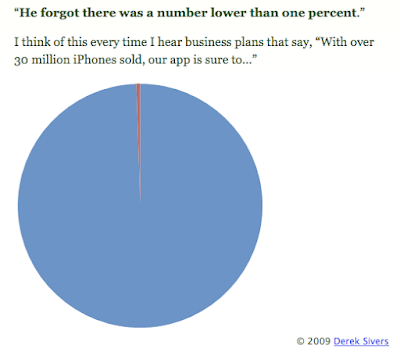
This image from Derek Siver's blog says that counting on even one per cent marketing reach may be folly. Many marketing initiatives result in no return. Beware of "vaporware marketing".

Derek Sivers, in a blog posting referenced by Seth Goldin, wrote about a musician who pressed 10,000 CDs, expecting a flood of orders from his quarter-page ad in a magazine with a circulation of one million. The musician assumed if he could attract just one per cent of the magazine's readers, his mailbox would be full, within a week.

The musician received four orders.

Experienced marketers know the folly of the musician's mistake; notably, don't pin all your hopes in a single ad and certainly don't spent significant amounts of money without checking and testing first. The musician might have had much better luck if he had received a raving review in the magazine or set up some "trial by Internet" system where people could hear his work. Or, as commenters remarked, the musician could have succeeded, slowly, by playing at local gigs and selling a few CDs at a time.

Seth Godin notes that the "long tail"; (see my review of Chris Anderson's book here) -- the great collection of small purchases and tiny niches possible within the Internet, still has a bottom limit. If no one buys, even if it costs a tiny amount to sell, you still have nothing. An if you spend a small fortune on marketing for minimal return, you are worse off than if you did nothing -- unless you persevere and learn from your experience.

This brings forward my next point. A few days ago I saw an ad on someone else's site promoting a contractor marketing service. I clicked on the ad, and (not surprisingly) received the free e-book offer in exchange for my email.

The book, not professionally set up, offered useful advice but nothing earth-shattering. That's okay, I suppose when it comes construction industry marketing, I "know it all" (I really don't.)

Not surprisingly, again, I am now on this marketer's autorespond list promoting his lead-generation program.

But I have my doubts about how much he is really selling (and has sold) and whether he has just bought someone else's package and is repurposing it. Whois.com searches take me to what I expect is a residential address in the Eastern U.S., and what appears to be some sort of inactive condo service business with an email address whose emails bounce.

I smell vapourware . . . that is someone putting something up for sale which he hasn't really validated or proven through first hand experience and results. I believe he will be disappointed about the response he actually receives and his own marketing budget will go into the "zero return" space.

(Note I will continue to try to track him down, and if the news is actually good, share it with you. If not, I will write a follow-up report without, as is my policy, identifying the marketer. As a rule, this blog does not publish negative reports naming specific individuals or businesses.)

Then does any marketing work? Of course -- but please use some common sense before believing any claims.

Check credentials with real references. If you are working with someone or something new, this is okay, but expect limited results and ensure you don't pay for effort without results.

Most times, if you expect people to give you money, they will need to form a relationship with you, validated by relationships with others they know. In other words, you need an environment where you can achieve social validity and word-of-mouth referrals to back up your marketing activities.

Saturday, October 03, 2009

The final (or first) chapter

Last night, I rewrote the final chapter of Construction Marketing Ideas: How to attract profitable business without struggling, in any economy. On Monday, the manuscript goes to our designer for layout and page-set up; the next stage in the progress towards publication.

The book, like any project, has its own pace, influenced by competing objectives, external conditions, and constantly changing circumstances. Some words written last November and December continue to have resonance now; others seemed, on review, to be badly dated. And there is another chapter to write even as the book is in production; the story of how new social networking and Internet resources are reshaping marketing methodologies, but not fundamental principals.

The more I learn about the topic -- with reading, videos and Internet surfing coupled with live business operations -- the more I appreciate that a few core principals need to be combined with some creativity to achieve ideal results. You can take off-the-shelf solutions, but the real gems of success occur when you combine your specific business knowledge and experience, common-sense principals and some copying (ideally from non-competitive markets) to create something truly unique, unforgettable, and effective.

You can do this marketing work yourself. Alternatively, you can hire or contract the services. Your biggest challenge will be the discomfort you feel when you leave behind tried and true approaches for something "better". Usually the first efforts are far from successful or you may have the misfortune to have a fluke success early on, distorting your perspective of what really works.

I expect the book will be ready for publication by the New Year. But even as we edit and prepare it for printing, I know the story will change. There really isn't a final chapter.

Friday, October 02, 2009

Self-interest

Rational human beings act in self interest and respond to short-term stimulus. In other words, if we are given something we cannot resist, and the gratification is immediate, we usually go for it.

Of course these decisions aren't always the wisest. Generally, when we pay the price with patience, generosity and delayed gratification we achieve much better results, long term.

Great ideals, eh. You are so successful in business that you can focus on community service, industry associations, and long-term relationships that you forget you need the "immediate gratification" to meet your payroll (or sales quota). Suddenly you are in crisis mode, and suddenly, "tomorrow" seems to be eons in the future.

Maybe we can blame the recession. But Ret. Gen. Lewis MacKenzie, who led UN humanitarian relief efforts in the 1990s Balkans mess, reminded me and a few dozen Ontario General Contractors last week that leaders accept unconditional responsibility for the faults of their organization, even if they aren't the cause of the fault. In other words, no "buts".

I'd like to say I have gems of wisdom and understanding to solve every one's problems but that puts me in a place higher than any mortal human should even think of getting near.

Thursday, October 01, 2009

Dreaming and doing: Changing habits

Habits are hard to change. When we've been doing things one way for months or years on end, we resist.

We need catalysts. Fear works, sometimes. Romance is helpful. Occasionally a leader inspires us. Cajoling blog postings aren't usually that effective, alas.

Some marketing habits are good. If you get results doing things the way you have always done them, why change?

But some habits are bad. If you rely on, rather than nurture, referrals and repeat business, you need to change. If you advertise only when a telemarketer phones you and offers you a great deal in an obscure journal, you should discover new habits. When your "Internet marketing" is paying a small fortune for leads which you could have collected yourself, you should turn things on their head and do things differently.

But you won't, most likely.

One way to change is to make a public commitment. It takes courage but the embarrassment of failure can really stir you to action. Last month, I wrote in this blog that I would finish the rewriting of my Construction Marketing Ideas book by updating a chapter a day, and posting the results on Twitter. I'm at the final chapter. You can read the second-last chapter, about using leads services, here.

Another approach is to set an annual planning process (another habit, once developed) with systematic meetings and follow-up. You can't get too far off track before you are reminded.

Do you have a marketing habit you want to change?

Wednesday, September 30, 2009

The simple answer that raises more questions

Yesterday, I received this question from an offshore reader:

I will be most grateful if you can assist me with some ideas with regards to business development for an engineering consultancy service.
My brief, perhaps curt, answer:
I'm not really qualified to suggest ideas in your market although the basic principals outlined in various blog postings may be helpful.
You are going to need to build your business from your relationships; and if you don't have them, you will need to connect the dots and find your way to be near the people you want to do business with.

"Marketing" for consultancies is almost 99 per cent relationship-building and virtually any other resource you try will only work if that is at the root.
Trouble is, my answer didn't go far enough because it doesn't answer the question: "How do build relationships?" The simple answer is:
Join relevant associations (of individuals likely to be decision-makers within your market) and contribute your skills, passions, and time freely, wholeheartedly, and without any expectation of return.
You may scratch your head at this idea, especially if you need some fast cash to stay afloat or your boss is breathing down your back to meet your sales quota.

This question, of course, is from someone seeking to build a consultancy. Realistically, how can you expect to succeed unless you connect with potential clients in an environment where they can assess you safely, without feeling pressure to do anything?

They need to see you in action and need to both like you and feel you really can solve their problems.

Associations provide that link. Get involved.

Tuesday, September 29, 2009

Failure leads to success (really!)

This posting from Ford Harding, "A Fall in a Ditch Makes You Wiser" is worth reading, and the comments to it are even more revealing. Essentially, Harding and his commenters remind us that a failure in winning business opportunities is never that if you learn from your experience. Most importantly, if you communicate with the organization where you lost the business for a debriefing, you may discover important answers. And if you conduct yourself with integrity and without any pushiness, you may well find you recover the business.

Monday, September 28, 2009

The Job You Hate (not)

One of this blog's readers tweeted a reference to Teena Rose's blog posting: Six Strategies for Surviving in a job you HATE".

Rose's suggestions are quite reasonable, but it saddens me when I find anyone in a job they hate. Those of us with the good fortune to be working within our strengths (where we can combine our passions and competences) experience the truly liberating freedom to look forward to, not dread, our work.

Sure, you say, but who is paying the bills?

I would argue that the dumbest thing you can do is accept the status quo if you are unhappy at your work, especially if you are doing it for (survival) money alone. This doesn't necessarily mean "quit the job and shove it" -- you should have a plan and place to go -- but you need to put as much mental energy into making your work right, as you do in complaining about it not being what you want.

Why is job satisfaction so important for Construction Marketing? I dedicate a chapter to the concept in my upcoming book, but my main point is that if you aren't really happy where you are, you are unlikely to be successful at marketing in the long term. And if your business is full of unhappy people who "hate" their jobs, your marketing will be truly ineffective because your clients, most likely, will hate being near the people who hate their work.

(That is why I don't fight employees who, while technically qualified, simply don't enjoy their work in our organization. I wish them well as they move on -- after reviewing our own operations to see if we are creating situations where they wouldn't be happy to be around here.)

Note that most of us do not have 100 per cent perfection in our work; there are days and times when nothing goes right -- but if your underlying work matches your passions and strengths you can live through the low points and ultimately thrive. If you speak with anyone who achieves meaningful and lasting success in their careers, business and lives, you will almost inevitably find they have found their workplace of strength and passion.

In other words, if you must work at a job you hate, stay there only long enough to solve the problem or find something better.

Older workers, younger workers

Chase, delegated the challenging task of recruiting and screening potential sales employees for our business, has observed that many older candidates are reluctant to answer our questionnaires or complete the full pre-employment evaluation process.

Conversely, younger candidates, in their early to mid-20s, may complete the evaluations, score well, start out great, and then have a tendency to flame out much more rapidly than older employees.

Does this mean that either younger or older people should not work for us? No -- in fact they can be ideal employees, with enthusiasm, skill, and talent.

But what can we do to minimize hiring stress/waste and keep the younger or older employees engaged? This is a question all businesses must answer, of course.

Chase notes in his blog posting:

The process which I can not divulge in complete details is set up to allow people to demonstrate their true knowledge of what we do and produce measurable results.

The purpose is to weed out the candidates that are great fictional writers with resumes and find a truly great sales person.

I am finding that candidates under the age of 40 are happy to take up the challenge and demonstrate their skills. The other side of the coin is I am finding sales professionals over 40 take offence to our process and have heard the term "Jumping through hoops!" used several times.

How do I encourage these potentially great employees to play the game and take a leap of faith and do what they may think is below them? Most could probably pull out a Rolodex of business cards and demonstrate their ability to sell rather quickly, however like a fine wine they expect to be appreciated based on the vintage of their grapes or really in this case their experience.

The publisher and the owner of the company always ask the same question when these great candidates come along, "Why are they no longer there?" I am guessing in most cases performance slipped either based on the changes to environment or industry where they came from or more likely you can remove a higher ranking individual and with the savings in salary hire two people to replace them.
I posted the question to my publisher about how we could handle these candidates differently. I proposed he take them on and coax them to demonstrate their skills. I think there may be an opportunity for establishing rapport better based on the amount of grey hairs on their heads as well as overall career experience.
I answered Chase in my own publisher's viewpoint with these observations about older workers:
I don't have an easy answer to this question. I think the person who likely would be a great sales representative in our organization has extremely strong self-reliance and entrepreneurial characteristics. Most of the time, by the time people have reached middle age or older and have these traits, they have started their own business. If they are responding to an employment advertisement offering a salary, they either haven't succeeded, or perhaps crave much more security than a good salesperson should ever need.

This doesn't mean that we cannot modify our approaches but know of no better way to evaluate potential than to ask the potential sales representative to do some useful work before we offer permanent employment. Our lead/sales cycle isn't that long and someone who is motivated and understand the basics should be able to find results reasonably quickly. Since we pay for this work, we are not unfair to the potential employee. If they insist on job security before they truly prove their ability, I think they are putting the cart way before the horse.
For younger employees, I think the key is to make the connection between their real circumstances and passions, and allow for more intrinsic instability and self-discovery.

In one case, a young employee started out really well, then flamed out in a "firing" offence. After re-establishing communication with him, I confirmed that his problems at work had much to do with emotional confusion relating to his personal relationships. He has matured and discovered more clearly his entrepreneurial character.

So we discussed putting together a new working arrangement that will serve the business's interests, while allowing him to grow independently. (I'm a firm believer in allowing second chances for employees unless their failure relates to fundamental integrity weaknesses. Of course we don't go beyond this, to a third chance because if the problems repeat twice, you can virtually be certain they will not go away anytime soon.

So, hire young, hire old. You can respect the age differences without giving up your core standards.

Saturday, September 26, 2009

About responsibility

Maj. Gen. Lewis MacKenzie at the Ontario General Contractors' Association Annual General Meeting. (Photo courtesy Janis Rees)

The Ontario General Contractors' Association invited Major-General Lewis Wharton MacKenzie to speak at their annual general meeting in Ottawa. Maj.-Gen. MacKenzie established and commanded Sector Sarajevo as part of the United Nations Protection Force UNPROFOR in Yugoslavia in 1992.

With totally inadequate resources, and a confusing (and irrational) U.N. command structure and mandate, MacKenzie structured the media to bring in humanitarian aid and some semblance of order to this chaotic region. According to Wikipedia, his observations are controversial, especially his dispute about claims of Serbian genocide in the region. At one point, opponents accused him of taking money from Serb organizations -- but he responded that his usual speaking fee is $10,000 minimum.

I'm not sure if the OGCA paid Maj. Gen. MacKenzie this fee (but it is quite possible, given the AGM's budget), making the opportunity to listen to him at lunch something of a special, exclusive treat as there were perhaps 100 or so in the room.

He indeed is a great speaker, and his points about leadership and management ring true. Here are some points from his presentation that stick in my mind.
  • "I learned more from the three or four bad leaders I had, than the good ones."
  • "Leadership is not management. Management is doing things right. Leadership is doing the right things."
  • "If you have someone who can do both right, don't let them go."
  • "The definition of leadership is getting people to do things they don't necessarily want to do, and have them enjoy the experience."
He also offered some simple tips:
  • "Be yourself".
  • Practice LBWA -- Leadership by Wandering About. "The more senior you are, the more you are trapped by your in-basket."
  • Listen. "I discovered most people who work for me are smarter than me. I listened, implemented their ideas, and gave them the credit -- and I was forever associated with the idea. They got the credit, I got the credit, and the organization was better."
  • "If you know nothing about the people working for you, now one thing, what's their passion -- something that really turns their crank -- if you know that, that's the key, and that will allow you to get through to them."
  • "Set difficult but achievable objectives."
  • Have a sense of humour and be approachable.
And, to me, his most important suggestion:
  • "Accept responsibility even when you are not responsible, for the good of the organization."
This concept stopped me in my tracks but is so important I would like you to consider its fundamental importance. MacKenzie said at a public inquiry into an awkward racist incident in Somalia, several officers said: "Yes, I was responsible . . . but" and ended up spending a long time explaining and justifying their situation.

MacKenzie suggests that you need to truly accept 100 per cent unconditional responsibility for your organization, no matter what or who really might have mucked up. This can be painful and superficially may seem unjust, but if you don't, you can never truly lead it. After all, if you are not responsible, who is?

Friday, September 25, 2009

Life is not fair (and therefore, why you should be aware of construction marketing)

Tonight, I spent the day and evening at the Annual General Meeting of the Ontario General Contractors Association (OGCA).

Partly an expenses-paid break (for those fortunate to have the money for such indulgences), partly an informative event with insights and observations and lessons, I looked a little beneath the surface and remembered an life lesson: "Life isn't fair, and if things are fair, you will wish they aren't."

The issue that brings this concept to life arrived in my email yesterday. A general contractor, interviewed for an unrelated story, told me about his problems with the pubic bidding process at the Ontario Realty Corporation (the crown corporation which administers provincial buildings.)

He said the number of contenders for simple jobs had grown truly outrageous recently. More than 50 prequalified contractors are bidding for some jobs, jamming up site meetings, and making it virtually certain that any regular and well-established business would lose to a low-ball offer from someone barely eking out a living, with no overhead and little sense of what needs to be done to earn a fair profit for the work. (Certainly, the contractors winning this sort of public work would not be able to spend a few thousand dollars to bring their wife to a weekend in Ottawa for the OGCA conference -- in fact, most could not even afford the association's membership dues.)

Trouble is, as the contractor reported to me in a letter he had sent to OGCA President Clive Thurston, the excessive competition resulted from the OGCA's negotiations with the ORC for a transparent and fair bidding process. Previously, general contractors felt they had no chance at the public-sector work as service providers and third-party contracting organizations played games and favorites. How could businesses which played by the rules and really could do the jobs break into the closed circles of qualified bidding lists and restrictive tendering?

Clive Thruston confirmed today the ORC has listened to the association's concerns about transparency. Trouble is, the Crown Corporation is responsible for many smaller projects, which require limited bonding capacity, and which are within the range of many smaller contractors. And, like lemmings, these contractors are chasing after the dream in the open bidding process -- with dozens of bidders competing for each simple job.

Thurston acknowledged the contractor complaining about problems has a point; this excessive competition discourages reputable contractors from bidding, and could result in badly managed jobs with bidders under-pricing their work. He said the optimal number of bidders for a job is six to eight -- this allows for fair competition, but not the craziness when 50 or more are competing.

Solutions might include some system of rotational qualification. As well, Thurston noted, contractors are evaluated on their past performance, so if they mess up once, they won't be back again.

Many small construction businesses can perform the same services. Without marketing or relationships to differentiate themselves from the others, their only option is to compete on price for openly publicized projects.

There is only one escape from this trap: Marketing and sales. If you can differentiate yourself from the others, if you can stack the deck to your favor, if you can win the opportunities that are invisible to others, and discover clients who wish to do business with you because they want to, despite all the competition out there, you can earn a fair price, make a profit, and afford the conference fees which allow hours on the golf course and five course dinners.

Otherwise, prepare to struggle, hoping to "earn" less than you could if you took a job at a fast food restaurant.

Life isn't fair.

Thursday, September 24, 2009

Past, present and future


A video with music which evokes memories of the African adventure three decades ago.

Last night, I opened an email from someone I had last seen close to 30 years ago.

I still remember that final moment. A few days after Zimbabwe's independence, and a week or so after I had been dismissed from my employment as a sub-editor at the Bulawayo Chronicle, I returned to the newsroom with a parting gift, a bottle of Canadian Club.

Ian Watson, who had worked in Canada in the 1960s as a strike-breaker at the Globe and Mail before heading to Zimbabwe where he combined his work at the Chronicle with para-military service with the British South Africa Police, had sat next to me for close to 18 months, handing the motley crew on the "subs desk" news wire copy for editing and headline writing. Part of our work included removing Robert Mugabe's name from the stories and turning the Zimbabwe leader into "an external terrorist leader based in Mozambique".

When I walked out of the room that day in late April 1980, I didn't know if I would ever see any of my fellow Chronicle employees again, but I knew for sure the experience had permanently changed my life.

Last night, Watson invited me to call him at his home in Hong Kong and I reached him there this morning. Now in his 70s, and in good health, he brought me up to date on various co-workers and their fate over three decades.

We pieced together common acquaintances and friendships. Notably, the impressive number of people I know who made their home in Hong Kong, not only from Rhodesia, but also from Vancouver and my former student newspaper peers.

It seems the South China Morning Post had become a haven for expatriate journalists from my circle. One of them, Gary Coull, went on to fame and much fortune as an investment banker before his untimely death a couple of years ago. Watson worked with Coull on the Post before starting his own publicity and communication business.

As you read these words, you are probably wondering: "What does this have to do with Construction Marketing?" Nothing, specifically, but much, generally.

When we are young, we cannot know for sure our life's trajectory. The events and decisions that led me to Africa, and the things I learned there, however, set the course for my future and allowed me to define and establish my values.

Ian Watson remembered the tense battle I had with another young co-worker, in the final days before a wildly insane evening of drinking and self-discovery that led to me being asked to leave The Chronicle. I sensed this colleague had serious problems, especially in lacking respect and concern for women.

Watson said the former Chronicle colleague also turned up in Hong Kong, drinking himself to death in anger and hostility.

Keeping score, I realize I now know someone who grew rich and successful, and died, and someone who died poor, broke, and alcoholic. Two I know are divorced. One, a young colleague seemed to have everything going for him, has been at the desk of a London England newspaper for years going nowhere, slowly.

Then, there is me. Married for 16 years, with a 12-year-old boy and a five-month-old dog, not extremely wealthy, but certainly not impoverished, I can look forward to years of healthy adventure, dreaming and risk taking. I realize that when I was young, I made a decision not to grow old, at least in spirit and values. And that means I am truly fortunate.

I cannot suggest to you when or how you should decide to break your barriers, to reach out beyond your presumed limitations, and head in directions like the one I took in the late 1970s, when despite a personality beset with fears and social skills inadequacy, I decided to go half way around the world to witness first-hand the end of a seven-year civil war in Africa.

The biggest lesson I learned occurred at the end of the journey, however. I attended a gathering of the International Press Corps and looked at the people around me. "Is this the life I really want for my future?" I asked.

Yes, I had broken the bounds, but I realized my life dream would truly be fulfilled with a stable home life, married to a woman I love, with a family and security. I discovered what really matters. You can travel far and wide, seek new adventures, and try to find answers in faith and experience but often the truths are simple, and right in your backyard.

Wednesday, September 23, 2009

Some thoughts about CRM systems (2)

Several fellow bloggers who I respect greatly participated in a group blogging initiative this week about Client Relationship Management (CRM) systems.

I think if you read through these posts you will discover some of the key elements of effective CRM systems -- and what to avoid. Certainly, if you are preparing to spend significant funds/implement these systems, read these blogs first.

I'm humbled by the thought put into these postings and need time to digest things to see if my previous posting on the topic a few weeks ago needs updating.

Tuesday, September 22, 2009

When things aren't working . . .

Our primary business consultant, Bill Caswell, believes that many business people focus on superficial problems. This failure to get to the bottom of the issue results in floundering, frustration and ultimately defeat.

His hierarchy, in order of depth, is:

  1. Results (Current Mood, Miscommunication, Wastage, Crisis)
  2. Operational (Sales, Production, People, Money)
  3. Strategic (Mission, Planning, Structural, Strategic Information)
  4. Accountability (Responsibility, Authority, Metrics, Information Flow)
  5. Mood (Individual - Leadership, Group, Department, Company
  6. Environmental (Company: 1. Can have some effect on it; 2. Can have little effect on it, 3. Can have no effect on it, 4. Is caught by surprise)
Caswell suggests that if the underlying issues are not resolved, nothing you do at the higher levels really matters -- your problems won't be solved.

This is fair enough but the problem is, how do you know what the real underlying issue is?

A few years ago, for example, as my business endured a major crisis, I initially attributed many of the problems to environmental causes. For example, our business had grown in the U.S. and we had been profiting from truly lucrative exchange rate differentials -- as these narrowed, our margins slipped dramatically. We obviously had no control over the exchange rates.

But I'm satisfied that the environment wasn't the cause of our problems during that business crisis; we had failings on several higher order issues, notably my ability to lead, manage accountability, and clearly define strategy.

In the last year, things haven't been easy, either. "It's the recession, dummy," may be a quick and easy answer -- but where do our responsibilities begin?

Today, we conducted interviews for a new administrative employee (our key office person is leaving for a new career in a field she prefers -- showing that recessions don't stop great people from finding opportunities.) Previously, in filling this spot, we had trouble finding people we would like to hire; now there is no shortage of candidates.

Our former editor visited the office in between these interviews. I had to lay him off earlier in the summer as the numbers declined and it became a choice of maintaining my salary or inviting him to use the government's Employment Insurance program. He doesn't like sitting around, and was ready to take a much-lower-paid job at a remote community publication. But that local newspaper, short of staff by about half of its key employees, can't hire anyone because of a corporate hiring freeze. So the employees who are left there are working themselves to the bone, while our editor sits at home. (I can't give him part-time work, which I have, because it would mess up his employment insurance benefits.)

Of course the other part of the equation is that while we have many candidates vying for available jobs (and we have a few posted, especially in sales, where we pay a starting salary), sales are much harder to come by. While advertising makes real sense in a recession, it is hard to justify discretionary expenses when you are laying off long-term, good employees.

So what do you do when the four letter hits the fan and you realize that things really are bad out there, and it isn't just your business management, accountability, mood, strategy, operations or current results? In other words, you are doing most things right, but things are still turning out wrong, for reasons which are beyond your control.

The answer is to remember some universal laws of business and life. I'm mangling some concepts of Brian Tracy and Bill Caswell, but here they are:

If you can't change the overall environment, you can adapt to where you are within it. If there is a recession, you may need to do what you have to do, which means humbling yourself, if necessary, and getting down to some really hard work.

You can control the things you can control but not the things you can't. Focus on what matters. Sometimes you need to fight. Sometimes you need to run for the hills when you are in survival mode.

Keep things in perspective. Recessions end. If you are doing (generally) what you enjoy, and you are good at your work, you will land on your feet though you may need to adapt and change directions -- using your core skills and strengths to find the new route.

If things are going really well for you or someone you know, be thankful. If they aren't, be thankful for the elements of your life that are healthy and work to make them more central to you. This will help you pull through the rough patches around you.

I'm not going to paint an overly optimistic picture here -- looking at my own business now, compared to this time last year, I'm amazed by the changes, challenges, and contradictions in expectations and experiences.

In a few weeks, we'll meet to review our 2010 business plan and look back at 2009. Yeah, "It's the recession dummy". I can't change that overall economic environment. But I can be satisfied that the other elements of the business are in order, we are lean, well-managed and ready to capture the opportunities going forward. You can survive, and succeed, too.

Advertising ideas (2)

How can you reduce the trial and error and risk in planning your advertising? This question is important because, if you are like most businesses who have tried advertising, you know that it is not always successful but often can be very expensive.

The problem is compounded by the fact that you need to give your advertising time enough time and consistency to succeed.

Jumping from one "answer" to another will only lead you down the path of disappointment. Undoubtedly, however, you will be disappointed if, after consistently advertising for a year, you see no improvement in your business.

Here are some options to reduce your risk.

Study effective advertising from similar businesses in non-competitive markets similar to yours. You may find the advertising in your travels but you may speed up the process by reviewing success stories in relevant trade-focused forums like remodelcrazy.com or contractortalk.com. If you are connected with your trade associations and groups, they also can be helpful; notably chapter or group leaders in other cities may be able to refer you to people in their communities who have achieved advertising success.

Speak with your current and recent clients and learn which media they like, read, follow and hear. You need to understand the tastes and interests of your clients, not your own personal values (though they may often be in alignment). These conversations also allow you to renew your acquaintances and connect with people you know.

Look for advertising media with high measurability, solid pay-for-performance standards, and low mandatory commitments. Does the Yellow Pages fit in this list? No. (But if most of your current clients originated with your Yellow Pages advertising, obviously don't ditch them for something untried.) Conversely, pay-per-click advertising can be really effective, though you need to know what you are doing or hire an expert who does.

Work with competent marketing/advertising consultants who you trust because you have been able to verify their work first-hand through references and referrals. These can, in some cases, be media sales reps, but usually you need someone more independent. You will either wish to work with a specialist agency focusing int he construction industry, or a smaller local agency who you know will delver the goods.

Will these measures remove all the risk? No. You also need to plan for things going wrong, and put enough money in your budget so that you are not intimidated by the failures along the way. The last thing you want to do is stop advertising just before your campaign is successful.

Sunday, September 20, 2009

Advertising ideas


William Martin started a provocative thread on Michael Stone's linkedin.com Construction Business Owners discussion group asking about where and how to advertise. This is his blog.

William Martin, owner of WR Martin Co. in the Boston area, posted this question on the linkedin.com Construction Business Owners discussion group: "What are some of the best advertising venues being used today? What gets you the best results." (If you are a construction business owner, I encourage you to apply to join this group if you are not already a member.)

The responses from other contractors are both intriguing and significant.

Mike Davis at TMT Home Remodelers in Eugene, Oregon,wrote:
Advertising is not a one shot or one choice deal. What works best in your marketplace, depends on that marketplace. I you live in an area like ours, radio creates better results than TV. Reason, people spend more time outdoors here and are, therefore, listening to the radio more.

Our marketing campaign consists of radio advertising on the local talk radio station, print advertising in a local magazine that deals primarily with food, print advertising in a newspaper that is distributed once per month in a local destination resort (his newspaper goes to all of the homeowners), we are actively involved in our local builders association, we take part in all of the home shows in our area, we participate in our "Tour of Remodeled Homes" every year, we have a well developed website that shows on the first page in a Google organic search, locally.

I am quite sure that I am forgetting something. We don't count on any one thing to do the "trick" for us in our advertising & marketing. If you have questions about inexpensive ways to get your name out, but take some effort, read Guerrilla Marketing by Jay Levinson. If money isn't an issue, contact a local advertising agency to help you out.

First things first, however, you need to identify who your ideal customer is, what the product is that you have to sell, and how much money you have to spend to reach that audience. If you choose an agency, don't go after one of the "big boys," as they will charge you way more than you can ever come up with in your construction business. You will find that there are a number of high quality small companies around your area that can do a terrific job for a relatively small amount of money.


One more thing, when you choose to take a direction with your marketing, stay with it. Give it a chance to work. The biggest tendency that people have is to bail out on a campaign too quickly. Radio, for example, will take almost 12 months to actually work. That's not to say that you won't get any calls during that time, I'm just saying not to expect huge results just because you start advertising. About the time that you are tired of hearing your ad, your listeners are finally beginning to hear it.


The moral of the story is, identify your ideal customer, find out where they are, identify the best way to reach them, and then give your marketing a chance to work. Be committed when you make the decision to move forward with your campaign.

Kathe Russell, General Manager at DreamBuilders Kitchen and Bath, Inc., in Sacramento, CA. said:
I have found that advertising works best if you have a clear marketing plan. After spending 100's of thousands of dollars on advertising over the years in every publication pertinent to my market, I had to learn this the hard way. Now I don't advertise unless I have a specific, measurable goal.

The main lesson that I've learned is that advertising isn't very effective, in any publication unless you have a specific call to action. For example, one of my company's strategies for getting new clients is to give educational seminars. So we use advertising and other mediums to promote a particular remodeling class. The call to action is that they have to register or the class by a certain date and it will be free. Late registration is a nominal fee. Advertising is great way to get a message out.

We target local homeowners within a 10 mile radius of our showroom, so we use the local newspaper to advertise this. This works great.
The other thing that works well for us are home shows. Advertising an upcoming home show is another great way to call people to action. Just before a home show, we advertise free tickets that can be picked up at our showroom. If you don't have one already, take some time to create a marketing plan before you throw dollars at advertising.
Robert Wright at Citadel Renovations in Ottawa wrote:
What we do is two home shows a year...the next one is in a couple of weeks, have an active website, have a branding radio campaign, and make sure we have happy clients.

I only do the two shows as they are the ones that work for me. There are others that I pass on as they didn't work for me.

I also send out a monthly newsletter to 300+ addresses and growing. They generally are well received. I am also linked to other reno websites that link and use my materials. Lets see how well this works in the future.
More on this topic tomorrow.

Construction Marketing, branding and advertising: How do they relate?

Is having fun at events like the Greater Ottawa Home Builders' Awards Sales and Marketing Awards event part of branding. Sure, but marketers must not forget that their great logos and showpiece sales offices and advertising will ultimately provide less long-term value to their company's brand if the overall client experience is not in alignment with the image conveyed by the marketing initiatives.

A fascinating thread on remodelcrazy.com, Branding Your Business, has now reached its seventh page. You need to be registered with remodelcrazy to read this thread, but since registration is free, I urge you to do it.

The discussion touches around the core principals of marketing and what exactly "branding" means. This is a concept that is arcane and out of mind-reach to most people in the construction industry (and I'll admit, for several years, it was beyond my comprehension, even though our business provides a marketing service). But it is vitally important to understand if you are to succeed.

This post from Jesse Kirchoff of Handyman Solutions in Jefferson, MO, expresses the core concept of effective branding (in my opinion):
While I have been struggling to put my thoughts into written words these past couple of weeks - Chris Wright has wrapped it all up with a neat little bow in his last two posts - but especially in this one sentence "A brand is a collection of perceptions in the mind of the consumer." That nails it right there.

Everything you do or say, the quality of your marketing, the clothes you choose to wear, your hair cut, your attitude, the look on your face ........ EVERYTHING adds to the perception of your company - be it good, bad or indifferent people are judging and putting a "perceived" value on us from that first impression like it or not.
This is why I believe contractors who have relied" on word of mouth and referral business in good times have a great brand -- their challenge is they haven't learned how to manage and control it, so are at the whim of forces beyond their control. When the economy tanked, they suddenly found their business drying up, and (without experience in marketing or advertising) discovered they were floundering.

Advertising of course can be part of your brand -- in fact, it, done right, will enhance and build it. Most contractors however won't want to try to advertise purely to build their brand -- they want people to call and purchase their service, or at least inquire about it. Branding, itself, is a difficult concept to measure, even for the largest corporations, and the benefits are indirect (but truly important, as a great brand allows you to put a higher price -- and thus earn a higher margin -- for your service.)

However, unless you are operating a one-time-visit tourist trap (I think of the line-ups snaking for a tour of the Empire State Building in New York City as an example) -- all the advertising in the world won't help you if people find the experience distasteful, overpriced, and irritating. They won't return for more. (The Empire State Building brand is so strong that the tour operators can deliver crappy service and still stay in business, of course.)

Next post I'll report how some contractors have successfully developed advertising strategies to keep their business flowing, which are consistent and enhance their business brand.