Discover your free Construction Marketing Ideas Email Newsletter

Sunday, April 19, 2009

Fear and the brand

The Tower of Terror is probably the most popular ride at Disney's California Adventure. It is a wild "elevator" ride in the Hollywood Hotel -- at one point, the doors open and park visitors can hear the screaming riders from high up.

If you play the video from the previous California Screamin' posting, you'll see images of one rather wild roller-coaster ride. The idea of this type of entertainment is to give you a thrill: Doing something scary that you know is safe -- even for your kids. And from a marketing perspective, that is the magic of branding, or more accurately, the branding experience. It also is a key element of success in marketing construction services.

To explain: On Friday, as I considered whether to risk riding what seemed to be the scariest rides imaginable (like a really fast roller-coaster with a 180 degree loop), I thought: "Has there ever been a fatality at a Disney site when a ride failed?" My reaction as I boarded the ride -- "This stuff is so safe that there is no real risk."

It turns out there have actually been some accidents and crashes (mostly fortunately minor in nature) over the years at Disney park attractions. You can find out additional details at Rideaccidents.com. But I didn't know this when I was there; I sense most Disney patrons have similar perceptions. In any case, most people consider the rides safe enough for the risk (certainly thousands of people fly or drive to Disney sites each year, and I expect there are enough plane and car accidents along the way to top the Disney accident frequency.)

Consider other elements of the Disney experience: You don't find the low-lifes that hang around many amusement parks and carnivals; all employees of course are briefed and trained (and I'm sure screened) for client suitability; the fun is tightly scripted and controlled, and once you've had the experience, you know what to expect.

There are changes every year, but the basic rules remain the same. You pay a flat rate to enter the park for the day, ride as much as you like (but usually get only one shot at the really good rides unless you are willing to endure a truly major wait), and you can spend as much as you like on extras including food and souvenirs (but Disney does not impose the irritating restrictions on your bringing your own food on site to save costs.) In other words, the experience, while not inexpensive, leaves you feeling you've been treated fairly.

Of course, Disney has turned it experience into corporate programs for training and motivation at the Disney Institute. I'm not sure if these services are worthwhile to most construction businesses, but you can see here how they are able to leverage their brand in new and interesting ways.

Fair enough. But what do amusement parks have to do with construction businesses? The answer is in your ability to overcome the fears of your current and potential clients of the bad experiences they either have heard or experienced in the past. If you are an architect or engineer, are you dealing with people who have had bad luck with sloppy design, missed schedule, or less-than-perfect trade relationships? If you are a general or sub-contractor, have you met people who have been burned by incomplete jobs, messy sites, and offensive employees? And if you are a residential contractor, do your clients have experience (or fear) of work not completed right, on schedule, and with massive inconvenience to their lives?

If your work shares any of these less-than-wonderful qualities, your brand is mud. You can spend a fortune on advertising and marketing, and end up with very little: Sure, a few new clients (or suckers) might arrive through expensive promotion, but your marketing cost will magnify because you will lose many potential clients as bad word-of-mouth spreads faster than your marketing can overcome.

Conversely, if your work is good enough to attract unsolicited repeat and referral business (to the point, in good times, you didn't need to advertise because you relied on repeat and referral business), you have an excellent brand. You now need to leverage and develop it through marketing, both to current and potential clients and new customers.

Here, advertising really will work for you and if you are truly successful, you will budget in the range of five per cent and 10 per cent of your sales volume for advertising (and additional funds, if you wish to use a direct sales force). Simply ensure your pricing is able to sustain this marketing cost -- but don't worry, businesses with solid brands (that is great reputations) can charge more for the same services as their competitors.

Consider Disney. They don't offer many coupons, discounts, special savings or the like -- especially for short-term visitors. Disney has built a brand based on safe, fun, family entertainment. The story may be partly mythology -- as I strapped myself into the roller coaster seat, I (falsely) thought no one had actually been injured on a Disney roller coaster. But I had been sold by the brand, and felt secure that when the ride ended I would be safe, and would want more of the same.

Your objective in developing your construction industry marketing is to achieve the same goal: A brand that attracts repeat and referral business, because clients perceive your service is really safe, fair, and enjoyable.

Saturday, April 18, 2009

The marketing lessons from California Screamin'


What construction marketing lessons can you learn from this and other Disney rides? I'll answer the question tomorrow.

Friday, April 17, 2009

The sub trade marketing challenge

So you are marketing your subtrade services and want to find new business.

How do you get through the gatekeepers, and earn the respect for your proposition?

You may think your wisest approach is waiting for the opportunity to bid the job and you simply need to get on a prequalification list, or (worse) wait for the job to be tendered publicly.

Go ahead. Spin your wheels. Lose your money.

You haven't passed stage one of elementary marketing and sales. And you are like a large percentage of the construction industry hoping for business and wondering why you are struggling.

You need to think differently. The key is to recognize the combined power of effective relationship-building and effective marketing. When your brand (roughly equivalent to reputation) is so strong that clients think of using you and no one else, and take it for granted that your sole source quote will be fair and doesn't need to be cross-checked against your competition routinely, then you have achieved success. When you are able to chose which jobs you bid, and you know you will be profitable going in, you have hit the business jackpot.

Can this be done?

Yes, but here is an important observation after seeing some successful sub-trades at work. Two whom I have met personally, Mike Feazel in at Feazel Roofing in Columbus, Ohio and Leonard Meglolia at Bestline Plumbing in Los Angeles, say they stay away from most commercial and virtually all new construction work because they cannot see any margin or opportunity for profit in the bidding-war environment out there. (They will do some commercial projects, presumably where they can be sole-sourced.)

Surely, however, subtrades and suppliers find a way to make some money dealing with builders, developers, and owners on commercial projects. They succeed, I think because their business is at the scale where they can achieve incredible operating efficiencies and their relationships with their clients are strong enough that they can squeeze just a little more margin through scope of work or other arrangements than the neophytes trying to win bids through public competitions.

If you aren't at that level yet, consider smaller scale residential and limited-scope commercial projects where you can provide direct services to your clients; and develop your own advertising and marketing strategy to achieve this business.

Or if you wish to work within the conventional space, remember that a little energy spent learning how to market effectively will pay you really big dividends, especially if you an escape the rat race of "low bid wins the job" (and loses a fortune in the process).

Wednesday, April 15, 2009

Different roads for different folks

That's me, getting ready for my ride through the Malibu Canyon to visit Bestline Plumbing in Gardenia (Los Angeles). Not everyone likes sportbikes, and not everyone needing plumbing services is middle-aged or older. You need to define your niche and demographics in setting your marketing goals.

Leonard Meglolia at Bestline Plumbing in Los Angeles says he finds virtually none of his business from the Internet, and virtually all of his clients are middle aged or older. (The older client demographic has remained consistent from the start of his business, he says.)

Accordingly, for him, the website doesn't serve much marketing purpose, and if his salespeople are going to provide images of what needs to be done, they will print and give the photos right to the homeowner.

Is this the only way to go? I think not. Just as some people drive Buicks, and others prefer sportbikes, still others believe motor vehicles are gas guzzling environmental headaches, and prefer the bus or bicycle. The right marketing approach depends on many circumstances, including your target market. (Bestline may not find younger clients profitable, but surely homeowners in their 20s and 30s also have plugged drains, failing pipes, and wish renovations including new bathrooms and kitchens.)

As well, it is interesting that Leonard Meglolia engages in communications in online forums like contractortalk.com and uses his website to connect and provide resources for other contractors.

You might also note how Meglolia is willing to try new things, and in the process, discovers ways to make his core marketing methodology -- flyers -- even more effective. He tried a canvassing strategy, and developed a new kind of flyer offering free services to support the canvassing initiative. He is shocked by the huge response to this new flyer. The natural question to ask is: Why not just use the new flyer (modified to correct some flaws he developed) and forget the canvassing process? In other words, the enhancement to his core business method has occurred when he tried something different.

The Bestline Plumbing story -- Advertising flyers and marketing systems

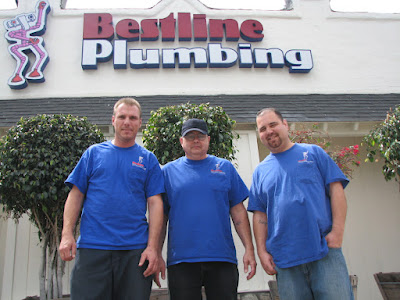
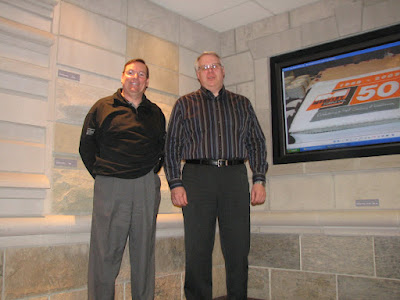
Alex Lacek (left), with Leonard Megliola and David Callahan at the Bestline Plumbing offices in Gardenia, California (Los Angeles). Megliola shares many clues and his business documentation with other contractors through an obscure link at his website.

How can a plumbing contractor, who started with $1,800 and some bad luck in 1973, grow to a $5 million business (and continue growing) during recessions? I wanted to find the answers to these questions, and did yesterday, finding my way on the rented sportbike through the Malibu Canyon and then some urban streets few Los Angeles tourists would ever visit to arrive at Bestline Plumbing in Gardenia.

Leonard Meglolia says he obtains about 90 per cent of his business through advertising flyers -- 50,000 to 100,000 per week. These flyers, hardly works of art but obviously effective, blanket his service area in the Los Angeles area, largely lower-to-middle income neighbourhoods, several times a year.

He says if other plumbing contractors followed his system they would see their phone ringing immediately. At present, he says he receives about 15 to 20 service calls a day. The phone rings, in good times and hard (though he can find neither rhyme nor rhythm to the calls; some days the phone doesn't ring at all; then everything goes crazy, some seasons things work really well; others are disappointing. Megliola knows, however, that if business slows down he can step it up by sending out more flyers, which represent most of his marketing budget (about 10 per cent of sales.)

Is repeat and referral business vital to his success? Surely it is. He estimates about 73 per cent of his clients return for more, and he uses a few mailers and reminders for his 6,000 name list each year. "But I can only 'remind' my old clients a few times -- most just respond to the regular flyers they receive like everyone else," he says. "You can only communicate with your former clients a few times a year, anyways, but they all receive a calendar and pens from me each year."

Is this the flyer story the entire picture? Not exactly. Here are the other essential pieces of the Bestline success story:
  • The sales culture is deeply ingrained in the business. Crews led by a sales leader earn commissions for their work, not fixed salaries. The average employee earns about $65,000 per year. However, no one minds -- Megliola's flyers and marketing provide enough leads to keep everyone busy.
  • The company has a non-scripted but highly effective relationship-building model when its sales plumbers are in homes. The Bestline representative takes pictures of the problems and provides photographic evidence. This time and care to communicate the situation builds rapport and confidence. (Before digital cameras were available, Bestline used more than $1,000 a month in Polaroid film.)
  • The company avoids long term debt -- equipment is purchased at distressed auction prices -- and (with its commission based model) avoids fixed costs. This is not a business with fancy offices and state-of-the-art electronics.
  • Megliola focuses on his niche: Middle-aged and older residential clients who need plumbing work done. Early in his career he was burned by a new home builder who stiffed him for thousands of dollars. He doesn't rely on the Internet for business, and generally is not successful in selling to younger clients, who often seem to know more about the work than his team.
Megliola says he will try new things, and learn from old. Early in his business career, he tried a cable television advertisement. It didn't work, but the agency he used as a secondary project developed a simple ad for the Pennysaver which, in the early going, attracted much business (this medium stopped working for him in the late 1990s.) He avoids the Yellow Pages and other directories -- the last thing he wants are clients calling several contractors for competing quotes.

Home shows sometimes work, but less than before. He is experimenting with door-to-door canvassing; he says the project is initially working, but he is not sure how sustainable his canvasser will be; but the revised advertising flyer he is using in co-ordination with the canvassing program might work well on its own.

Megliola says if he had to start from scratch, he would use his flyers. He said anyone in a smaller community, say 80,000 to 100,000 people, could quickly dominate the market with effective flyers, and the results would be fast. But few people will actually follow his model. "I had someone in here who spent several hours with me, and then said, 'this would not work for me,' and gave up before he even tried the process." If you are on a low budget, you can deliver the flyers yourself, like he did at the very beginning.

There is another aspect to Bestline's success, however, which I realized when Alex Lacek and David Callahan joined us in the interview. The two employees bantered freely and easily, they reflected equality and mutual respect with their boss and a comfort with the work standards and rules.

Callahan joked that he knows he will make a sale when he sees a Buick in the driveway -- every time he appears at a home with that model of car, he sells plumbing services. (I suggested he should become really good friends with the local Buick dealers and their sales reps.) Lacek noted that the company doesn't micromanage its employees, perhaps some plumbers take some materials from the shop without clearing this stuff with management, but in turn, the group keeps an eye on everyone.

Formal and routine staff meetings are rarely necessary; but "if you screw up and we have to go back after hours to fix things, you'll hear about it the next day," Callahan said. Everyone gets along, most of the time.

So, should you commit a few thousand dollars and have some flyers printed up? Sure, go ahead, but maybe spend a few days in Los Angeles and see if Megliola will allow you to ride along with his plumbers on sales calls. He hasn't set up a consulting business; he doesn't charge for his working manual which is freely available here, and relates exactly how he does business.

My sense is most people won't follow his lead because he doesn't look successful like in those get-rich-quick marketing pieces; you know, the guy standing in front of a luxury mansion and riding the coolest car. Gardenia is not Beverley Hills or Malibu. Bestline Plumbing doesn't look like anything special from the exterior.

But Leonard Megliola has indeed discovered the secret for a plumbing business success -- one which could, I think, be replicated with most residential-focused trades -- and he'll share it with anyone who is interested.

I've posted a link to a downloadable copy of the complete Bestline Plumbing manual at http://www.constructionmarketingideas.com. (Just leave out the .blogspot and you'll get there!)

Monday, April 13, 2009

Coffee and Gossip (Courtesy Ford Harding)

Maybe Bestline Plumbing in Los Angeles won't win web page design awards (neither will I!), but Leonard Megliola is one of my panel of experts that knows his stuff. This "would you marry a plumber" image is from his website. I will meet him tomorrow.

One of the best things about this blog is that it has allowed me to develop relationships with some really competent people. Reflecting my business, I have an interdisciplinary approach. I'm looking forward to rolling up on my rented CBR 600 to meet Leonard Megliola at Bestline Plumbing in Los Angeles tomorrow; equally, I've enjoyed many dialogues with Harvard graduate and rainmaking guru Ford Harding.

If you are intimidated by power, you should read Harding's latest blog entry where he suggests the best way to capture the ideas and minds of CEOs is to have coffee (or maybe network through linkedin.com) with their subordinates.

Great marketers of course learn to relate across cultural, geographical and economic lines to achieve their business objectives. Paradoxically, the best way to succeed is to be yourself and do what you enjoy doing. I'll never be a championship motorcycle racer, but today enjoyed the experience of riding through the Malibu Canyon on a powerful machine that burns $7.50 in premium gas if I use the entire tank. (And yes it is a legitimate business expense as my wife and son will be using the personally-rented car while I am doing business tomorrow -- though I will rebate the cash cost of the rental back to the company as it is unfair to abuse this mixture of business and pleasure.)

The road (or flight) to Los Angeles

Later this morning, we will head to Vancouver airport to take the three-hour flight to Los Angeles. At the airport, we will pick up a rental car,. We will then will drive to a nearby motorcycle rental place, and I will rent a sportbike for a couple of days (while my wife carries on in the rental car). This mobile orientation of course is appropriate for the freeway and auto-focused southern California communities we will visit during our stay next week.

Our itinerary includes a couple of days in Augora Hills, then a brief stay in Anaheim (for Disneyland), and finally to Palm Springs. Tomorrow, on the motorcycle, I'll head out to visit Bestline Plumbing and discover how a successful contractor markets in a truly competitive environment.

If you are a subscriber, you will also receive the bi-weekly Construction Marketing Ideas newsletter (see form at top to subscribe) on schedule.

Sunday, April 12, 2009

Look at this contractortalk.com posting from CF Construction and Remodeling Inc. in Miami, Florida, and if you can't see something that you can apply to your own business, you must be rather dense!

We've tried this approach, and continue doing so. The people in which we target when we do things like this are mostly architects and doctors. I go online and go to the website of local hospitals. When I'm there, I pull up their doctor directory, and basically that's where my work starts. We do this with doctors because in the past we've discovered that some of them are in the process of leaving the hospital to start their own practice. Obviously, the area that they will use to conduct their business will need some extensive interior remodeling, in which will require the services of a licensed and insured General Contractor to ensure that the process is as smooth and painless as possible. This approach in the past has worked and has helped us get several big projects. We recently completed offices of neurologists, cardiologists, and a doctor who does endoscopy.

In addition to our construction related services, we also offer expediting services (running permits/plans to the corresponding cities). This is how we approach architects when we mail them. We offer our expediting services to them and you'd be surprised how many of them do it themselves and are willing to hire others to do that for them. The thinking behind this, which again has resulted to be true because we've won several projects because of it it's because at times architects are working on plans for a client whom at the moment has just completed the "design phase" of their project and don't have a G.C. to turn too. By offering our expediting services to these architects, we've basically put our "foot in the door" with their firm. We make them aware that we're a licensed and insured General Contracting company and that our service are available to them or their clients at any time, in which that's when the doors open for us. I basically do Google searches to see architectural firms within the South Florida area to target. From time to time I also purchase those Architect Digest magazines because obviously many of them advertise there.

In the past we've targeted interior designers/decorators, but the outcome hasn't been that favorable. We've probably landed a couple of jobs from them which is still good so from time to time we still target them, but not as heavily as the other two.

Another group of people we target are luxury hotels, restaurants, spas, lounges and nightclubs. Again, being that this is Miami, many of these establishments are constantly doing upgrades in their facilities for an updated look and to compete with others. I've also sent out letters to management in luxury condominiums, which in return have referred some of their new buyers to us to help them out with whatever remodeling idea(s) they may have.

This is a very good approach and quite inexpensive compared to other choices out there. The key is knowing how to approach all these prospects. Approach them wrongly and you've just closed an opportunity for you and your company.
I like the website from this company, owned by Claudio Fernandez. See http://www.generalcontractorinmiami.com/

Stress and optimism

It is good to blog, to be open, and to share with readers the heart and soul of this business. But some internal business issues should not be public -- at least when they are current and uncertain.

Certainly, this vacation, I've been very busy reviewing crucial concerns and even fending off a panic attack or two. This is the nature of the self-employed person's lifestyle; we experience stress of a different sort than the regular employee (who might worry about losing his or her job but doesn't generally have to spend vacation evenings pouring over financial reports). The difference is that I have more control over the outcome; I can make decisions and respond to the situation creatively, and this morning, I could see things are under control.

Construction marketing, always, needs to be seen in the light of your entire business; you cannot market in isolation of your circumstances. The good news is that you can manage, project, and even control your results with a little foresight, planning, and cautious optimism.

Saturday, April 11, 2009

Time and place shifting

This construction image of the Olympic Village site is from the Canadian Broadcasting Corporation. See: Vancouver approves $100M bailout for Olympic developer.

Yesterday, our family visited Science World near the Olympic Village site in Vancouver. As we enjoyed our White Spot meal there, we could see the construction site for the 2010 Winter Olympic Village outside the window. Caught in the financial crisis, the city has had to approve a $100 million bailout for the Olympic developer -- ultimately creating true budget risks and challenges.

If you look at things superficially, of course, you see construction continuing on the site, and and elsewhere in the city, and indeed things are nowhere as desperate as in the Dirty Thirties.

Vacation (especially over a long weekend) changes the work-time rules. The computer with high speed connections in my mother's place is in the room where our son sleeps, and family time is not best spent with a blackberry tethered to my hand. So I catch up during morning sessions at a nearby Starbucks while the family sleeps (and regular business hours have commenced in the East.)

In a few minutes, I will distribute online versions of our April issues to readers in Ontario and North Carolina.

Friday, April 10, 2009

The online era

The latest issue of Triangle/Triad Construction News in North Carolina. You can view this publication online at http://www.triangleconstructionnews.com or http://www.triadconstructionnews.com.

At our special meeting yesterday, we decided to focus attention on online publishing. The combination of versatility and effectiveness, and much lower distribution costs, makes this a no-brainer for improving the product while reducing costs.

Online service yudu.com has solve the problem of putting the publications online. There are several other page turning services out there, but I've found all of them to be astoundingly overpriced for an online service -- yudu.com's basic service is free and its enhanced offer, which we will soon purchase, is only a few hundred dollars annually.

You can see our online editions by visiting the relevant publications' websites -- for example, Ottawa Construction News is at http://www.ottawaconstructionnews.com and Charlotte Construction News in North Carolina is at http://www.charlotteconstructionnews.com.

When you go online, you'll notice that hyperlinks and email addresses in editorial and advertisements are set so you can click right through to the relevant websites or email addresses -- an obvious advantage to advertisers. With the enhanced yudu.com version, we will also be able to import video ads and make other revisions to the pages; creating a new multi-media package.

We won't stop the print publications just yet, but I expect the migration to an online business model is imminent.

(In our cost cutting meeting, we decided, however, not to reduce our allocations and resources for editorial quality -- savings on freelancer fees will be offset by my own efforts and harder work.)

Thursday, April 09, 2009

Crunching the numbers

Mixing vacation with high-level financial analysis and review creates a rather unique business/life mix. Right now, I'm sitting in a Starbucks near my mother's place in rainy Vancouver, B.C. I've just reviewed extensive financial reports and prepared materials for a special teleconference planning meeting this afternoon, as we pull things together to ensure our business's ongoing viability.

In a few minutes, I'll close the laptop, and return to vacation -- for a few hours.

The most important thing in preparing for today's meeting is to respect the values that define our business: To acknowledge the importance and contribution of every employee, and to treat everyone with respect and recognition for their contributions to the organization. I've seen too much corporate mismanagement, where senior managers take care of their own needs, at the expense of owners (shareholders), employees, and clients. This type of corruption tears at the soul of the business and ultimately destroys its brand and marketing effectiveness.

Consider how your own business and professional practice handles its internal relations and operations in thinking about your marketing strategies. You cannot really separate the two perspectives, as the external marketing manifestation will reflect either directly or indirectly your internal business realities.

Sure, it's raining in Vancouver, but the Starbucks coffee is warm (as are the hours with my family) and in a few days we are heading to the Los Angeles and Palm Springs areas, where things will be much brighter.

Wednesday, April 08, 2009

Resolving the big picture and little details

In a couple of hours, our family will head to the airport for a 10 day vacation to visit family in Vancouver and friends in southern California. As we prepare to travel, I am also burning some midnight oil (with our accounting contractors who are also working overnight) to get to the bottom of some very real and critical business challenges.

About the time of our business planning meeting in October, something went off in our expense and income assumptions and practices -- and losses have been mounting when my immediate interpretations were we were in reasonably healthy shape.

We now have to make some hard and challenging business decisions, and our employees will assemble tomorrow for a special meeting to discuss the situation. We've always practiced open book management but (gulp) the books have not provided a clear perception of what and why things are the way they are. I certainly don't hold anyone but myself responsible for this problem.

Of course, in 2009, you can take a vacation yet still remain very much in touch with your circumstances. High speed Internet, instant banking information, and conference calls allow me to stay in touch and work on the problems -- and something can be said for seeing these things from 30,000 feet (in business class, but on points rather than with cash.)

The answers we will find will combine elegance with creativity and practicality. I won't force top down solutions on the team; rather, we will provide the most accurate information possible and invite everyone to share in the problem-solving exercise.

So what does this airing of our internal business situation have to do with construction marketing? The answer to this question is at the core of most marketing challenges. Unless you are running a fraudulent scheme, your inner business workings define your marketing place -- h interactions between your employees, and your employees and current, potential and previous clients will give you the answers about whether you are succeeding or failing.

You need to get the details (and numbers!) right, of course. In the end, however, the numbers are created and the results are determined by you, your employees, your contractors and suppliers, and your clients. You can find your answers by respecting and recognizing the people around you.

Tuesday, April 07, 2009

Constructionomics

I've been enjoying John Poole's blog, Constructionomics (the title is certainly catchy). Poole discusses some important challenges and ethical choices as he deals first-hand with the recession.

Test your assumptions

Great marketing is great communicating, and too often we get it wrong. We assume someone thinks something, or feels something, because of our own preconceptions. Or maybe we are right in our assumptions, but the situation is temporary. For example, the person doesn't return your call, or your ad draws disappointing results. Is it because the ad is bad, or the person isn't interested, or is it something else? (Maybe the person you are trying to reach has a personal crisis.)

Of course, knowing when to question the obvious and when to accept it is something of an art rather than a science. You don't want wishful thinking to rule your choices. So you need simple, quick, and inexpensive (and fast) tools to test out your assumptions. The amount of testing and questioning you do (if your initial results are discouraging) depends on the importance of the matter to you.

Say, for example, you wish to reach a key decision-maker and he or she doesn't return your calls or voice-mail messages. At some point, you may decide to give up, or try someone else. But there are arguments for checking a little more deeply -- perhaps calling the person's administrative assistant, or someone else in the company.

And it never hurts on important things to check with your colleagues, your boss, friends, or other clients. They may give you a different perspective to the situation and you may have a much more valuable response.

Monday, April 06, 2009

Selling 101

This Contractortalk.com thread, Selling 101, starts off with a simple question:

I'd like to learn sales. What are some of the basic things that separate a good salesman from a bad one? Any good book recommendations would be helpful as well.
Responses range from the simple to the complex.

I suggest that the contractor who, in good times, "relied" on referrals and repeat business is actually in the best place to succeed through effective marketing and selling. The reason: If your underlying business practices are healthy, if clients truly enjoy doing business with you, you avoid the uphill battle of constantly having to fight for new business as clients generate referral and repeat orders.

But you still need to learn the basics, and you need to have the persistence to overcome the initial problem. No doubt about it, when you have to market or sell directly -- rather than rely on referrals -- you will seem to have to work much harder for much poorer results. But you will still be in business when conditions improve.

Sunday, April 05, 2009

Your reputation and your marketing

This weekend, we've engaged by email with a truly important and influential client (well connected at senior levels in relevant industry associations) who recently has been burned by one of our competitors. In engaging with the other organization, he didn't realize that not every publisher in our sector -- and using superficially similar operating methodologies -- operates in the same manner. Dissatisfied and angry with the result, he asked what recourse he had.

Just a few hours before he sent that email, our leading sales rep reported to me that another business is considering doing business with the same unethical competitor. He asked if he could communicate with our influential client to facilitate an accurate (if less than positive) reference of the other business.

I hesitated at first, because we had a more immediate priority -- solving our client's problem. I proposed we offer a make-up feature (with free advertising for the victims of the other organization), even though we would bite the loss for someone else's mistake. Our client immediately accepted this answer (and then, observing the law of reciprocation, proposed purchasing enough advertising on his own account that the repair work would not put us out of pocket.)

Then he invited us to have the other company considering contracting with the competition to give him a call to compare experiences. He wrote: "I will definitely get her to advertise with you. If you run in to anybody else trying to choose you can use my name anytime. That other mag will get some serious abuse from me."

I am writing this post not so much to brag, but to restate something that should be underlie all of your marketing. You need to deliver the goods with integrity and respect for your client. All the selling and marketing in the world will do you no good if your client does not have a really good experience.

If you have been conducting your business so well that in good times you "rely" on referrals and repeat business, you can also breathe a sigh of relief about your business viability. When you learn the advertising and marketing basics, you will have a steady and satisfactory flow of new business even in hard times, and you will be able to connect this new business with your existing reputation and relationships.

(Incidentally, this influential client has fed us thousands of dollars in business. When I tell him we owe him a favour, he says, "no" -- we delivered the goods which even when naysayers said it couldn't be done.)

Saturday, April 04, 2009

Cross fertilizing canvassing ideas

Leonard Megliola at Bestline Plumbing in Los Angeles arranges to deliver this flyer before his canvasser starts door-knocking, He says the canvassing campaign is now highy effective because of the genuine free service offer.

Can this blog take credit for facilitating the cross-fertilization of a referral/repeat client marketing idea in the Washington DC area, with a plumbing contractor's canvassing program in southern California? Yes, according to this contractortalk.com thread started by Leonard Megliola at Bestline Plumbing in Los Angeles.

In his canvassing campaign, he sends out an advance flier offering free plumbing services, then when the canvasser door-knocks, a plumber is ready to provide the free service.
We started our canvassing campaign about 5 weeks ago and the start was very bumpy. We changed our tactics a few times and we are just starting to see amazing results. We have only one door knocker and he is getting 3 to 6 hot leads every day and we gave estimates on almost every lead for prices ranging from $3,000 to $16,000. There are many reasons we did not close sales for the first few weeks. The main reason was because we used the same system for closing sales we use when customers call from other advertising campaigns. We got into a home, found problems, and attempted to close a sale. Now, on the first day, we go into a home, make small repairs, and follow through with closing the sale the following day, after we build trust and a warm relationship.

We came up with what I think is a terrific canvassing campaign. The day before we canvass an area we hand-deliver the ad that on the bottom of this post. This ad is to warm up the customer and prepare them for our canvasser's visit. The following day, we send a plumber to the neighborhood with the door knocker. We tried sending the door knocker alone to set appointments, but this did not work because most people cancelled, or we had to play cat and mouse.

Like many people I always thought door knockers take a beating from customers and I was surprised to find we get a friendly welcome from almost every person.

We have a lot of changes we will be making. We will set up a database and track every house on every street, so we know every person in a neighborhood. We are going to set up farming areas and put the door knocker's picture on advertising for their area so we can make every person 'their plumber'. We will be able to back-track to go to people's homes who were not home.

The way I met my door knocker may be important. I put an ad in the Los Angeles Times, interviewed over 300 people over the phone, hired three, and they flaked. I decided to start soliciting to people who were soliciting to me, so I told a sales rep, who was trying to sell me something, about my door canvassing and he came to work for me. He is one of the nicest and most professional salespersons I ever met. In the next few weeks we will start adding more door knockers until we have four and I am very confident we will close $20,000 to $30,000 every day.

I originally offered my door salesman a guarantee of $100 per day as a draw against a 7% commission for getting the lead, plus 5% to 7-1/2% for closing the sale when he gains enough experience. After the first day, I knew the campaign was going to work, so I raised his guaranteed salary to $150 per day. This week, after closing the 3rd sale, I raised the guaranteed salary to $200 per day, and I may raise the % for getting the lead to 8-1/2%. My overall advertising budget for my company is 10% to 15%, so 8-1/2% for getting a lead leaves me a little cushion for managing the door canvassing.

These figures are based on our average contract price. When the door salesman sells a job for $6,000 he will get 8.5% x $6,000 = $510, plus for closing the sale, he will get 7.5% x $6,000 = $450 + $510 = $960. If he sells only 3 jobs per week he will earn $2,880 x 52 weeks = $149,760 per year, plus if he is the manager of 3 more salesman who are paid $15 per hour plus a much smaller commission, he will earn about $300,000.

I know there are a lot of companies that are doing door canvassing, but this is new to me and really exciting. I hope companies that need more business give this serious consideration.

You may have noticed that my company gives away (or offers) $5,000 in free services, every month, for elderly persons with financial difficulties. While we put in writing that we will never take money from a person who is recommended for assistance, we do a lot of work for members of churches and the churches themselves. This week, we signed a contract with a church for a 14,000 sq ft Torch Down roof for $38,000.

"The more you give for free, the more you get back"

My favorite is:

"You get more bees with honey than you get with vinegar"
In a follow-up posting, Megliola notes:
I actually got the idea of giving services for free from this forum. It was from the Contractor Marketing Ideas Magazine that mentioned a handyman who was giving away 1/2 hour of free service to customers.
He is actually referring to this blog's posting about Hopkins and Poirier's approach to their 25th anniversary.

I'll see this myself within the next couple of weeks, when I visit southern California.

Getting it

Ford Harding's posting, "Getting it" in Matt Handel's Help Everyone Everyday, is a worthy read for anyone struggling with rainmaking and selling professional AEC services.

Your abilities to persist, to ask, to connect, and to share/give are the keys to success in business development. And if you want to delegate these responsibilities to others, you certainly have to fist understand and feel the pain and joy yourself.

Fortunately, despite the sales and marketing systems out there, I don't think there is a one-size fits all approach to success because much depends on your own values, interests, and focus. If you are a great writer and are socially awkward, your model will be different than if you love sports and can build a Facebook network of 41 real friends (and growing) in less than a week.

Here is the original photo for this post. See Ford Harding's second comment below.

Friday, April 03, 2009

The new way for online construction marketing

We've just wrapped up (at 11:30 p.m. on Friday) an intensive online business session, where I and two of the company's employees, Chase in St. Catharines, ON and Karen Buckley in northern Virginia, engaged in some pretty intensive and resourceful email exchanges.

Of course, I don't expect this company's employees to be available for work near midnight as the weekend starts, but the Internet makes this sort of thing possible and feasible. Individually, we're just catching up on our business; with emails and web reviews; it just happens we're all working collaboratively as midnight approaches.

Why not?

These observations provide important clues for your marketing approach in 2009. The online space operates with astounding geographical and temporal range. Sitting in our family rooms with wireless laptops, we work in spare minutes off hours and get lots done.

You can use these tools -- and respect your clients -- by sending personalized emails, images, even estimates, any time day or night when it is convenient to you and your clients.

Note I am not suggesting you spam or send junk email; and if you wish to use an online newsletter or any other form of mass communication electronically, remember the importance of obtaining permission first.

But personalized one-on-one emails (where appropriate with individualized image or video links/attachments) are powerfully effective for marketing because they can reach your potential and current clients when they otherwise would be unreachable, without intruding in their space or disrupting them when they don't want to be bothered. This is much different than the irritation of having to go to the door to say 'no' to a canvasser or answer your phone from some ill-informed telemarketer.

Construction marketing is only part of the story

This image of an unfinished basement is from Connecticut's WSFB TV.

The tragic failure of Custom Basements in Glastonbury, Connecticut, provides an enlightening reminder that great marketing (short term) will never replace solid business practices and ethics, and when you abuse the basic principals for short-term marketing gain, you can cause truly long-term damage.

According to the WSFB TV website, the business promoted its success in receiving the local Better Business Bureau Torch Award for Integrity and Ethics. To make things worse, the Connecticut Attorney General attended the awards ceremony in recognition of the winners' purported high ethical standards.

Unfortunately, according to Michael Stone, the whole thing represented a deck of cards. Stone had worked with one of Custom Basement's competitors who could not figure out how they could stay in business with their uneconomic pricing and business practices. In the end, dozens of people lost (each) tens of thousands of dollars, including clients and sub trades.

This news is sad on several levels.

A few years ago, I served on the board of directors of the Ottawa Better Business Bureau as the Bureau launched its Torch Awards program. Everyone involved in the selection and assessment process maintained high standards, and we found it satisfying to be able to grant the awards without charging any fees to the entrants; relying on client testimonials and independent judging.The recognition really helped the contractors and other businesses who won the awards attract hundreds of thousands of dollars in new business.

This is why I encourage contractors with good reputations and business values to enter (free or low fee) awards competitions. (I am not talking about the commercial services where the awards publicity company charges tens of thousands of dollars to promote the purported "winners" and where for some rather obvious reasons, anyone with the money, regardless of ethical standards, is able to "win" the recognition.)

But what happens when a business enters legitimate competition, wins the award, and then fails to deliver? You have marketing muck everywhere.

Maybe Custom Basements meant well. They certainly got their marketing practices on the right track initially, including selecting a clear and valid niche speciality (basements), while making use of the free recognition awards programs.

But what good does great marketing do when you can't pay your suppliers or complete your projects? You need to put everything into perspective and run your business properly. Effective marketing is only part of the story.

Thursday, April 02, 2009

The (unwelcome) sales call

About 10 a.m., just as I was about to leave my home office for a series of errands, I heard the business line ring. A woman's voice addressed me in a manner I instinctively knew as "a salesperson reading from a script". She worked at an office supply place, but she didn't get past her first sentence before I bluntly interrupted her, saying "I don't have time for this call" and hung up.

As I got into my car, I thought about my rudeness and disrespect for someone simply doing her work.

Maybe the rep had a non-sales purpose (I didn't even give her time to make a pitch), and maybe her offer would be worthwhile and useful for my business. I didn't give her the time of day, and I'm sure, as she hung up the phone, she felt just a little less secure, and a little more frustrated with another cold call, and another cold, uninterested business owner.

A few years ago, on the advice of sales guru Jeffrey Gitomer, I tried a different approach. I asked my administrative assistant to log all the inbound calls, and put every caller through to me, unless I was in a meeting. I also committed to returning all calls -- from sales people or others -- within 24 hours, and I instructed my assistant to relay this fact to anyone who called, inviting them to leave a message or a voice mail which would be returned.

After a month, I reviewed the results. The entire amount of time spent on the phone took just a few hours. At the time, I accepted a proposal from a representative for a job creation program to provide some IT services at low cost, and fielded an insurance rep who convinced me to apply for some additional life insurance. (Because of some pre-existing conditions, it turned out the premiums would be far higher than I could justify).

I concluded that it really isn't too hard to be courteous and respectful to everyone who tries to sell me stuff, and vowed to change my ways.

So what happened today? And why do I often fail to return voice messages from sales reps?

Thinking about it, I realized that while I have a responsibility to be respectful to everyone, perhaps the sales reps have a responsibility to be respectful to me.

Surely, the person who called this morning could not have known that I was about to leave and really didn't have time to speak. But why did she have to call me? What offer is so important, valuable, and useful, that it requires the intrusion of an inbound call to a "decision maker"?

If she had something directly and specifically relevant to me -- not a canned message she would express in the same way to 100 or 1,000 other people, I would have listened, and if I had been rude, she would have been correct to phone me back and say, "Wait, really, listen, I know you."

The problem is that most people selling stuff are so busy selling their thing, that they forget that the individuals who might be appropriate to buy the service are not a cookie cutter "prospects" who fit the script. We're individuals and humans, too.

Is there a better way? Yes, and it involves some common sense and respect.

First, can you do enough homework before phoning anyone to know that the service you are offering is truly relevant. If you don't know, and need to find answers, maybe someone more junior in the business can help you with the research information.

Second, can you find a way to commence the relationship by giving or sharing something of value and utility. You probably will have trouble doing this by a blind phone call, but you can mail some information or if you have an email address, share things that way.

Third, do you really know who you are calling, and if you do, do you have some valid connection?

Say, for example, you were a printer trying to sell me printing services. Maybe you could speak with one of my best advertisers, and obtain their permission to call using their name. Do you think I would take a call on reference from one of our better clients? Absolutely.

I'm not saying that script-based telemarketing doesn't have its place -- and you can sometimes achieve worthy results playing the numbers game. And I vow to be more courteous in the future.

But sellers should appreciate that buyers don't need your call, unless you care enough to really know what is really important to them. This morning, I simply wanted to get on with the day.

Great marketing is a multi-faceted process

Robert and Ken Merkley at Merkley Supply Ltd. in Ottawa understand and apply construction marketing at its highest and most effective levels.

Recently, I invited our current and former clients to receive a free one hour consultation on Construction Marketing. This is simply part of our own marketing and follow-up service strategy: When clients do business with our company, even for a one-time support advertisement, they can receive free guidance on the entire marketing package. (This blog traces its roots to an effort to provide our existing clients with something more than an invitation to spend more money. It has taken on a life of its own.)

Intriguingly, I only received a handful of responses, and every one who accepted my offer is in the top rank for effective and consistent marketing performance. In other words, the clients who accepted my consulting offer could more accurately provide me with consulting services.

Consider, for example, the story of Merkley Supply in Ottawa, a building materials supplier focusing on masonry and stone products. The company is celebrating its 50th anniversary this year. Its location, in an old industrial area, is hardly fancy or luxurious. Nevertheless, the business has thrived, even in the era of business consolidation and big-box retailers.

Ken and Robert Merkley know how to leverage marketing and supply chain relationships effectively. Their annual MSL Show has become the main "Construction Show" in Ottawa. Suppliers pay for booths at the event in March, and Merkely in turn turns out the crowd, with free food, refreshments, and incredible networking and lead building opportunities. The company especially focuses on architects and major developers. Merkley's suppliers get the opportunity to talk with people they would otherwise have great difficulty meeting.

But this isn't an elitist event. Merkley's trade contractor clients are also invited. So you have an eclectic and effective mix of blue and white collar visitors -- approximately 1,200 attended the March event.

Robert Merkley said that one of the keys to the show's success is that it is an invitation-only event. You won't be turned away if you come with an invited guest, but he doesn't want it open to the general public (a good idea, because with the free food, drinks and goodies, the place would otherwise be mobbed with unqualified freeloaders!) But Merkley pulls out the stops to bring the people who he wants to be there -- if you qualify to attend and don't respond to the invitation, he and his staff will phone you personally.

This is fine, but can Merkley improve? I reported to them that some clients find the showroom and order desk environment at MSL less than perfect and the experience not quite what they want. Merkley made it clear they are working on improving the service and then he also noted something I didn't know -- special, supplementary invitations and programs for the truly important clients. Aha. If you are among Merkley's best clients, you receive a higher level of individualized and personalized service. Makes sense.

There is another aspect to the story, one which I am growing to appreciate. Merkley connects to the community. At one point in the early 90s recession, he served as the Chair on the boards of both the mixed and residential construction building associations in Ottawa (Ottawa Construction Association and Greater Ottawa Home Builders' Association). He continues this level of involvement, along with charitable and public service contributions. This is helpful both to the community and to his own business relationships (I know of few better networking environments when you are working together with your clients on committees and boards of community service organizations).

Wednesday, April 01, 2009

The real "Change Order" boat(s)


Yesterday, I reached Paul Frazier at Bronze Construction in Memphis, Tennessee. Indeed, he owns a boat named "Change Order" but his boat is not the same boat whose image has found its way around the Internet over the past year. (Brian Ernest of Mississauga, Ontario, took that image). With Paul's permission, I'm posting some images of his boat. Below is the story we're publishing this month in The GTA (Greater Toronto Area) Construction Report. Misssissaga is in the Toronto area, so the story is now relevant to our print media readers.

The Change Order boat: An Internet hit from Misssissaga
Who owns it?
By Mark Buckshon

Misssissaga management consultant Brian Ernest didn't expect to create an Internet viral hit when he snapped a photo in July 2007 of a large yacht named “Change Order” moored next to a tiny dinghy named “Original Contract” while travelling in Ohio.

He sent the image to a few friends in the construction industry, and they sent it to a few more, and soon, thousands of copies of the image were circulating in emails between architects, engineers, contractors, and consultants throughout North America.

Mark Buckshon, president of the Construction News and Report Group of Companies, first noticed the image in September, 2007, and posted it on his Construction Marketing Ideas blog.
“Almost immediately, I saw a surge in visitors to my blog from Google keyword searches for the 'change order boat',” Buckshon said. “The image seems to capture one of the big issues of the construction industry.”

(Change orders are controversial. Some owners say that requests for change orders inflate the profits of general contractors and sub-trades; while many contractors and sub trades say they have trouble being paid for their true costs in implementing changes from the original project plans.)

Buckshon tried to find the Change Order boat owner, and discovered a U.S. Coast Guard registration in the name of Paul Frazier, in Memphis, Tennessee.

Frazier, president of Bronze Construction, indeed owns a boat named Change Order – but it isn't the same vessel. “I've heard about it – in fact about 20 people have sent me pictures of the other boat,” he said.

Frazier's office forwarded photos of his “Change Order” boat, generally moored on Lake Pickwick, on the borders of Mississippi, Tennessee and Alabama.

So who owns the other Change Order boat – the one circulating throughout the Internet? This is still a mystery.

“I was on assignment in Vermillon, Ohio, in late July 2007 eating at the Red Clay on the River restaurant patio overlooking the water,” Ernest wrote.

“I noted the boat and tender moored in a slip across the water and given my construction background thought the boat and tender names highly funny. (So I) shot the picture with a digital camera that I carry, (and) sent some copies to a few close friends and associates who I thought would appreciate the humour.

“This year (March 2009), I was with a client in New Jersey, who had the picture in his office and said 'See my boat',” Ernest wrote. “My immediate answer was that it wasn't his boat since I shot the original image. I knew it was my original from the girl in black in the picture, the placement of her leg behind the piling and the bow of the boat just entering the picture on the lower left.

“I have no idea of who owns the boat other than that he appears to be a successful contractor with a great sense of humour.”

In Tennessee, Frazier says most people who see his boat, unfamiliar with the construction industry, wonder what 'change order' means. He said it started as a joke. People in the construction industry, of course, understand the story. “Our company, we're developers and site contractors, and we do a bunch of third party work,” he said. Change orders are part of the business, and can be a good source of revenue, he indicated.

Several thousand miles away, in Misssissaga, Brian Ernest said: “The interesting part of this story is that I had no idea the image would resonate as it has.

“I found that you can Google the picture and find it which is how I happened on your (Construction Marketing Ideas) website. I know the power of the Internet but had never really experienced how things of interest can travel so widely in cyberspace. There is a small part of me that wishes I had 10 cents for every computer this picture has been sent to. I might be in Tahiti with a beach house, etc. Oh well.

“But I am happy that many others seem to have enjoyed it,” he wrote.

Frazier, meanwhile, is thinking of purchasing a new boat. He's planning to name it: “Divorce Papers.”

You have to advertise -- Michael Stone

Since we sell advertising for a living, I will enthusiastically repost this recent blog entry from Michael Stone, "You Have to Advertise".

Note, if you are successful enough in business that in good times you have been able to work "only by referral" you have a great opportunity to build on our brand and reputation with effective marketing, which can include resources other than conventional advertising, and you will find your current and recent clients to be truly helpful in deciding which media to use and how to adapt our advertising effectively.