Success, again, is in your current client relations
I'm travelling today and tomorrow -- today I visited a successful general contractor in a relatively rural area of Southwestern Ontario; then travelled to a resort north of Toronto to attend part of the Ready Mixed Contractors Association of Ontario convention. Research and writing for these events will consume my energies for the next couple of days, so blogging will be lighter than normal (at least until Sunday).
But I want to share with you right now the powerful impressions I received at that general contractor -- where they are ready to take risks and expand their knowledge in areas of specialized expertise, but where they thrive because of their solid and natural client relationships.
When you work out in a relatively rural area, and want to do most of your business within a 100km radius of your office, you are not going to thrive by specializing in a narrow type of business niche -- you need to be a 'generalist' within your geography. And this means doing stuff that is often done by specialists; like water treatment plants, multi-story condo buildings, hospitals, and the like.
Now this diversification of course contains the seeds of both risk and opportunity -- risk in getting over your head in areas where you don't have competence; and opportunity, because you become relatively immune from market downturns because even in the most difficult times at least some of your knowledge/services will be in demand.
But how can you manage the risks effectively? Great relationships, is the answer.
For example, your project superintendent is so well liked on a conventional low-bid-wins-the-job project that the client, to avoid having to work with anyone else, accepts your proposal for a design-bid initiative.
Then your client has a job that requires expertise not in your normal range of skills. But you have an inside track; you can explain frankly to your client how you will overcome your lack of previous experience, and assure the client that if anything snags along the way, you will fix it. Your client trusts you, and gives the go-ahead.
So, next problem, you really don't know much about the specialized function. But you've conducted yourself properly previously with designers, architects, engineers, and consultants. Would they be willing to help guide you through the first job -- which, as it progresses, you can co-ordinate with your own understanding of the contracting business?
In other words, by really treating your clients right, you will understand the single most construction industry marketing lesson you can learn here or anywhere else. Great relationships, really incredible service, absolute integrity, and true sensitivity to the needs of your current clients will give you the edge in jobs and projects that, in a purely hard-ball environment, you wouldn't have a chance in a million to win.
And so the rural contractor grows at a comfortable, planned rate, year after year, and 'markets' through respect and integrity.
P.S. To write my story, I asked for testimonials. Within two minutes, the administrative assistant had brought out an inch-thick stack. This company has obviously earned its clients' respect -- and also knows that it is important to ask for testimonials when the job is well done.
Thursday, September 20, 2007
Posted by
Construction Marketing Ideas
at
3:23 PM
0
comments
Labels: customer satisfaction, specialization, testimonial letters
Posted by
Construction Marketing Ideas
at
1:31 AM
0
comments
Labels: gatekeepers
Wednesday, September 19, 2007
Marketing consultant Henry Goudreau in his CD Series advocates the use of the "Measure Call". This call/visit occurs after you've systematically qualified the initial lead and, Goudreau suggests, is the point where you find what really matters to your potential client.
For residential work, this 'measure call' is the visit to the home to take measurements and determine the scope of work. But, Goudreau wisely suggests, during this visit you absolutely must refuse to discuss price, even if the homeowner pesters you for a ballpark number. Instead, while you are taking notes and measurements, you use the time to engage in 'small talk' with various questions to determine exactly why the prospective client wants the work done. Then, you arrange a second visit with a well-thought, comprehensive proposal, that answers the prospect's hot button priorities.
Goudreau suggests a similar approach for commercial, industrial or even government work. In these cases, he said once he called members of an organization's Board of Directors individually, listened to their specific concerns and priorities, and then, when he made his formal presentation to the Board, included these concerns in his observations. And for a government design-build project, he again arranged a pre-meeting with the decision-making group; discovered what really matters to them, and then presented an appropriately responsive proposal.
This requires work and effort -- clearly you need to have a screening resource to qualify your prospects because you are going to need to spend time with an additional visit and/or phone calls to gather the insights you need. But it makes a whole lot more sense to do things this way than to just blast out a standard proposal, and 'pitch' your service -- you then, even if you have a chance of winning the work, will likely win it only on price -- and that will probably be unprofitable for you.
Unfortunately, in his CD, Goudreau moves on to an 80s style approach and recommends you not take 'I'll think it over' for an answer. Even though he says he does not advocate 'high pressure', he goes on to say that you should never leave that second call where you make the meaningful presentation without an order in hand. He suggests you press for the decision and hold the pen for the clients to sign. Maybe this approach works if you are a died-in-the-soul hard-rock salesperson, but it doesn't ring right to me. Obviously you need to have confidence to ask for the order, and you should investigate for hidden objections if the potential client uses the traditional "I'd like to think it over" stall, but if you are doing things right, in my opinion, the process should flow so naturally that if the client is the type who really likes to deliberateand think carefully and not sign on the spot, then you will still get the business with some 'think it over' time. The point at which some sincere effort to put the deal through transforms to high pressure can be murky --I think you need to assess the situation on a case-by-case basis.
Posted by
Construction Marketing Ideas
at
12:30 AM
0
comments
Labels: "Henry Goudreau", closing techniques, prequalification
Tuesday, September 18, 2007
The name of the boat is "Change Order" and the name of the dinghy is "Original Contract".
Note: See this posting from March 24, 2009, where the original photographer reports he took the image while in Vermillion, Ohio in late July 2007.
Posted by
Construction Marketing Ideas
at
11:59 PM
3
comments
Labels: "change orders", "leads services"
Posted by
Construction Marketing Ideas
at
3:03 AM
0
comments
Labels: client relationships, rfps
The non-commercial Internet
An intriguing observation about using the Internet for business is that it doesn't really work for sales and marketing (even in the context of a construction marketing ideas blog). Sure, there are tacky and purportedly proven successful approaches to marketing over the web -- you see this all the time with these lengthy web pages filled with testimonials, calls to action, video clips, and offers of 'free newsletters' which turn out to be thinly or not-so-thinly disguised sales pitches. They work to some extent, I suppose, as do corporate (or even small business) websites which are sought out by potential clients, perhaps at the early stage of research processes. These are the variations of the electronic brochure -- useful if someone already knows about you, is looking for some more information and confidence-building support, but wants to gain insights about you without too much direct involvement.
Keyword advertising and 'pay-per-click' lead generation also have their place; here you have extremely effective measurability, and can match your commercial marketing to the organic or non-commercial side of the web. Nothing wrong with this -- it can be the most cost effective advertising you do.
But all of these elements overlay the following very direct and blunt observation: If you really want to take a leadership role on the Internet, you have to put your business interests to second place, and focus on giving real value without any expectation of return. A deviation from this role will, short term, cause your marketing to be perceived as spam and, long term, will harm your reputation.
The reason for is observation is simple. We are past the stage where readers -- at least readers with reasonable intelligence and experience; and these are most likely to be your clients for AEC services -- believe everything they see or read on the web. They quickly scan the website and if it 'smells' promotional or self-serving, avoid it like the plague. Yes, once you are well established, you can build some subtle marketing or promotion into your site or blog, but if it overpowers the thing -- or is seen as its main obvious purpose -- bam, readers will hit the delete or back button almost as fast as the speed of light.
So, is there value in creating content-rich websites and blogs where readers can gather information and even solve their underlying problems without giving you a cent of business -- especially when creating the useful content may take many hours of work and result in your giving away your insights and what many people would consider to be proprietary secrets?
The answer is 'yes' if you allow for longer-range impact.
- Your authoritative website and/or blog will achieve, naturally, sufficient back links that it will begin rising in the organic search engine rankings. This is not instant, and since the search engines like Google and Yahoo are indeed businesses which sell paid advertising for their profitability, they are not going to rush to give you top space on truly valuable keywords unless your content really is useful and non self-serving;
- Your Internet presence may eventually result in media attention, positive publicity and a higher reputation;
- You may find your web presence enhances your current client and employee relationships.
For your website, for example, consider including several pages of knowledge and resources relevant to your area of expertise and skill (and your local or regional market considerations). Done right, this 'evergreen' content only will need occasional refreshing and updating -- or can be supplemented with a blog or similar resource; requiring some time each day or week, but not much effort in maintenance or posting. Don't worry about selling anything on these pages -- in fact, edit them so that your marketing message is 'out' and your value to readers is in.
Then relax. Your phone won't ring, you won't receive enthusiastic emails saying "I want to do business with you" and you'll wonder if anyone is reading your words. At least initially. But after about a year, if you do it right, you'll begin seeing signs that things are working. And I believe after two to three years, you'll see tangible and meaningful business success from your efforts.
Does this posting seem a little autobiographical? It is.
Posted by
Construction Marketing Ideas
at
2:09 AM
0
comments
Labels: non-commercial marketing
Monday, September 17, 2007
Thud (3): More on the Canwest go! Local directory
Tonight I talked with a prospective salesperson seeking employment with our organization. He had worked on the pay-per-call phone book experiment for CanWest Global, but didn't make the cut there and left the company earlier in the summer.
He explained a little more how they set the prices for this rather innovative product which, if successful on a wider scale, will revolutionize the printed directory segment.
Apparently, the publishers garnered 'average cost per lead' information on the 300 top Yellow Pages categories, and set the prices according to this table.
Furthermore, salespeople working on this project were paid on commission, but could collect a draw and received an expense allowance. The salesperson who discussed the business with me explained that the sales team was supposed to collect a 10 per cent 'deposit' (based on estimated total sales) on closing the sale; and receive another 10 per cent on the back-end based on pay-per-call.
Many advertisers, he said, balked at the 10 per cent deposit, saying they would only pay if they achieved results. The salesperson said the top producers accepted the clients requests not to pay the deposit, and so wrote up the orders without collecting a cent of cash. (This piece of news may surprise, and perhaps annoy, the clients who paid the deposit!) Because of course the risk to the client went to zero, these salespeople naturally closed more orders. They in turn must hope that people actually call the numbers and revenue flows through to CanWest, or they won't be paid. (However, these sales reps didn't starve; again because of the modest allowance for expenses.)
Again, the jury is still out on the viability and effectiveness of this new medium. Within a few weeks, I will call some advertisers first hand for their assessments.
See my previous posting on this topic here.
Posted by
Construction Marketing Ideas
at
7:39 PM
0
comments
Your first impressions, then second and third
Posted by
Construction Marketing Ideas
at
5:35 AM
0
comments
Sunday, September 16, 2007
Posted by
Construction Marketing Ideas
at
3:27 AM
0
comments
Labels: directmarketing, postcard service
Saturday, September 15, 2007
The "Florida Contractors Exam" blog
Karyn Elliot, director of Education/Marketing for HG & Associates in Sarasota, FL, has started a blog which references this rather specialized URL, though internally appears to have the name "Elite Contractors Blog"
HG & Associates is lead by marketing consultant Henry Goudreau (photo at right).
The most recent entry gives a warning to contractors that hard times are on the way. She writes:
Right now we are in a major colon cleansing of the weak from the strong. I think conservative forward-thinking, tightening the old money belt and the mastering of better business skills is the most prudent course of action for any owner to take. This is exactly what makes the difference in the existing survival situation we have now. Knowledge is power, ego isn't.
HG & Associates is one of a few marketing/consulting organizations serving the industry. I don't know enough about their services to endorse them; selecting and using a consultant is one of the more challenging business decisions you will encounter. Be thoughtful and careful before rushing any decision. This entry in the Losing My Mind blog -- "Getting Good Advice Without Consultant Fees" cites among other references one of my own blog entries.
Posted by
Construction Marketing Ideas
at
2:28 AM
0
comments
Labels: consultants
Friday, September 14, 2007
http://www.builtenvironment.blogs.com/. posted this observation and granted me permission to reproduce it here:
I have a pretty good website and I maintain a blog about marketing for the A/E/C/Planning/Environmental industry. After making initial mailings of brochures via the US Postal Service, I've sent out hundreds of emails regarding services, helpful information that I find in my Internet research, links to interesting websites, and other things that I hope will bring value to a prospective client.
What I'm finding is that 95 per cent or more of these emails don't even get opened.
They either wind up being filtered out as spam if my email address isn't already in someone's address book, or just ignored/deleted by someone doesn't already know my name. And we're getting so inundated with spam today, that we seem to be OK with missing the occasional piece with value as long as the rest is screened out. So, ultimately, every contact process has to start with a personal touch -- a meeting or a phone call -- or with a recommendation from a colleague or friend who will call someone else, recommend me, and tell them to expect my call.
I think that e-marketing can be very successful when you are marketing to folks already on your list, where your name is already in their electronic address books. Self-produced webinars are great if you have already established your credibility among the folks on your mailing list. If not, getting folks like ZweigWhite to produce/present your webinar is great because THEIR credibility gives credibility to YOU!
But for initial contacts with prospective new clients, we have to find a more personal and interactive way, or we risk getting thrown out with the electronic "trash" just because there's so much of it.Seiben is absolutely right, as is Tom Merker, Director of Business Development,The Clark Enersen Partners in Kansas City, MO, who observed:
But we have to realize that e-marketing is nothing more than regular direct marketing. It just has a different format. A good response rate for direct marketing is 3-5 percent (unless you're giving away free stuff, then you can count on about 10-15 percent). It is what it is. Nothing will ever replace personal contact as the #1 way of marketing in our industry.
Posted by
Construction Marketing Ideas
at
11:37 AM
0
comments
Labels: e-marketing
Posted by
Construction Marketing Ideas
at
3:34 AM
0
comments
Thursday, September 13, 2007
The Constant Contact survey page. We use this software (and collect a modest referral fee if you sign up for it.)
Posted by
Construction Marketing Ideas
at
4:15 AM
0
comments
Labels: online surveys
Wednesday, September 12, 2007
Going with the flow
Anyone who has enjoyed the life of a self employed person knows that things don't always work out as planned. Certainly my vision for today received a jolt at 9:00 pm last night when someone we thought would be coming in for testing looked promising, decided at the last minute that our opportunity wasn't for him. Achhh. We've been seeking candidates for two sales positions (with a reasonable base salary) for the last two months. We've received hundreds of resumes and initial applications, but we are selective -- the last thing we want to do is hire someone who is applying for work purely for the job and pay. (Of course we pay our employees fairly and well -- but competency, passion, and enjoyment of work are important as well.)
My mind whirred into action. No time for blog entries this morning -- despite yesterday's visits reaching (a still somewhat modest) record. I drafted an email to our Ottawa-area readership inviting people to let me know if they know someone who might be interested in the work; and discovered a potentially useful free website at this region's main community college. And I reviewed some additional resumes and questionnaires, and found a few candidates worthy of additional attention.
As the business day winds to a close, I feel much better -- we achieved progress on the recruitment front, and also got a lot done on other aspects of the business.
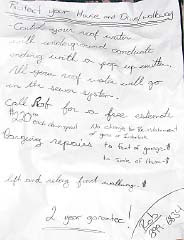
P.S. I expect to follow with additional discussions about Rob Norton and his handwritten note success story -- certainly, many readers of our bi-weekly newsletter expressed interest in the achievements outlined in the previous blog entry.
Posted by
Construction Marketing Ideas
at
1:47 PM
0
comments
Sunday, September 09, 2007
Posted by
Construction Marketing Ideas
at
9:11 PM
0
comments
Labels: "citizen marketing"
Image from constructionbreak.com (Construction Break has produced printed newsletters for the construction industry for several years.) You can't click at the above image, but you can get the same results here.
Posted by
Construction Marketing Ideas
at
8:23 PM
0
comments
Labels: electronic newsletters
- Interlock
- Aslphalt
- Complete roof Drainage
- Landscaping
- Snow Blowing
Posted by
Construction Marketing Ideas
at
4:36 AM
0
comments
Saturday, September 08, 2007
Posted by
Construction Marketing Ideas
at
7:33 AM
0
comments
- Your current clients are the foundation and essence of your marketing for new business. If you give them excellent value and service to the point that you are truly exceptional, you'll win the their references, future business, and -- if you really get it right -- their active support and encouragement. I believe 80 per cent of your marketing efforts should be concentrated with the clients you have now.
- You can:
- Send thank you notes
- Return calls promptly
- Resolve issues quickly and, if you sense a possible problem, proactively communicate how you will deal with the concerns
- Share rewards and gifts (within reason)
- Promote and publicize your customers -- even better, refer business to them!
- Communicate frequently -- electronic newsletters can help; also personal calls, visits, and events are often appropriate.
- Attain positive media publicity for your business in relevant (to your markets) communities.
- Join and participate in relevant trade associations or groups, either as an associate/supporter at your client level or, within the industry, with groups that allow you to enhance your best practices and peer network, especially in non-competitive markets. I like the Society for Marketing Professional Services (SMPS).
- Use selective Internet marketing and advertising resources -- but be wary about 'pay per lead' services unless you have good tracking and management/measurement systems to be sure you are obtaining value for money.
Posted by
Construction Marketing Ideas
at
12:11 AM
0
comments
Labels: "marketing priorities", advertising
Friday, September 07, 2007
Posted by
Construction Marketing Ideas
at
9:22 PM
0
comments
Labels: customer satisfaction, J.D. Power